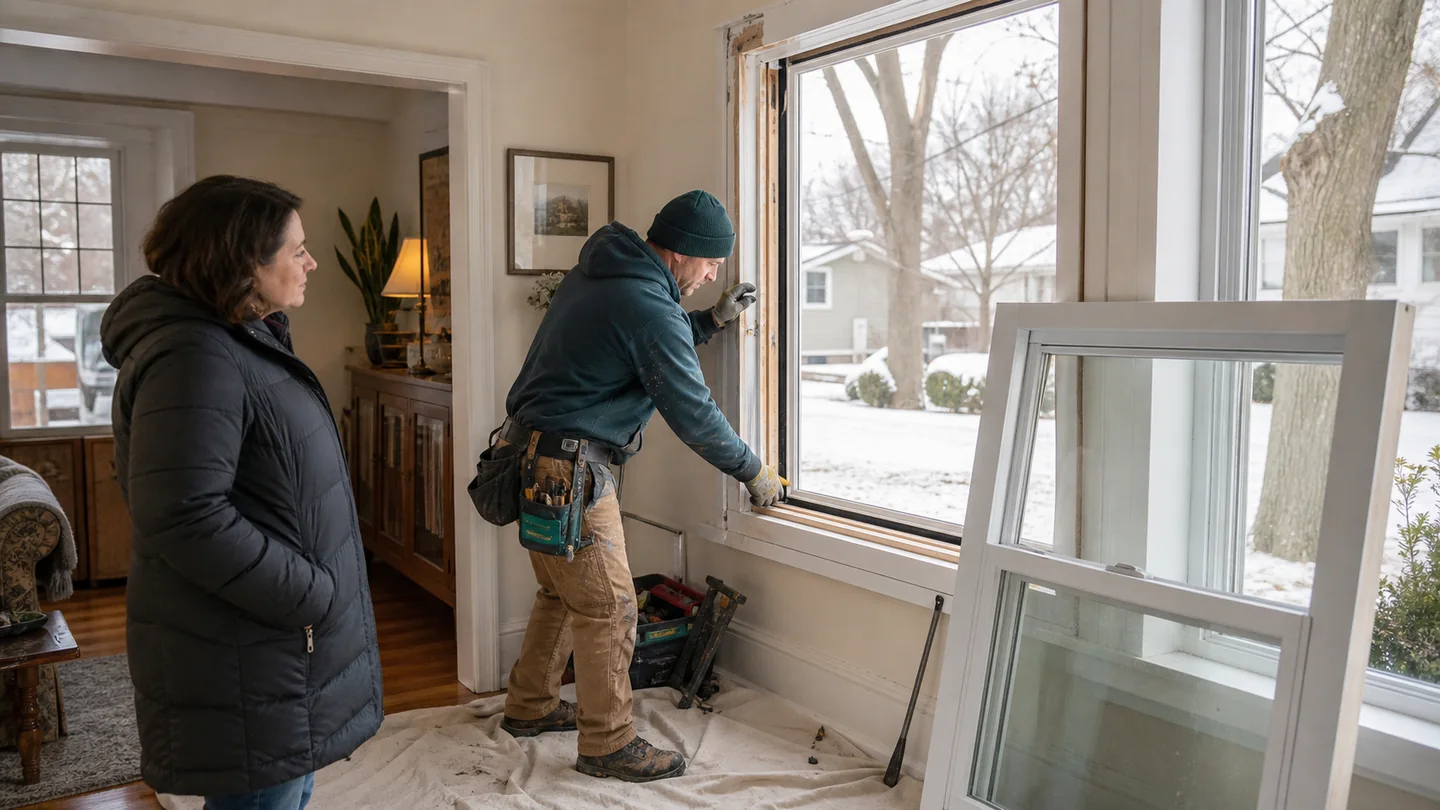
Why Do Windows Fog Up? Condensation, Failed Seals, and When to Repair or Replace
How to tell ordinary surface condensation from failed insulated glass, water intrusion, and a window that genuinely needs replacement

A foggy window doesn't automatically mean you need a new window. Sometimes you're seeing ordinary condensation caused by humid air touching cold glass. Sometimes the moisture is trapped between two panes because the insulated-glass seal has failed. And sometimes what looks like condensation is actually rainwater entering around the frame.
Those problems can look similar from across the room, but the right fix is completely different. Before you pay for glass or a full replacement, figure out where the moisture is and whether you can wipe it away.
Here's a practical way to diagnose foggy windows in your local area, your local area, your local area, your local area, Warren, and the rest of your area—especially during the cold, damp months when these symptoms become hard to ignore.
Start with one simple test: which surface is wet?
Use a clean cloth on the room-side glass. If the fog wipes away, it's interior condensation. If the room side is dry, check the exterior when it is safe to do so. Exterior dew often clears after the sun warms the glass.
If neither accessible surface wipes clean and the haze appears suspended inside the glass assembly, the moisture is probably between the panes. That points toward a failed insulated-glass unit, commonly shortened to IGU.
| Where the moisture is | What it usually means | First response |
|---|---|---|
| Room-side surface | Indoor air is humid enough to condense on cold glass | Dry the surface, reduce moisture, improve ventilation and airflow, then monitor |
| Exterior surface | Outdoor humid air met glass colder than the outdoor dew point | Usually wait for weather or sunlight to change; confirm it is truly outside |
| Between sealed panes | The edge seal of an insulated-glass unit has likely failed | Check warranty and price IGU, sash, and full-window options |
| Around trim or wall | Possible rain intrusion, plumbing, roof, siding, or installation problem | Trace the water source promptly; don't assume it is humidity |
Why interior condensation forms in a cold winter
Warm indoor air holds moisture from showers, cooking, laundry, houseplants, humidifiers, damp basements, and simply living in the home. When that air touches glass cold enough to fall below its dew point, water forms on the surface.
Your area creates plenty of opportunities for that to happen. A sharp overnight temperature drop can chill even a good window. Older single-pane glass, metal spacers, air leakage around the opening, and closed blinds that block warm room air can make the glass colder still.
ENERGY STAR notes that even efficient windows can experience interior condensation in cold weather. Its guidance focuses on insulating around the rough opening, allowing airflow over the glass, venting dryers outdoors, using kitchen and bath fans, and managing indoor humidity.
Does interior condensation mean the window is bad?
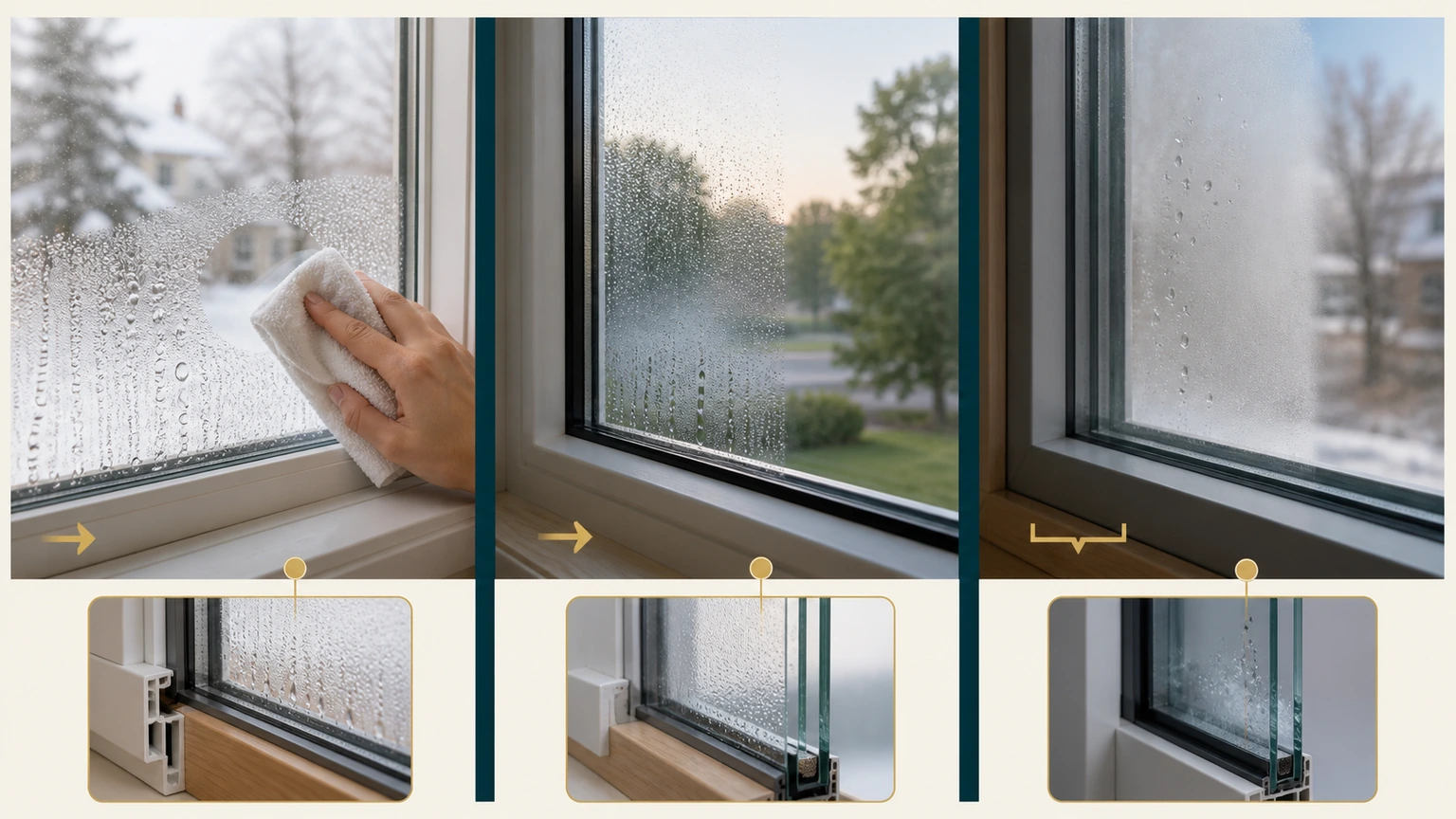
Not necessarily. A small amount on a very cold morning may be a humidity-and-temperature issue rather than a failed window. The bigger concern is repeated or heavy moisture that wets wood, drywall, curtains, or the sill.
Persistent wetting can stain finishes, swell wood, peel paint, and support mold growth. Wipe the water up and address the source instead of waiting for the season to change.
Why new windows sometimes show condensation
This surprises homeowners. A newly sealed window may reduce the drafts that previously carried indoor moisture outside. The house becomes tighter, but the same showering, cooking, and humidifier habits continue. More moisture stays indoors and becomes visible on a cold surface.
That doesn't prove the new window is defective. Check where the water is, whether the perimeter is drafty, and how indoor humidity changes with outdoor temperature. If condensation is unusually localized to one new unit, ask the installer to inspect air sealing, insulation, operation, and glass specifications.
What exterior condensation is telling you
Exterior fog or dew is often harmless. It forms when humid outdoor air contacts exterior glass that is colder than the outdoor dew point—often after a clear, calm night. Pella and ENERGY STAR both describe exterior condensation as a normal weather-related event that typically clears as conditions change.
Efficient glass can sometimes make exterior condensation more noticeable because less indoor heat reaches the outer pane. Still, don't use that as a blanket explanation for water on siding or trim. Dew on the glass is different from rainwater entering joints around the window.
Fog between the panes is a different problem
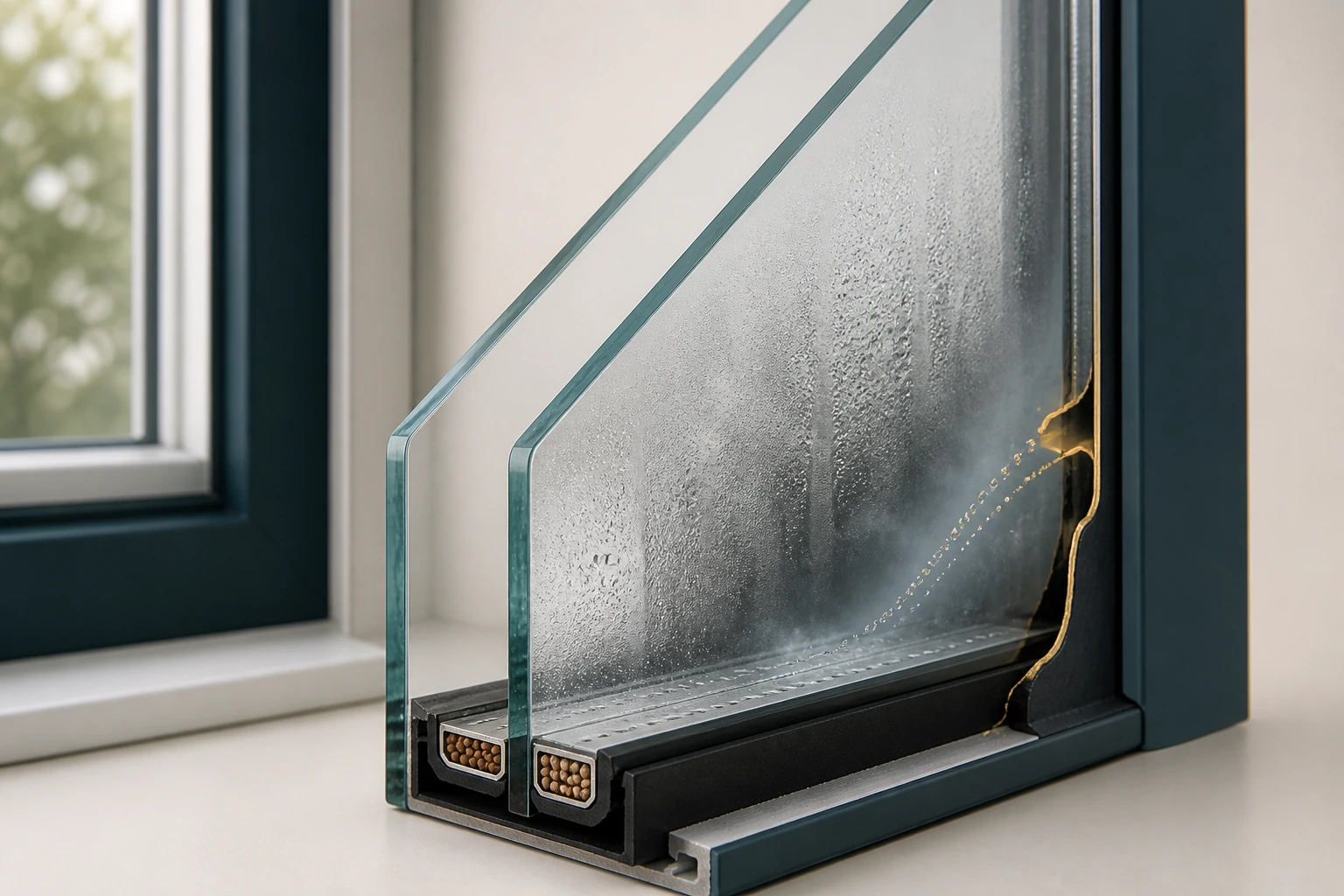
Most modern double- and triple-pane windows use a factory-sealed insulated-glass unit. The panes are separated by a spacer and sealed around the perimeter. The cavity may contain dry air or an insulating gas, and desiccant in the spacer helps manage small amounts of residual moisture.
When the edge seal fails, outside air and moisture can enter the cavity. You may first notice a faint haze that changes with the weather. Later it can become droplets, mineral deposits, or a cloudy film that never wipes away.
Pella and Andersen homeowner guidance both identify between-pane condensation as a sign of insulated-glass seal failure. Lowering your indoor humidity won't repair that seal because the moisture isn't on the room-side surface.
Does a failed seal mean the whole window is ruined?
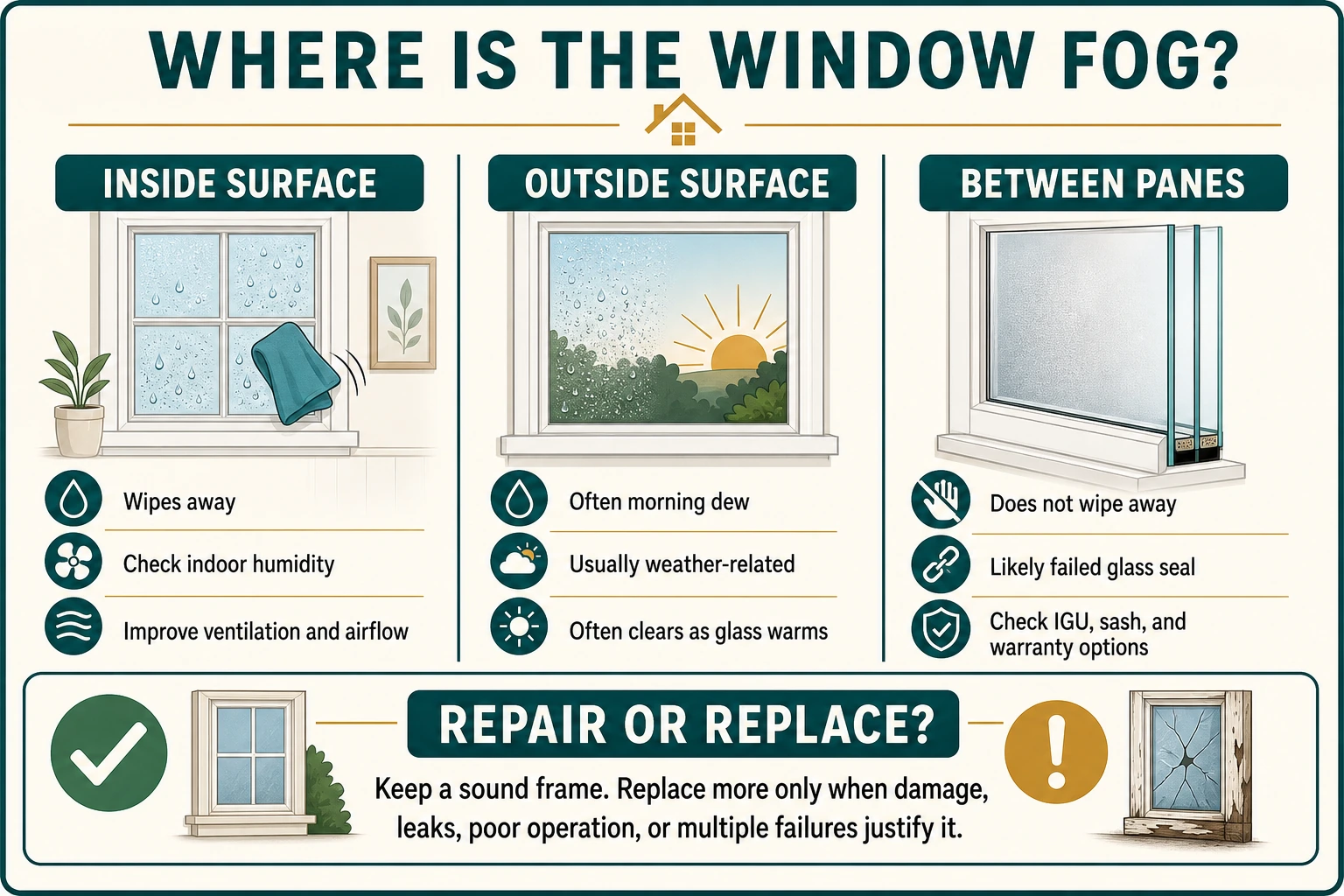
No. The glass unit, sash, frame, hardware, and wall installation are separate parts of the decision. If the frame is sound, the sash operates correctly, replacement parts are available, and the only problem is the sealed glass, replacing the IGU or complete sash may restore the view without removing the full frame.
Full-window replacement becomes more reasonable when the frame is rotten or distorted, the window leaks around the perimeter, operation is poor, several components are failing, replacement glass is unavailable, or the window no longer fits your performance and egress needs.
| Option | Usually makes sense when | What it does not solve |
|---|---|---|
| Humidity and ventilation changes | Moisture is on the interior surface | A broken seal or rainwater leak |
| Hardware, weatherstrip, or perimeter repair | Drafts or operation problems are localized and materials are sound | Fog trapped inside a sealed IGU |
| IGU or sash replacement | Glass seal failed but frame and installation remain sound | Rot, poor flashing, distorted frame, or wall leakage |
| Complete window replacement | Multiple parts are failing or the frame/opening needs correction | Unrelated roof, siding, plumbing, or indoor-humidity sources |
What about “defogging” a window?
Some services drill small holes, remove visible moisture, and add vents or treatments. That may improve appearance, but ask exactly what performance is restored. Clearing haze is not the same as rebuilding the factory edge seal, restoring the original gas fill, or renewing the manufacturer's rating.
If your goal is simply a clearer view at the lowest immediate cost, a cosmetic approach may be worth understanding. If your goal is to restore the insulated-glass assembly, compare it with a factory-made replacement IGU or sash and ask how each option is warranted.
Could the fog actually be water leaking around the window?
Yes—and this is where diagnosis matters. Rainwater can enter at failed flashing, siding transitions, masonry, roof or gutter details above the opening, deteriorated exterior sealant, or a poorly installed window. Water may travel inside the wall before showing up at the trim.
Warning signs include staining beyond the glass edge, damp drywall, peeling paint, soft wood, musty odor, water that appears during wind-driven rain, or moisture concentrated at the head and corners. Recaulking the visible joint may hide the symptom without fixing the drainage path.
Document when the water appears and photograph the window, exterior wall, weather, and surrounding damage. A contractor may need to inspect more than the window itself.
A five-minute homeowner diagnostic
- Wipe the room-side glass and note whether the haze disappears.
- Check the exterior surface safely, or inspect it from outside at ground level.
- Look at the glass edge: haze or droplets trapped beyond your reach suggest an IGU problem.
- Open, close, lock, and gently check the sash for smooth operation and obvious distortion.
- Inspect interior trim, sill, drywall, and flooring for stains, softness, peeling paint, or musty odor.
- Note whether the symptom follows showers, cooking, overnight cold, morning sun, or wind-driven rain.
- Measure indoor relative humidity with a hygrometer and record the outdoor temperature at the same time.
- Check paperwork or the etched glass marking to identify the manufacturer, date, and possible warranty.
| Don't use a candle to test drafts A smoke pencil or other purpose-made diagnostic is safer. Keep flames, incense, and heat sources away from curtains, woodwork, sealants, and unknown air paths. A professional blower-door or infrared assessment can investigate broader leakage. |
|---|
How to reduce room-side condensation
Start with moisture sources. Use bath fans during showers and for a period afterward, run the kitchen hood when cooking if it vents outdoors, confirm the dryer exhausts outside, and reconsider an aggressively set furnace humidifier during cold snaps.
Open blinds or curtains enough for room air to reach the glass. Move furniture that blocks supply registers. Dry wet sills promptly, and use a dehumidifier where appropriate. If the home has persistent high humidity, moisture in the basement, or inadequate ventilation, the window may be showing you a whole-house issue.
Avoid chasing one magic humidity number. The level that avoids condensation changes with outdoor temperature, window performance, air movement, and indoor temperature. A setting comfortable during mild weather can create wet glass during a deep freeze.
When a repair is the sensible choice
- Only one or two insulated-glass units have failed and the frames are dry, square, and in good condition.
- The manufacturer offers a replacement sash or glass pack that preserves the original fit and warranty path.
- The problem is worn weatherstripping, a lock, balance, crank, or localized perimeter gap rather than failed glass.
- The window has architectural or historic value and a qualified specialist can repair it appropriately.
- Your budget favors targeted work and the remaining window assembly still meets your needs.
When replacement starts to make more sense
- Fogging affects many aging windows, making repeated sash or IGU work less practical.
- Frames or sills are soft, rotten, cracked, badly warped, or repeatedly wet.
- The window is difficult or unsafe to operate and multiple components are worn.
- Water enters around the opening and full-frame access is needed to inspect or rebuild flashing and damaged materials.
- The existing window is single-pane, very drafty, or no longer meets the room's safety, egress, comfort, or design needs.
- Replacement parts are unavailable or the repair warranty is too limited for the cost.
What will foggy-window repair or replacement cost?
Your area pricing depends on glass size and shape, double versus triple glazing, coatings, gas fill, grids, tempered or laminated glass, sash availability, floor level, access, frame material, installation method, trim, and hidden damage.
Angi's 2026 national guide places foggy-window repair around $75 to $200 on average, but that category can include very different scopes. Its separate replacement guide lists window glass around $200 to $400 and individual replacement windows broadly from $300 to $2,500. These are planning references, not local quotes, and specialty glass or full-frame repairs can fall outside them.
Ask each bidder to name the deliverable. “Foggy window repair” might mean cosmetic defogging, a new sealed IGU, a complete sash, or a whole window. A low number is not comparable to a higher number until the scope, glass specifications, warranty, trim, and disposal match.
| Cost driver | Questions to ask | Why it matters |
|---|---|---|
| Repair type | Defogging, IGU, sash, pocket unit, or full-frame? | Each restores a different amount of the assembly |
| Glass specification | Pane count, Low-E coating, gas, spacer, safety glass, grids? | Performance and fabrication cost change |
| Frame and opening | Any rot, leakage, distortion, or flashing work? | Hidden repairs can exceed the glass work |
| Warranty | Glass, seal, product, labor, transfer, and service-call terms? | A covered IGU may cost far less than an out-of-warranty replacement |
Check the warranty before authorizing work
Insulated-glass coverage varies by brand, product line, installation date, ownership, and whether the warranty transfers. Some warranties cover the glass unit but not labor, finishing, shipping, or access. Others are prorated or require proof of purchase.
Photograph the fogging and any etched markings in the glass corners. Find the original contract if possible. Before someone drills the glass or alters the sash, ask whether that work could affect warranty eligibility.
Red flags in a foggy-window sales visit
- Every kind of condensation is described as a failed window.
- No one determines whether moisture is inside, outside, or between the panes.
- A salesperson recommends whole-house replacement because one IGU is foggy without inspecting the frames.
- Cosmetic defogging is presented as restoring the original sealed unit and gas fill without documentation.
- Rain stains or soft wood are dismissed as normal condensation.
- The quote doesn't identify glass type, coating, safety-glass requirements, installation method, or warranty.
- A pre-1978 home will have painted trim disturbed, but lead-safe practices are never discussed.
- You are pressured to sign before checking product or glass-seal warranty coverage.
Questions to ask before giving a company your information
- Where exactly is the condensation—interior surface, exterior surface, between panes, or around the opening?
- What evidence shows an IGU seal failure rather than indoor humidity or rain intrusion?
- Can only the sealed glass or sash be replaced while keeping the sound frame?
- If you recommend the whole window, which frame, hardware, flashing, or wall conditions justify it?
- Will the new glass match the existing tint, Low-E coating, grids, thickness, and safety-glass requirements?
- Does the proposal restore insulation and sealing performance or only remove the visible haze?
- What product, glass-seal, labor, and service warranties apply?
- Have you checked the manufacturer's existing warranty before pricing new work?
- What trim, paint, disposal, access, and hidden-damage work is included?
- How will you protect the home and handle lead-safe work if painted surfaces are disturbed?
Frequently asked questions
Why do my windows fog only in the morning?
Overnight cooling can drop the glass below the dew point. Interior moisture may clear as the room and glass warm; exterior dew often disappears after sunlight or wind changes conditions.
Why is only one window fogging?
That window may be colder because of orientation, shade, airflow, glass specification, installation gaps, or a failed seal. Where the moisture sits is the first clue.
Can I wipe away fog between double panes?
No. If both accessible surfaces are dry, the haze is inside the sealed unit and ordinary cleaning cannot reach it.
Can a failed window seal be resealed?
The usual performance repair is replacement of the factory-sealed IGU or sash, if the rest of the window is sound. Ask whether a proposed service restores the sealed assembly or only improves appearance.
Will a failed seal make the room cold?
The unit may no longer perform as originally intended, but comfort also depends on frame leakage, weatherstripping, perimeter insulation, window area, and outdoor conditions.
Is exterior condensation a defect?
Usually not. It is commonly dew caused by outdoor humidity and glass temperature. Confirm the water is on the glass surface rather than entering around the frame.
Can mold grow because of window condensation?
Repeated moisture can support mold on dusty or organic materials such as wood, drywall, and fabrics. Dry wet surfaces and correct the moisture source.
Should I replace every window if one seal fails?
Not automatically. Compare the age and condition of the other windows, repair availability, matching concerns, warranties, and the cost of targeted versus phased work.
Does a higher NFRC Condensation Resistance rating prevent all condensation?
No. A higher rating means greater resistance under standardized conditions, but indoor humidity, outdoor temperature, installation, and airflow still affect real homes.
The practical next step
Take photos, note the weather and timing, and identify which surface is wet. If the haze is between panes, check the warranty and ask for separate IGU, sash, and full-window options. If water reaches trim or walls, investigate the opening and surrounding exterior instead of ordering glass first.
A trustworthy recommendation should connect the symptom to a specific failure and explain exactly what the proposed work restores. You shouldn't have to buy every part of the window to solve one failed part—unless the rest of the assembly gives you a clear reason.
Sources and cost methodology
Technical and cost sources were reviewed in August 2026. Condensation depends on indoor humidity, outdoor temperature, glass performance, installation, and airflow. Published national price ranges are planning references, not your area bids.
ENERGY STAR: Residential Windows, Doors, and Skylights
ENERGY STAR: Independently Tested and Certified Energy Performance
NFRC: Window Performance Ratings
Pella: How to Deal With Window Condensation
Andersen: Window Condensation 101
Andersen: Installing Windows for Vapor Control
U.S. EPA: Renovation, Repair and Painting Program