Tank vs. Tankless Water Heaters: Cost, Performance, and the Best Fit
2026 national planning ranges: $881-$1,825 tank-style | $1,400-$3,900 tankless
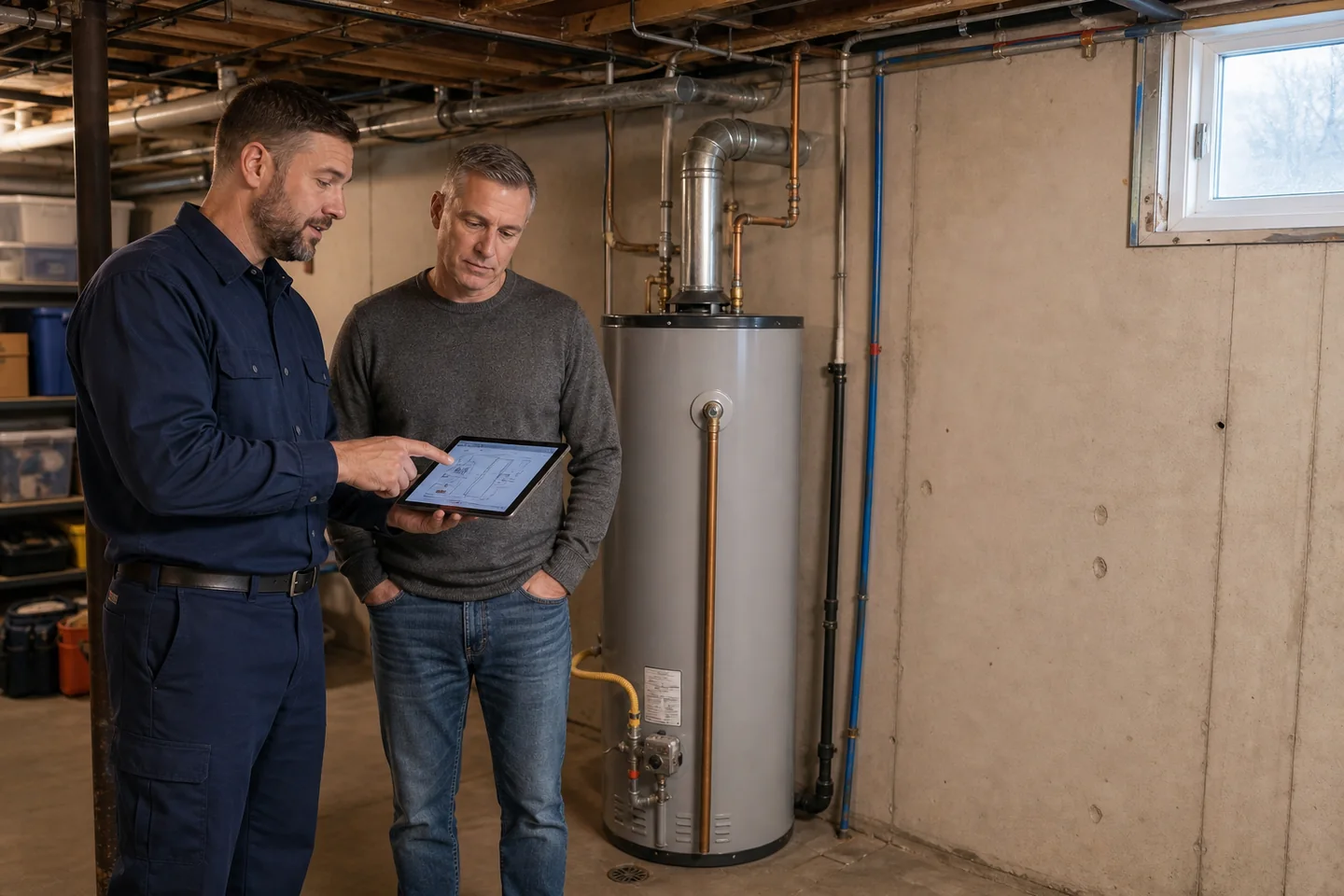
If your water heater is leaking, unreliable, or simply getting harder to trust, tankless can sound like the obvious upgrade. Endless hot water. More floor space. Better efficiency. Why would anyone install another tank?
Here's the thing: tankless can be an excellent fit, but it isn't automatically the better purchase for every home. The answer depends on how much hot water you use at the same time, how cold the incoming water gets, what fuel and utility capacity the house already has, and what must change to install the new system correctly.
The short answer: choose for peak demand, not the sales pitch
A tank water heater stores a ready supply and is judged largely by its first-hour rating: how much hot water it can deliver during a busy hour, starting with a fully heated tank. A tankless heater produces hot water as you use it and is judged by gallons per minute at a stated temperature rise.
That difference explains most of the decision. A tank can be depleted, then needs time to recover. A tankless unit can keep running, but only while your combined flow stays within its capacity. If two showers, a dishwasher, and a sink ask for more than the unit can heat in January, the system has to reduce flow or deliver cooler water. 'Endless' doesn't mean 'unlimited.'
Tank and tankless at a glance
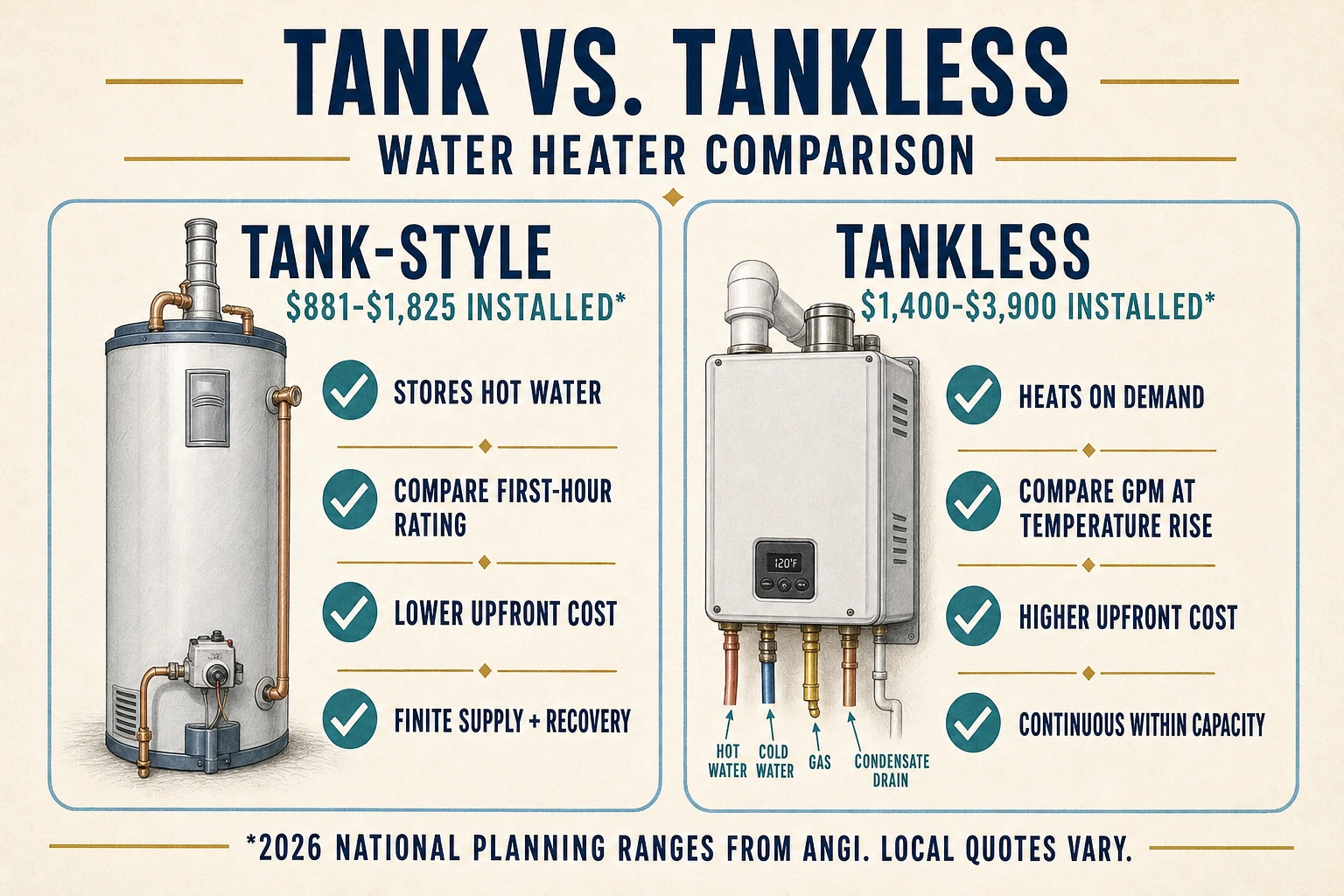
| Decision point | Tank-style heater | Tankless heater |
|---|---|---|
| Hot-water capacity | Stored volume plus recovery; compare first-hour rating | Continuous delivery within rated GPM and temperature rise |
| Upfront project | Usually simpler and less expensive for a similar replacement | Usually higher, especially when converting from a tank |
| Space | Needs floor area and service clearance | Wall-mounted, but still needs service and vent clearances |
| Energy behavior | Maintains stored hot water between uses | Heats on demand and avoids tank standby loss |
| Installation | Often reuses compatible connections and venting | May need gas, vent, condensate, electrical, and plumbing changes |
| Best fit | Predictable budget, strong peak-hour storage, straightforward retrofit | Long draws, limited floor space, planned high-efficiency upgrade |
Tankless gives continuous hot water—not instant hot water
A tankless heater starts heating after it senses flow. It doesn't magically place hot water at the faucet. The cooled water sitting in the pipe between the heater and your shower still has to move out first, so a distant bathroom may wait just as long as it did with a tank.
If wait time and wasted water are the real complaints, the bigger question is the home's distribution system. Shorter pipe runs, insulated hot-water lines, a carefully controlled recirculation system, or a point-of-use heater may address that problem more directly. Those are separate decisions with their own costs and energy effects.
Cold winters make the sizing math less forgiving
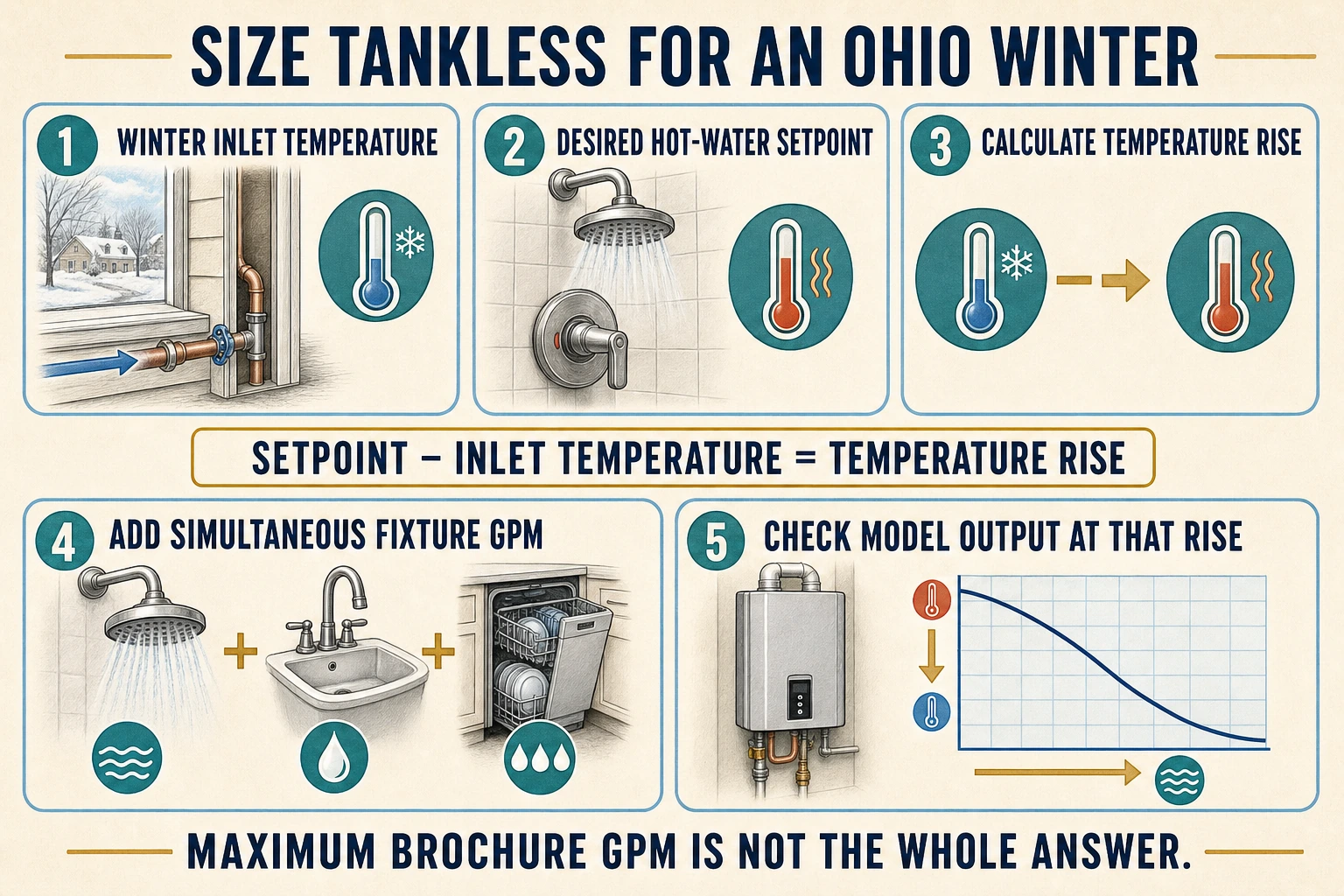
Tankless sizing requires two numbers: the total gallons per minute you may use at once and the temperature rise needed to reach your setpoint. Temperature rise is simply the desired hot-water temperature minus the incoming cold-water temperature.
That matters here because winter inlet water is colder than summer inlet water. The same heater may deliver fewer gallons per minute at a larger temperature rise. A brochure's highest GPM number may be based on warmer incoming water than your house sees during a cold your area stretch.
For example, ENERGY STAR's buying guidance uses average planning figures of 2.5 GPM for a shower or bathtub, 3.3 GPM for a clothes washer, 2.2 GPM for a sink, and 1.3 GPM for a dishwasher. Your actual fixtures can differ, and they won't all necessarily run together. The estimator should measure or verify the likely winter inlet temperature, identify realistic simultaneous uses, and show the model's output at that rise.
Cold-climate venting deserves attention too. Federal Building Science guidance says direct-vent, sealed-combustion, or power-vented equipment should be used in cold climates, with intake and exhaust terminations positioned for anticipated snow and frost conditions. That's a real installation detail, not an accessory to decide later.
Why a tank water heater can still be the sensible choice
A tank isn't outdated simply because it stores water. For many homes, a same-location tank replacement is easier to price, easier to schedule, and less likely to require major utility changes. It can also handle a short burst of heavy demand by drawing from stored volume even when the burner or heating elements alone couldn't keep up moment by moment.
The tradeoff is finite storage and standby loss. Once the usable hot water is depleted, you wait for recovery. A tank also occupies floor space and can release a meaningful amount of water if the vessel fails. A drain pan, properly routed drain where required, shutoff, expansion control, temperature-and-pressure relief piping, and leak detection may all be worth discussing.
Fuel source may decide the project before tank versus tankless does
If you already have a gas tank with an adequate gas service and a workable vent route, gas tankless may be a realistic conversion. If the existing gas line is undersized for the new input, or the vent and condensate route are difficult, the installation can become much more involved.
Whole-house electric tankless units can demand substantial electrical capacity. The equipment may be compact, but the service, panel, breakers, and wiring still have to support it. An inexpensive unit isn't a bargain if the house needs a large electrical upgrade.
If your home is electric, also ask whether a heat-pump tank is practical. It can be far more efficient than standard electric resistance equipment, but it needs suitable space, room conditions, and condensate management.
Efficiency ratings help—but they don't predict your exact bill
Uniform Energy Factor, or UEF, is the standardized measure used to compare a water heater's overall efficiency. Higher is better within an appropriate comparison, and ENERGY STAR sets different qualifying criteria for gas storage, gas tankless, and heat-pump storage equipment.
Your utility cost still depends on fuel price, hot-water use, setpoint, pipe losses, maintenance, household habits, and the exact model. A higher UEF doesn't tell you how quickly a more expensive conversion pays back. Use the yellow EnergyGuide estimate and your actual utility rates, then compare that projected difference with the installed-price difference.
How much do tank and tankless water heaters cost in 2026?
Angi's 2026 national planning data places a tank-style replacement at about $881 to $1,825 and a tankless project at about $1,400 to $3,900. HomeYou's broader 2026 tankless guide gives a range of $1,089 to $5,163, averaging near $3,000. Its your state planning range across water-heater replacement projects is $1,192 to $2,987.
| Project | 2026 planning range | Common reasons the price moves |
|---|---|---|
| Tank-style replacement | $881-$1,825 (Angi) | Fuel, tank size, venting, access, valves, disposal, and code corrections |
| Tankless installation | $1,400-$3,900 (Angi) | Capacity, fuel, gas line, venting, condensate, electric work, and relocation |
| Tankless installation | $1,089-$5,163 (HomeYou) | Broader project scope and installation complexity |
A like-for-like tank swap is often near the lower side of the decision. A tank-to-tankless conversion can move well beyond a simple equipment replacement. Ask for an itemized scope so the lower bid isn't merely leaving necessary work out.
Where tankless installation costs tend to hide
The wall-mounted box may be the most visible part, but it isn't always the most expensive part of the job. A complete proposal may need to address several items:
- Gas-pipe sizing from the meter or regulator to the appliance, not just the final connector
- Dedicated intake and exhaust venting with approved materials, clearances, and termination locations
- A condensate drain and neutralizer when required for a condensing gas unit
- Electrical power for controls, ignition, freeze protection, or a new high-amperage electric system
- Isolation and service valves that allow flushing and maintenance
- Water-line changes, mounting, disposal, permits, inspection, startup, and warranty registration
your local area specifically lists new or replaced water heaters among projects requiring a plumbing permit. Rules and contractor-registration requirements vary across your local area, your local area, your local area, Warren, and surrounding communities, so the written quote should identify who obtains the permit and what inspection is included.
Maintenance isn't optional for either system
Tankless is sometimes presented as maintenance-free. It isn't. Mineral scale can reduce heat-transfer performance, inlet screens need attention, and condensing units may have condensate components to inspect. The required interval depends on the model, water conditions, and usage, so follow the manufacturer rather than a universal internet schedule.
your local water utility's 2024 report listed hardness at 105 to 130 mg/L as calcium carbonate, averaging 117 mg/L. That one utility's result doesn't represent every your area address, especially homes on other systems or wells, but it is enough reason to ask how local water conditions affect the model's flushing requirements and warranty.
Tank systems need care too. your local water utility recommends maintaining a tank by flushing it and checking its temperature, pressure-relief valve, and anode rod at least yearly according to the manufacturer's recommendations. Skipping maintenance can shorten useful life or hide a safety problem, regardless of which technology you choose.
Repair the existing heater or replace it?
Not every no-hot-water call requires a new system. A failed thermostat, heating element, ignition component, valve, sensor, or control may be repairable. If the unit is relatively young, the tank isn't leaking, parts are available, and the repair is covered by warranty, fixing it may be the sensible move.
Replacement becomes easier to justify when a storage tank itself is leaking, corrosion is advanced, repairs keep repeating, venting is unsafe, capacity no longer fits the household, or the expected repair cost is too close to a properly installed replacement. With tankless equipment, a heat-exchanger leak or multiple aging components can change the math, but one fault code alone isn't a diagnosis.
Questions to ask before you give anyone your contact information
- What exact model and fuel type are you recommending, and why does it fit my household's peak demand?
- For a tank, what are the first-hour rating and recovery rate? For tankless, what GPM will it deliver at our winter temperature rise?
- Can you quote a suitable tank option and a tankless option separately if both are practical?
- Does the price include removal, permits, inspection, valves, venting, condensate work, electrical work, gas-line changes, and startup?
- How will intake and exhaust terminations be protected from snow, frost, and recirculation of exhaust?
- What maintenance does this exact model require with my water source, and what does that service typically involve?
- What do the equipment, heat exchanger or tank, parts, and labor warranties cover—and who registers them?
- If the installation uncovers an undersized gas line, inadequate panel, damaged vent, or code issue, how will the change be approved and priced?
Frequently asked questions
Does a tankless water heater provide instant hot water?
Not necessarily. It heats on demand, but cooled water in the piping still has to reach the faucet first. Pipe length, diameter, insulation, and recirculation design affect the wait.
Can tankless work during a cold winter?
Yes, when the unit and venting are designed for the climate. Size it using realistic winter inlet temperature, required temperature rise, and simultaneous flow—not the largest GPM printed on the front page of a brochure.
Will tankless run two showers at the same time?
It depends on the showers' actual flow and the heater's output at the required temperature rise. Add the simultaneous fixture demand and compare it with the model's cold-weather performance table.
Is gas tankless better than electric tankless?
For whole-house high flow, gas often offers more heating capacity, while electric avoids combustion venting. The better fit depends on gas availability, electrical service, utility costs, vent routes, and demand. Neither is automatically cheaper as a complete retrofit.
Is tankless always cheaper to operate?
Not always. It avoids storage standby loss and may have a higher UEF, but fuel rates, usage, maintenance, pipe losses, and controls affect the bill. Compare EnergyGuide estimates for the exact models using your current rates.
Can I replace a tank with tankless in the same location?
Sometimes. The wall, water lines, gas supply or electric capacity, intake, exhaust, condensate route, drain access, and service clearances all have to work. The old footprint alone doesn't prove the location is suitable.
Which system is better for a large family?
A large family may benefit from continuous tankless delivery, but high simultaneous demand can require a larger or multi-unit system. A properly sized high-recovery tank may be more economical. Compare the household's real busy-hour pattern, not family size alone.
So which one is the best fit for your home?
Choose a tank-style heater when you want a predictable replacement cost, the existing setup is workable, floor space isn't a problem, and a properly sized first-hour rating matches your busiest period. It isn't the flashy answer. It may be the financially sensible one.
Choose tankless when continuous delivery, floor-space savings, and reduced standby loss matter enough to justify the project—and when the gas, electrical, venting, condensate, and winter-capacity checks support it. The best tankless installation is planned as a system, not sold as a box on the wall.
Sources
ENERGY STAR: Whole-Home Gas Tankless Water Heaters
ENERGY STAR: How Whole-Home Gas Tankless Water Heaters Work
ENERGY STAR: Residential Water Heater Key Product Criteria
ENERGY STAR: Point-of-Use Water Heaters and Distribution Loss
U.S. Department of Energy Building Science Education: Gas-Fired Tankless Water Heaters
your local municipality: Plumbing Permits
your local water utility: 2024 Water Quality Report
HomeYou: Tankless Water Heater Installation Cost (2026)