How Much Does Whole-House Repiping Cost?
2026 national planning range: $1,500-$15,000 | About $7,500 average
If you've been told your older home needs repiping, online prices may feel meaningless. One website suggests a few thousand dollars; a contractor may quote five figures. Both may describe a repipe, but not the same job.
Here's the thing: access, fixture count, routing, permits, valves, and wall repair can affect the bill more than the pipe itself.
For homeowners, the useful question isn't only, 'What does a repipe cost?' It's, 'What exactly is being replaced, what remains, and what will the house look like when the crew leaves?'
The short answer: a typical repipe can land anywhere from $1,500 to $15,000
Angi's 2026 national data places a whole-house repipe at about $1,500 to $15,000, with an average near $7,500. Its broader reported spread reaches roughly $1,250 to $22,000. That isn't a guaranteed your local area, your local area, your local area, your local area, or Warren price. It is a planning range showing how dramatically scope can change the total.
A modest one-story house with an open basement ceiling and a straightforward PEX route may fall toward the lower side. A larger two-story home with finished plaster walls, widely separated bathrooms, copper piping, difficult chases, and full restoration may move toward or beyond the upper side.
Don't use the average to decide whether a quote is fair. A $6,000 plumbing-only proposal and a $10,000 turnkey proposal may be closer than they look if the first excludes permits, valves, wall repair, paint, and cleanup.
First, make sure everyone means the same thing by 'whole-house repipe'
In most residential estimates, a whole-house repipe means replacing the pressurized hot- and cold-water supply lines that feed sinks, toilets, tubs, showers, appliances, hose bibs, and the water heater. Old supply piping may be removed where practical or disconnected and abandoned in place.
It usually does not mean replacing drain, waste, and vent piping, the sewer lateral to the street, the water service line entering the house, gas piping, or every plumbing fixture. Those are separate systems and can require different permits, materials, access, and trades.
That distinction matters because 'replace all plumbing' sounds complete but isn't a measurable scope. An estimate should list what happens from the main shutoff or meter to each fixture, plus every important exclusion.
What current cost guides actually show
| Published planning data | Reported cost | How to use it |
|---|---|---|
| Angi whole-house repipe, 2026 | $1,500-$15,000; about $7,500 average | Broad national benchmark; local access, fixtures, material, and restoration control the quote |
| Angi broader reported spread, 2026 | $1,250-$22,000 | Shows that unusually small or complex scopes can sit outside the typical band |
| Forbes Home plumbing replacement | $3,000-$16,000; $6,500 average | Useful second benchmark; confirm whether removal and finish repair match your proposal |
| HomeYou plastic repipe by bathroom count, 2026 | $590-$4,501 | Lower published bands may describe a narrower piping scope; verify connections and restoration |
| HomeYou copper repipe by bathroom count, 2026 | $1,121-$7,190 | Use only when the bathroom count and included work resemble your project |
The ranges differ because repipe isn't a standardized scope. Some figures focus on pipe installation; others include removal, connections, permits, or restoration. None can see your walls or count your branches.
The better comparison is an itemized local estimate. Online pricing is a reasonableness check, not a substitute for seeing the house.
Why two similar-size homes can receive very different estimates
Fixture count beats square footage
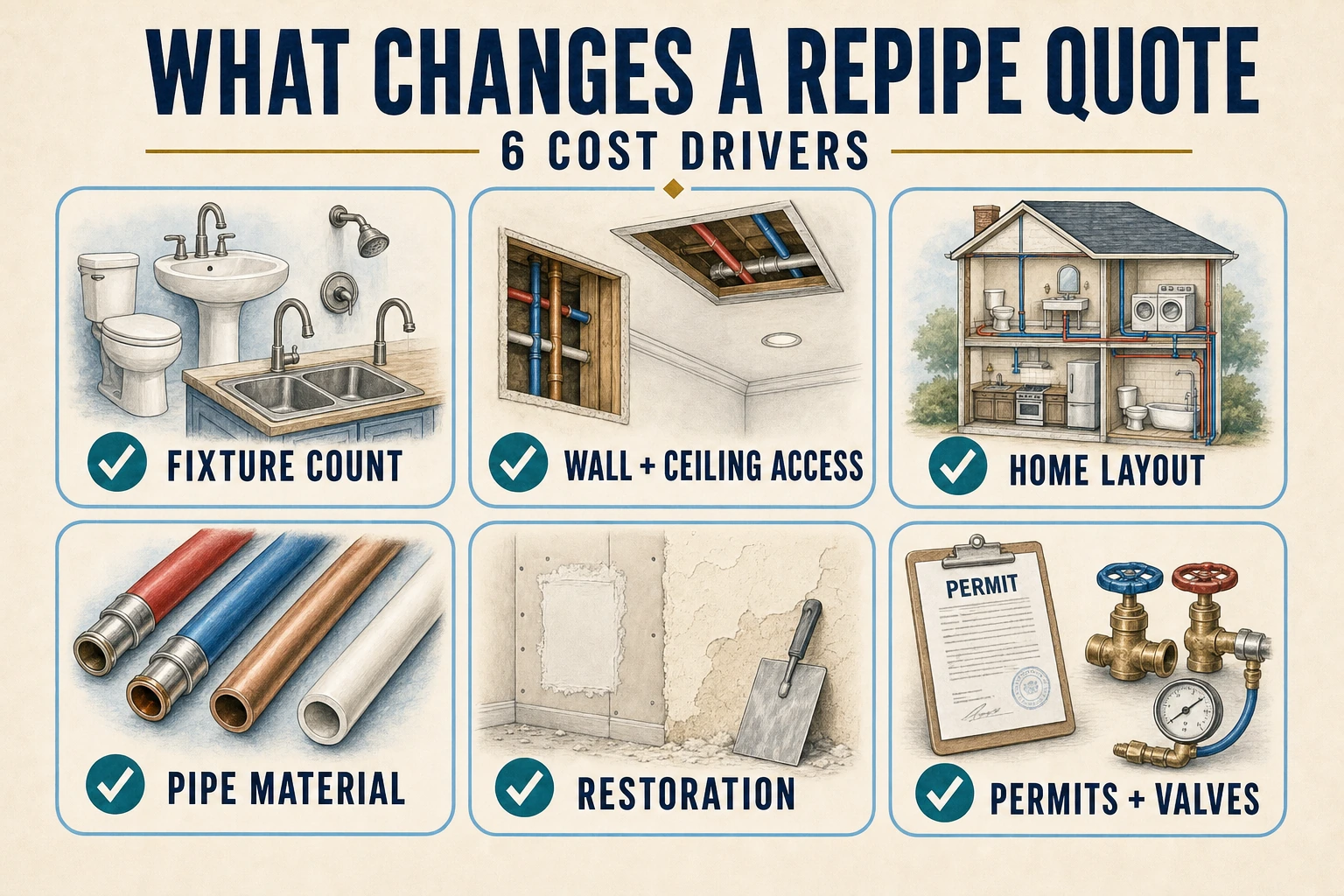
A 2,000-square-foot ranch with one clustered bathroom may be simpler than a 1,500-square-foot two-story home with two bathrooms on opposite ends. Count every sink, toilet, tub, shower, washer, dishwasher, ice maker, hose bib, utility sink, and water-heater connection. Each one needs a correctly sized route and shutoff strategy.
Access is usually the real labor bill
Open basement ceilings and accessible utility chases help. Finished basements, plaster-and-lath walls, tile surrounds, tight joist bays, slab sections, and built-in cabinetry slow the work. A flexible pipe can reduce the number of fittings, but it doesn't eliminate the need for safe, code-compliant routes and supports.
The existing layout may not be worth copying
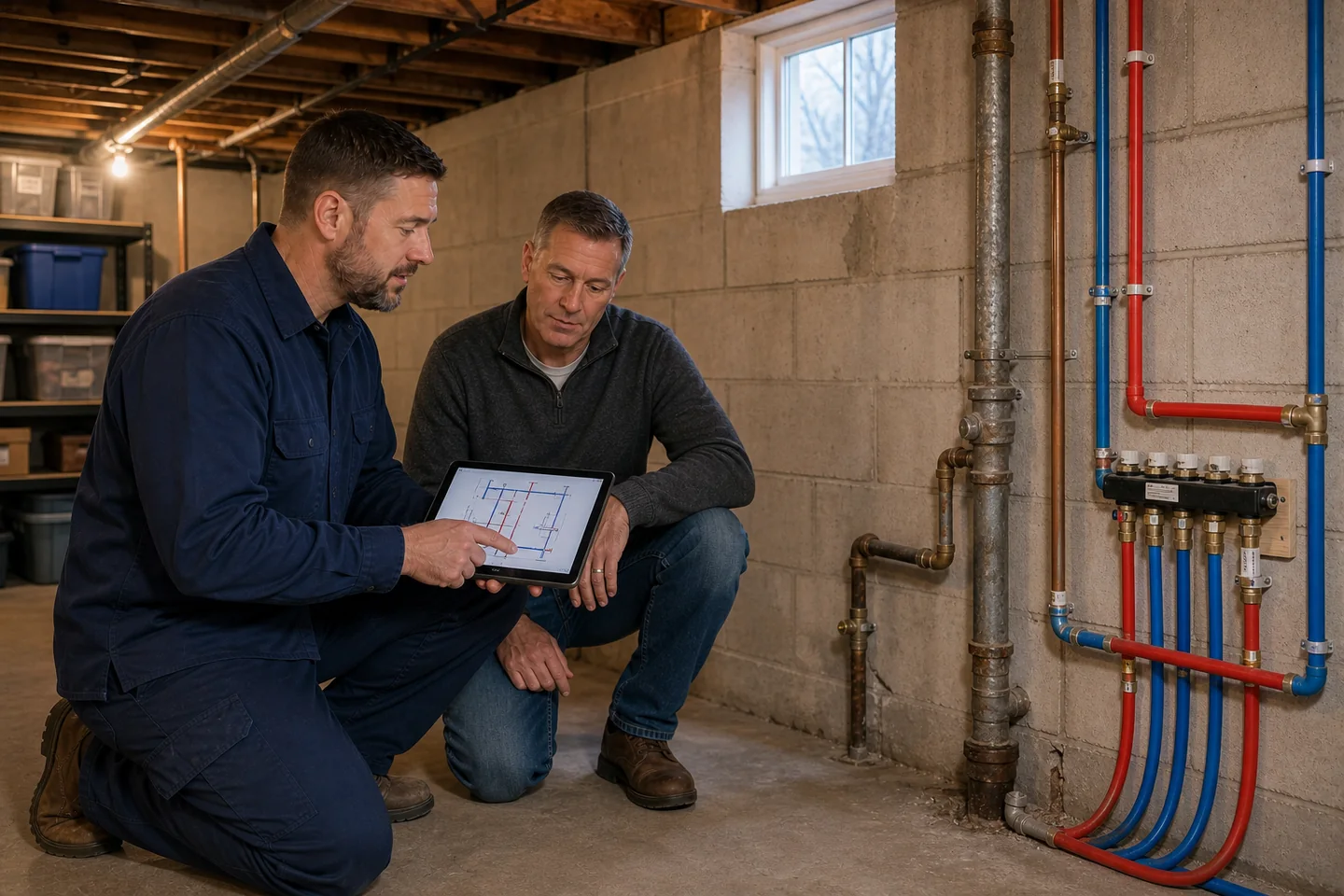
Repiping is a chance to correct weak flow, poor isolation, long hot-water waits, or vulnerable runs near an exterior wall. That may require larger trunk lines, a home-run manifold, recirculation planning, or a different route. An exact replacement is not automatically the best design.
Wall repair can be included, limited, or completely separate
Some plumbers make neat access openings and leave them ready for another contractor. Others include drywall patching but not texture or paint. Plaster, wood paneling, custom tile, and wallpaper need different restoration skills. Ask who performs that work and what 'patching included' actually means.
Valves and related components add up
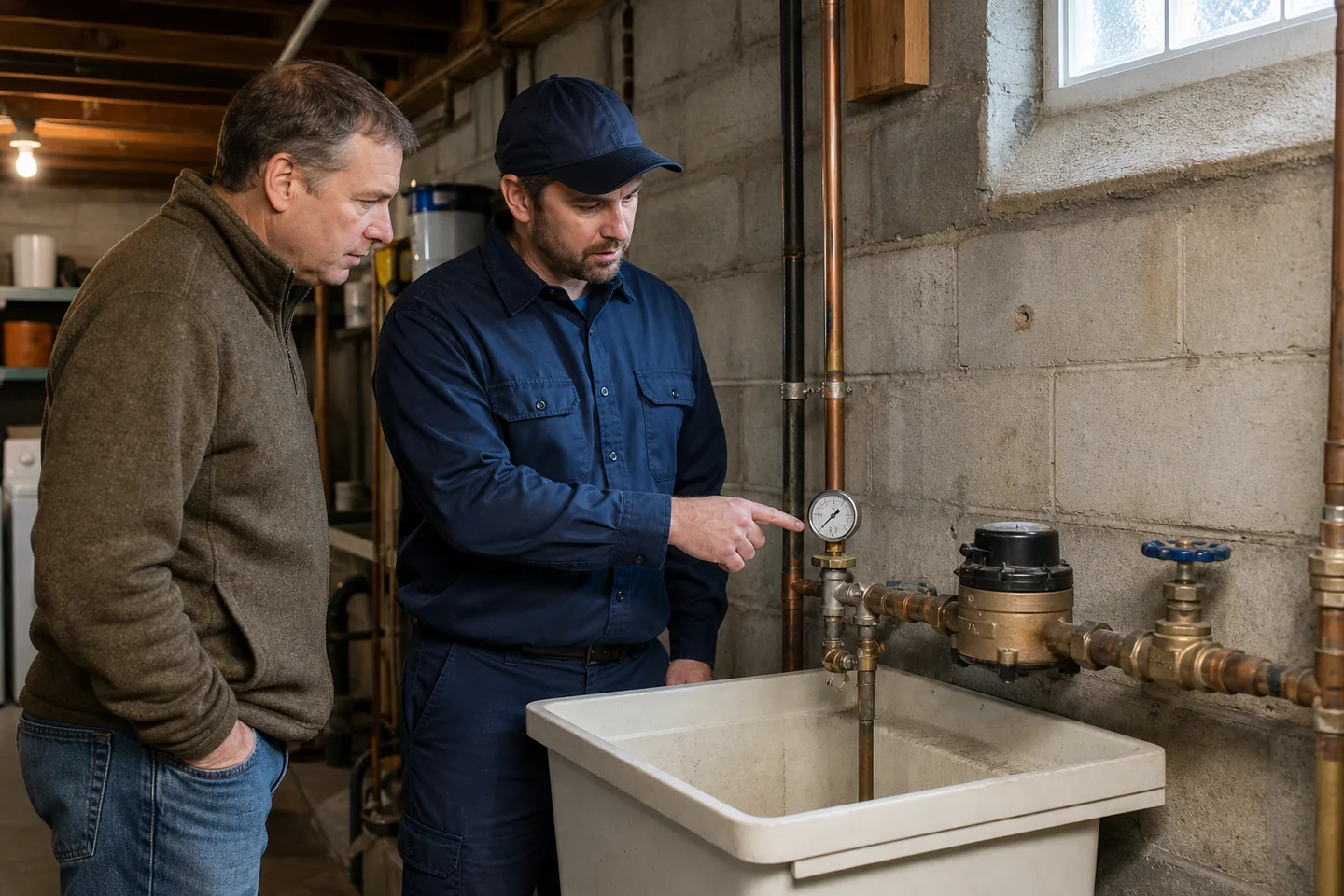
A complete job may include shutoffs, a pressure-reducing valve, expansion control, water-heater connectors, transition fittings, insulation, hammer arrestors, or a manifold. Not every home needs every item, but omissions can make a low quote misleading.
Winter routing requires judgment
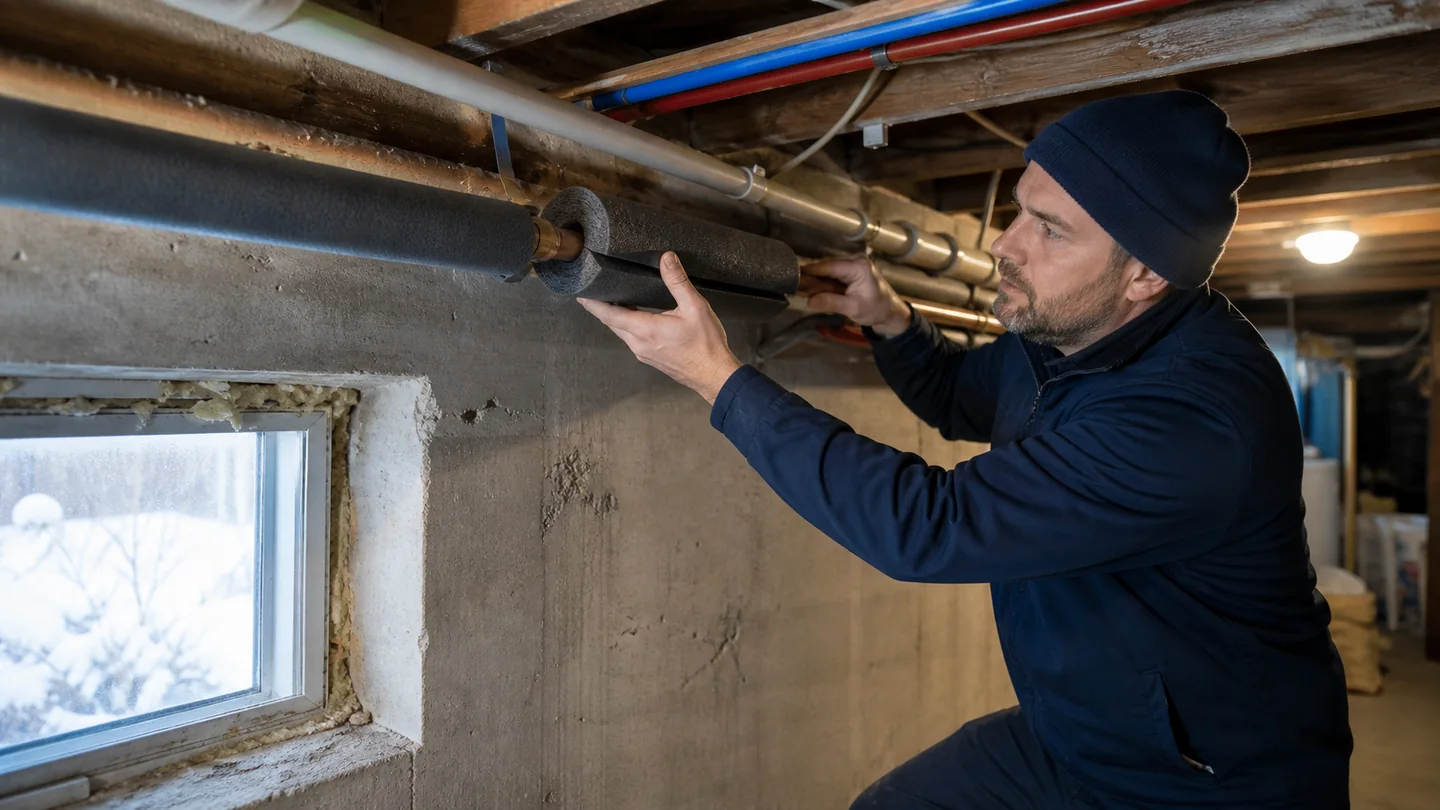
No pipe is freeze-proof. In a home, new lines still need to stay away from cold exterior cavities where possible and be protected by appropriate insulation and air sealing. PEX can tolerate some freezing expansion better than rigid piping, but that isn't permission to route it carelessly.
PEX, copper, or CPVC: which material gives you the best value?
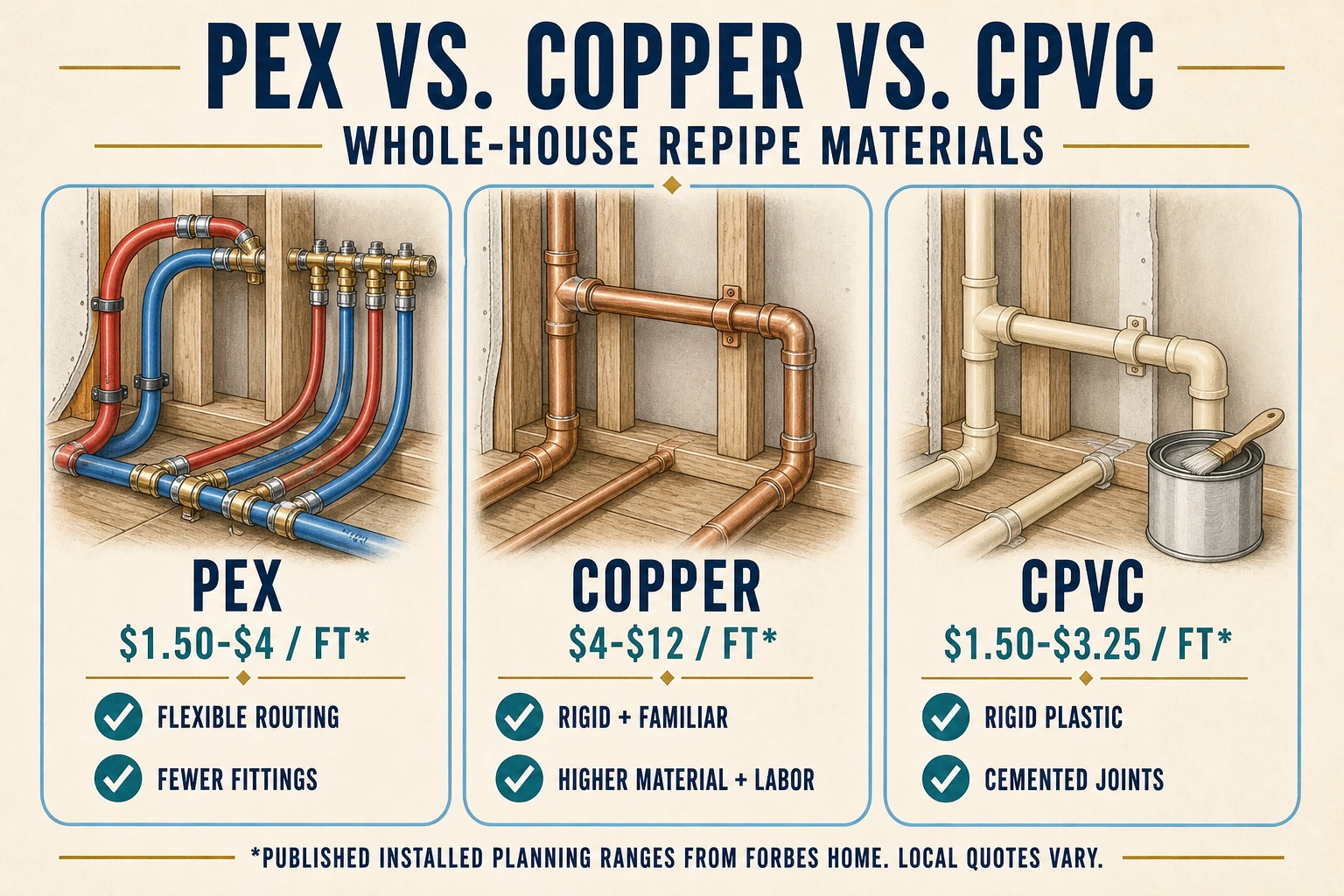
It depends. Material is a real cost factor, but installation design and workmanship matter just as much. A good PEX system is better than a poorly planned copper system, and the reverse is also true.
| Material | Why homeowners consider it | What to ask about |
|---|---|---|
| PEX | Flexible routing, fewer directional fittings, corrosion resistance, and generally lower labor and material cost | Tubing type, fitting system, sizing, support, UV protection, transition fittings, and manufacturer warranty |
| Copper | Rigid, familiar, compact, heat tolerant, and appropriate for exposed mechanical areas | Tube type, joint method, water chemistry, insulation, freeze protection, grounding or bonding review, and material price |
| CPVC | Lower material cost and a rigid plastic layout without metal corrosion | Local contractor experience, approved cement and cure procedure, support, temperature limits, transition details, and code acceptance |
| Hybrid | Uses different materials where each is practical, such as copper near equipment and PEX for distribution | How transitions are made, whether warranties remain clear, and why each material is used |
Angi's 2026 material-only planning figures list PEX at roughly $0.40 to $2 per linear foot, CPVC at $0.50 to $1, and copper at $2 to $8. Forbes Home lists installed planning costs of about $1.50 to $4 per foot for PEX, $1.50 to $3.25 for CPVC, and $4 to $12 for copper. Those numbers are not complete house prices; access, fittings, labor, removal, valves, and restoration still matter.
Does one leak mean you need to repipe the entire house?
Not necessarily. One failed fitting, a nail puncture, a frozen section, or a localized corrosion problem may justify a focused repair. A contractor should be able to explain why the failure appears isolated or why it represents a broader pattern.
A whole-house repipe becomes easier to justify when leaks keep appearing in different locations, galvanized supply lines are badly restricted, water remains discolored after utility issues are ruled out, pressure drops across several fixtures, or accessible pipe shows widespread deterioration. A planned remodel can also make repiping more economical because walls are already open.
The bigger question is the remaining system risk. Ask how much original pipe would remain after a partial repair, how its condition was evaluated, and whether the repaired section simply moves the next weak point elsewhere. That gives you a useful repair-versus-repipe comparison without assuming the largest project is always correct.
What a complete repiping estimate should include
- A fixture and connection count, including hose bibs, appliances, utility sinks, and the water heater
- The exact pipe brand or system, material, sizes, fittings, valves, supports, and insulation
- The starting and ending points of the repipe, plus any original pipe that will remain
- The route, manifold or trunk-and-branch design, and how simultaneous fixture demand was considered
- Wall, ceiling, cabinet, or tile openings and who handles patching, texture, primer, paint, and cleanup
- Removal or abandonment of old piping and how unused lines will be disconnected
- Permits, inspection, pressure testing, system flushing, and warranty documentation
- Allowances or change-order rules for hidden conditions such as blocked chases or deteriorated valves
If two estimates use different fixture counts or restoration assumptions, they are not competing bids yet. Ask each contractor to revise the scope so you can compare the same finished result.
A whole-house repipe is not the same as a lead service-line replacement
This is especially important in older local housing. The service line carries water from the public main toward and into the property. Interior distribution piping carries water from the meter or main shutoff to fixtures. Replacing one does not automatically replace the other.
your local water utility offers tools for checking the likely city-owned service-line material and explains how homeowners can test their portion. It also notes that plumbing or fixtures installed before 1986 may have lead-containing pipe or solder. If lead is the concern, identify the service line, interior plumbing, solder, fittings, and fixtures separately instead of assuming an interior PEX or copper repipe solves every possible source.
Ask the utility and plumber who owns each segment, whether a program applies, and what flushing and aerator-cleaning steps are required after work. Responsibility and programs can vary by address and water provider across your area.
Permits and inspection should be visible in the price
your local area's permitting guidance lists plumbing-line upgrades and alterations among work that may require permits and review. A whole-house repipe is large enough that you should expect the contractor to identify the permit path rather than treating it as an optional extra.
Rules, registration requirements, and fees vary across your local area, your local area, your local area, your local area, Warren, and surrounding municipalities. The written estimate should say who obtains the permit, who schedules inspection, and whether correction work is included if an installation detail does not pass.
How disruptive is a repipe?
Many homeowners can stay in the house, but water will be shut off for portions of the work. The exact schedule depends on the home's size, access, crew, material, inspection timing, and restoration scope. Ask which fixtures will work at the end of each day and whether any bathroom will remain available.
Before work starts, clear cabinets under sinks, protect valuables near wall openings, and discuss pets, dust containment, parking, and daily cleanup. After the water is restored, the system should be flushed and checked under pressure. If lead-containing plumbing or a lead service line is involved, follow the water provider's specific flushing and aerator guidance.
Questions to ask before you give anyone your contact information
- Are you pricing only the hot- and cold-water supply lines, or are any drains, vents, service lines, fixtures, or gas lines included?
- What evidence suggests a whole-house repipe instead of a localized repair?
- How many fixture connections are included, and which connections are specifically excluded?
- Which pipe system and sizes are proposed, and why do they fit this home's demand and winter conditions?
- How many wall or ceiling openings do you anticipate, and who restores plaster, drywall, tile, texture, and paint?
- Does the price include valves, insulation, permits, inspection, testing, flushing, disposal, cleanup, and warranties?
- What original piping will remain, and how will abandoned sections be disconnected?
- How are hidden conditions and change orders documented and approved before extra work begins?
- Can I see an itemized PEX option and copper option if both are practical?
Frequently asked questions
How much should I budget for a whole-house repipe in your area?
Use the 2026 national range of roughly $1,500 to $15,000 as an early planning band, not a local promise. A typical published average is about $7,500. Your fixture count, stories, access, material, permits, and restoration determine the real number.
Is PEX always cheaper than copper?
Usually, but not automatically. PEX material costs less and flexible routing can reduce labor. A difficult route, extensive wall repair, premium fittings, valves, or a larger design can still create a substantial PEX estimate. Compare complete scopes.
Will repiping improve my water pressure?
It can if old galvanized or scaled supply piping is restricting flow or if the distribution system is undersized. It won't fix low utility pressure, a failing pressure regulator, a restricted service line, or a fixture-specific problem unless those items are addressed.
Does the plumber repair the drywall afterward?
Sometimes. Some proposals include basic drywall patches; others stop after making access openings. Plaster, texture, paint, tile, cabinets, and trim are often separate. Get the restoration scope in writing.
Do I need to replace every fixture during a repipe?
No. Existing fixtures can often be reconnected if they are compatible and in good condition. Worn stops, supply connectors, faucets, or valves may be worth replacing while the system is open, but they should appear as clear line items.
Can I repipe one bathroom now and the rest later?
Possibly. A phased plan can fit the budget or a remodel, but it needs logical transition points, correct sizing, and a clear map of what remains. Ask whether repeated mobilization and wall repair make the phased total higher.
How long will a whole-house repipe take?
It depends on home size, access, crew size, pipe material, permit inspection, and finish repair. Ask for separate milestones for plumbing, inspection, water restoration, and wall repair instead of relying on one optimistic completion date.
Will an interior repipe remove a lead service line?
No, not unless the service line is specifically included. Confirm the material and ownership of the line from the water main to the house, then coordinate with the water provider and plumber if replacement is needed.
The practical way to compare your options
Start with the diagnosis. One leak may need a repair; repeated system-wide symptoms may justify a repipe. Then compare estimates only after the contractors agree on the fixture count, material, routing, access, valves, permits, testing, cleanup, and restoration.
A good proposal should let you picture the finished job. You'll know which pipes are new, which old pipes remain, how the walls are handled, when water returns, and what happens if hidden conditions appear. That clarity is more valuable than a suspiciously precise online average.
Sources
Angi: Cost to Repipe a House (2026 Data)
HomeYou: Plumbing Cost Guide (2026)
Forbes Home: Cost to Install or Replace Plumbing
your local municipality: Permits
your local water utility: How to Check for Lead Plumbing
your local water utility: What to Do if You Have Lead Plumbing