Low Water Pressure at Home: Causes, Tests, and Repair Options
How to locate the restriction, test your pressure, and choose a repair that fits the evidence
A shower that fades to a trickle when the washing machine starts is annoying. It can also make you wonder whether an old local home needs new pipes from basement to roofline.
Maybe. But don't start there.
Low water pressure can come from a clogged showerhead, a partly closed valve, a failing pressure regulator, a hidden leak, restricted galvanized pipe, the service line, or a temporary issue in the public system. The pattern tells you where to look, and a few basic tests can keep a small problem from turning into an oversized proposal.
The short answer: locate the pressure loss before choosing the repair
If only one faucet is weak, the problem is usually close to that fixture. If every hot-water tap is weak but cold water is fine, look at the water heater and hot-side piping. If the whole house struggles, the main valve, pressure-reducing valve, service line, interior distribution piping, or utility supply moves higher on the list.
Here's the thing: homeowners often use “pressure” to describe any weak stream, but plumbers separate pressure from flow. Static pressure is the force in the system when no water is moving. Flow is how much water can pass through the piping while you use it. A gauge may show acceptable static pressure even though a restriction causes the flow to collapse as soon as two fixtures run.
That matters because adjusting a regulator or adding a booster pump won't open a clogged aerator or restore the inside diameter of badly scaled galvanized pipe. The useful diagnosis records what happens, where it happens, and how the readings change under demand.
What your symptoms are already telling you
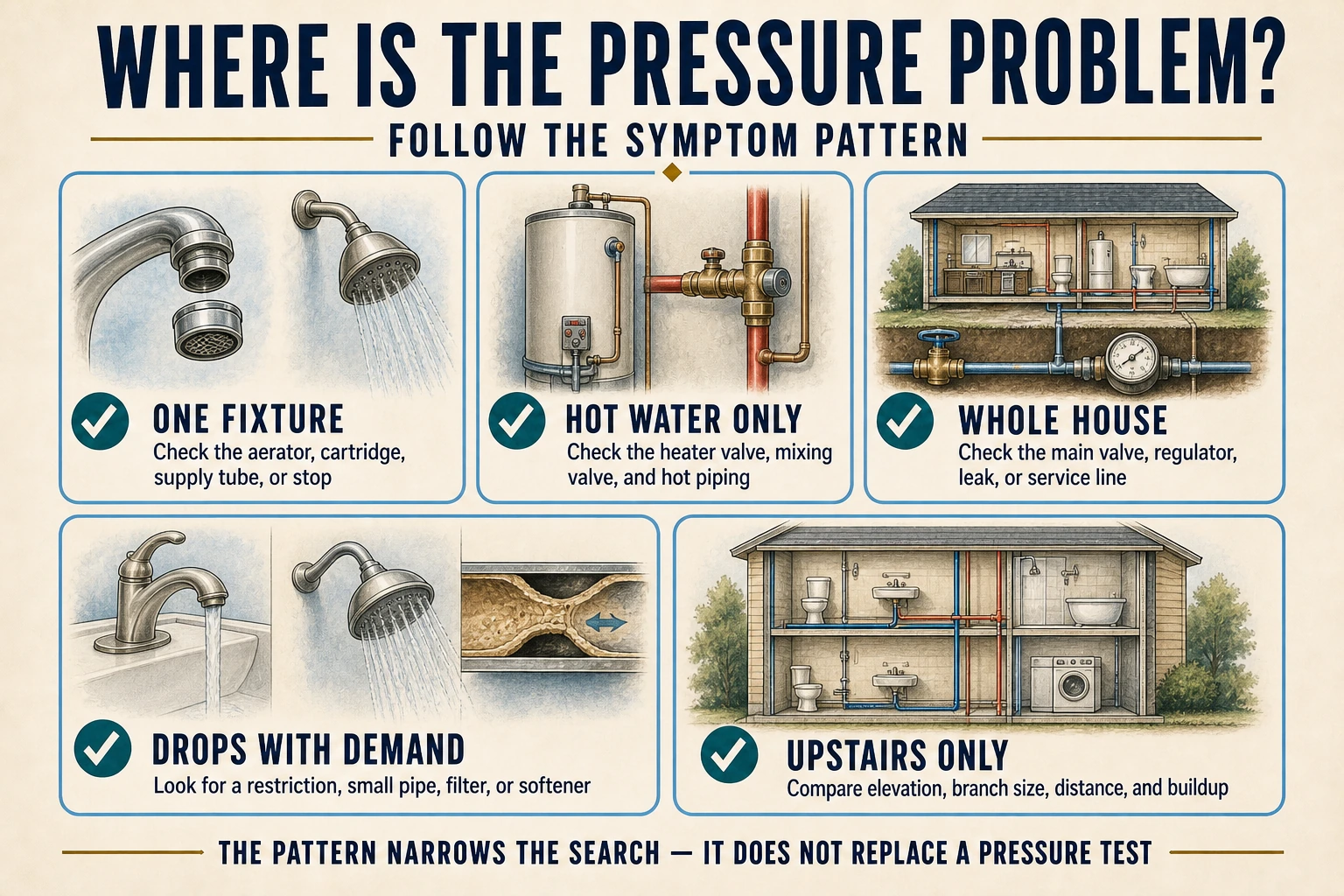
| What you notice | Most likely area | Best first check |
|---|---|---|
| One sink or shower is weak | Aerator, showerhead, cartridge, supply tube, or fixture stop | Compare hot and cold; clean the outlet screen |
| Hot water is weak everywhere | Water-heater valve, mixing valve, heater connection, or hot piping | Compare hot and cold at several fixtures |
| The whole house changed suddenly | Main valve, regulator, leak, service line, or utility work | Ask a neighbor and check for utility notices or visible leaks |
| Pressure drops when a second fixture runs | Restricted or undersized pipe, valve, filter, softener, or service line | Take a flowing-pressure reading and note which fixtures were open |
| Only the upper floor is disappointing | Available pressure, elevation, long runs, small branches, or restriction | Compare lower- and upper-floor readings under the same demand |
Pressure and flow aren't the same problem
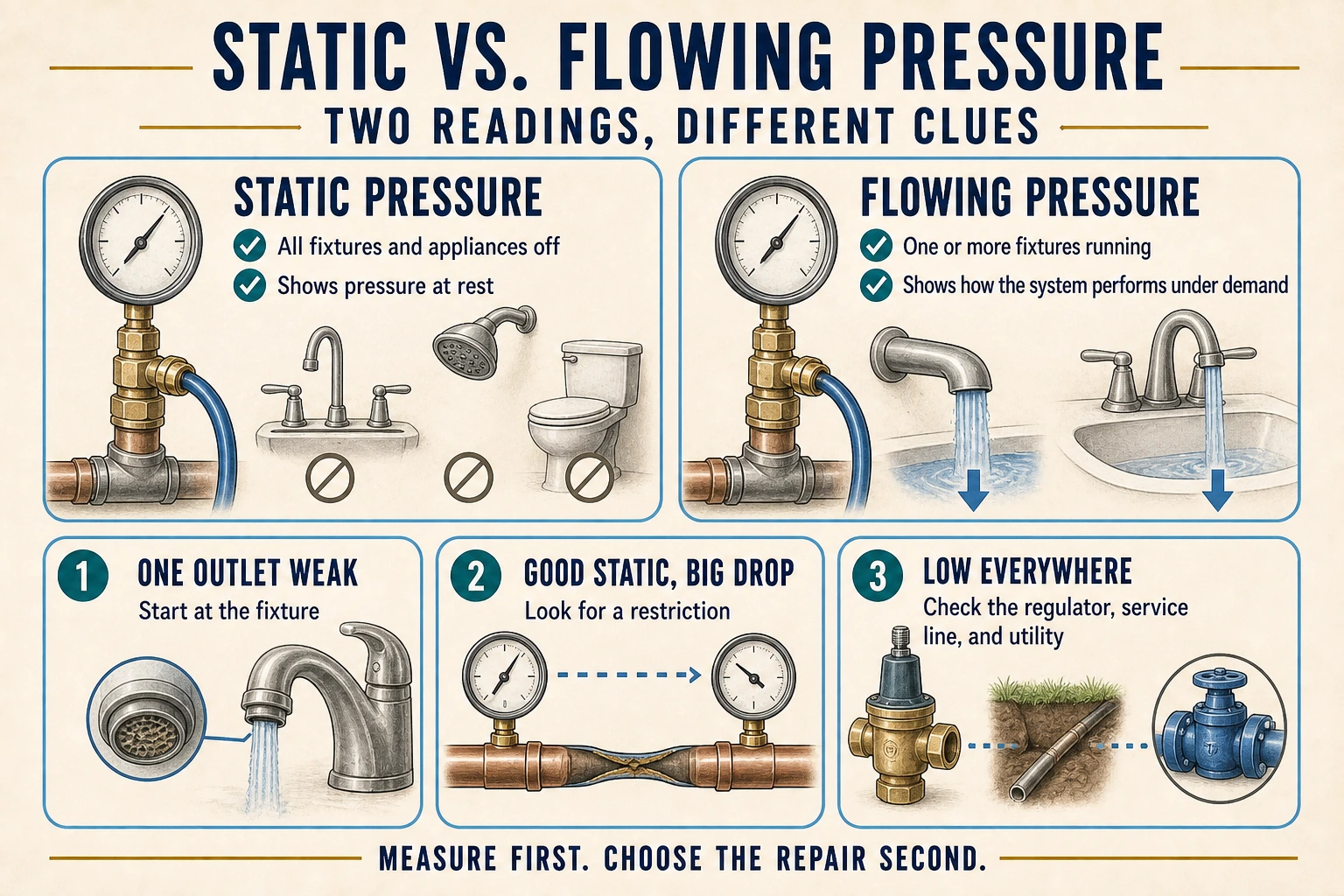
Static pressure is measured while fixtures and water-using appliances are off. Dynamic, or flowing, pressure is observed while water is moving. A large drop under ordinary demand points toward a restriction, an undersized route, or a supply problem. A consistently low reading can point toward the regulator, utility pressure, elevation, or another upstream issue.
your local water utility says pressure across its large distribution system generally ranges from about 45 to 120 psi, with exceptions, because the system includes multiple pressure districts and elevations. That does not mean your home's fixtures should receive 120 psi. your state plumbing rules require pressure reduction when static pressure inside a building exceeds 80 psi. Your actual target should be set for the home and its equipment, not copied from a neighbor or an online comment.
A practical 10-minute test before you call
1. Map the problem
Try several fixtures on different floors. Check hot and cold separately. Write down whether the weakness appears at one outlet, one bathroom, one side of the house, all hot taps, or the entire system. Also note whether it is constant or mainly happens when the dishwasher, washer, shower, or hose is running.
2. Clean the easy restriction
Remove and rinse a faucet aerator or showerhead screen if you can do so without damaging the finish. Sediment can collect after water-main work or after the home plumbing has been shut off and restored. If flow returns at that fixture, you have evidence of a local blockage rather than a house-wide pressure failure.
3. Check accessible valves without forcing them
A fixture stop under a sink may be partly closed. So may a valve at a filter, softener, water heater, or main entry. Confirm the handle position only if you know the valve type and it moves normally. An aging gate valve can look open while a damaged internal part still restricts flow, so appearance alone isn't proof.
4. Take a static pressure reading
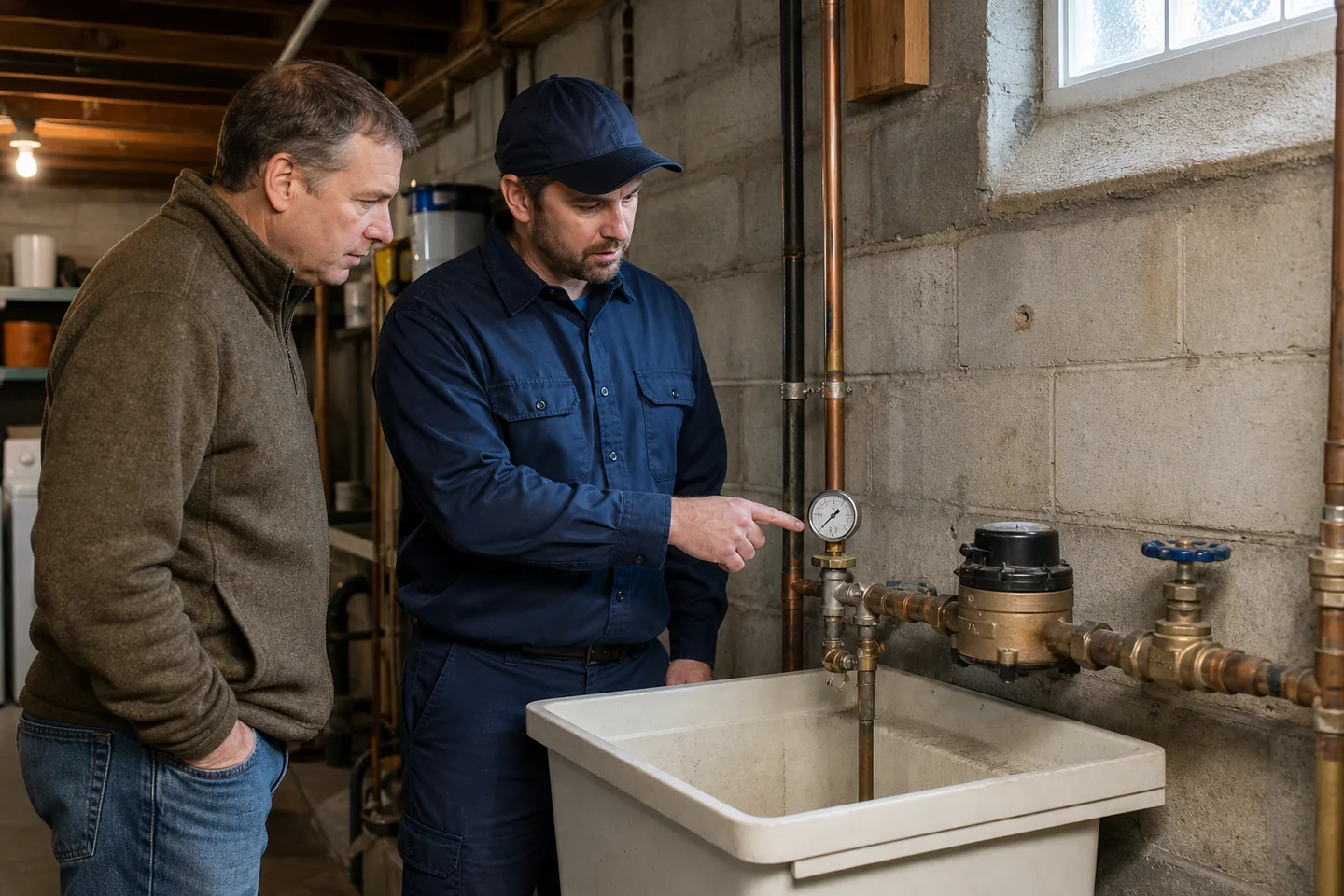
A screw-on pressure gauge can attach to a hose bib or compatible laundry connection. Turn off faucets and make sure the washer, dishwasher, ice maker, and irrigation system are not drawing water. Attach the gauge, open the valve fully, and record the reading. Check the gauge instructions and protect the connection from freezing weather.
5. Watch what happens under demand
Leave the gauge attached, then run a tub spout or another high-flow fixture. Record the new reading. Add a second fixture briefly and note the change. Tell the plumber exactly what was running; a number without the test conditions is hard to interpret.
6. Check for an unnoticed leak
Turn off every known water use and look at the water meter or usage portal. Movement or unexplained consumption may indicate a leak. your local water utility says it is responsible for repairs between the public main and the curb stop, while leaks on the customer-owned service line and indoor plumbing are the property owner's responsibility.
7. Compare notes outside the house
Ask a nearby neighbor whether their pressure changed at the same time. Check for hydrant flushing, water-main work, or a service interruption. your local water utility directs customers with a sudden, unexpected disruption or main-break concern to its 24-hour emergency line. If several homes changed together, start with the utility before buying equipment.
The most common causes in homes
A clogged aerator, showerhead, or cartridge
This is the inexpensive answer people hope for, and it is common enough to test first. Debris can block a screen, while mineral buildup or a worn cartridge can restrict one faucet or shower valve. If the rest of the house performs normally, a local repair deserves the first look.
A partly closed or failing valve
Fixture stops, main shutoffs, and valves around treatment equipment can restrict flow. Older gate valves can fail internally. Replacing a questionable main valve may require coordination with the water provider if the building-side shutoff cannot isolate the work.
A pressure-reducing valve that no longer controls correctly
Some homes need a pressure-reducing valve because public-system pressure can be high in their district. A worn or clogged regulator may cause low, high, or unstable readings. Don't turn the adjustment screw at random. Record pressure first, then have the regulator evaluated under both static and flowing conditions.
A clogged filter or water softener
A saturated cartridge, fouled media bed, or partly closed bypass can limit the whole house. If pressure improves when the equipment is placed in its approved bypass mode, that is useful evidence. Follow the manufacturer's instructions so you don't contaminate or damage the system.
Restricted galvanized supply piping
Many older homes still contain galvanized steel. Corrosion can narrow the inside of the pipe long before the outside looks alarming. Typical clues include weak flow across several fixtures, rusty water after periods of inactivity, and a sharp performance drop when more than one outlet runs.
A hidden leak or restricted service line
A service-line leak may bring higher usage, damp ground, unexplained water, or a sudden drop. A service line can also be undersized or restricted without an obvious surface leak. Because this pipe crosses the boundary between public and customer responsibility, confirm the location and ownership before approving excavation.
A hot-water-side problem
If cold flow is normal and hot flow is weak throughout the home, the water heater's shutoff, connections, heat-trap nipples, mixing valve, or hot distribution piping may be involved. A booster pump is not the logical first repair for a hot-only symptom.
Utility work, elevation, or a pressure-district condition
your local water utility manages multiple pressure districts because elevation and topography affect delivery. Hydrant flushing, main repairs, and unusual system events can also cause temporary changes. A problem shared by nearby homes belongs in a different category from a weak upstairs shower that has been declining for years.
Repair options: start with the smallest fix supported by the evidence
| Finding | Reasonable repair path | What should be verified |
|---|---|---|
| One restricted fixture | Clean the outlet or replace the aerator, showerhead, cartridge, supply tube, or stop | Normal flow elsewhere and correct replacement parts |
| Faulty main valve or regulator | Repair or replace the identified valve; set and retest pressure | Readings before and after, access, permits, and shutoff coordination |
| Filter or softener restriction | Replace the filter or service/bypass the treatment equipment | Pressure change across the equipment and manufacturer procedure |
| One restricted branch | Replace the affected branch and reconnect fixtures | Where the restriction starts and how much old pipe remains |
| System-wide deteriorated piping | Plan a partial or whole-house supply repipe | Fixture count, routing, pipe sizes, wall repair, permits, and testing |
| Customer-owned service-line problem | Repair or replace the service line with utility coordination | Ownership, material, length, access, excavation, inspection, and restoration |
| Truly inadequate incoming pressure | Consider a properly designed booster system after other causes are excluded | Utility data, minimum pressure, demand, backflow protection, controls, and code |
The proposed repair should change the measured problem. If repiping is recommended, ask which readings show a system-wide restriction. If the answer is a booster, ask what proved the existing pipes can already carry enough flow.
What low-water-pressure repairs may cost in 2026
| Service | Published 2026 planning range | Scope warning |
|---|---|---|
| Plumbing inspection | $138-$415; about $279 average (HomeYou) | A diagnostic visit may be credited to repair, or testing may be priced separately |
| Main water-line inspection | $120-$298 (HomeYou) | Confirm whether leak locating or other specialty testing is included |
| Pressure-regulator replacement | $200-$700 (Angi) | Access, pipe size, permits, inspection, and related valve work can add cost |
| Faucet cartridge replacement | $100-$400 with a plumber (2026 source summary) | A seized cartridge or damaged valve body can change the repair |
| Booster-pump installation | $200-$10,000; about $1,200 average (Angi) | The unusually broad range reflects very different pumps, controls, and water sources |
| Customer water-line replacement | $647-$2,834 average range (Angi) | Length, depth, trenching, obstacles, permits, and yard or pavement repair may push higher |
| Whole-house repipe | $1,500-$15,000; about $7,500 average (Angi) | Fixture count, material, access, wall repair, permits, and finish work define the real scope |
Compare the same scope. Ask whether each price covers diagnosis, repair, permits, restoration, retesting, and the finished project.
Who handles the service line in your area?
your local water utility places the dividing point at the curb stop, generally in the tree lawn. The utility is responsible for the city-owned portion; the customer-owned service line extends from the curb stop into the basement or crawl space, along with indoor plumbing. Other your area water providers may define responsibilities differently, so verify the rule for your address.
your local water utility provides a service-line material map and instructions for checking the customer-owned portion. Low flow does not prove a pipe is lead, and an interior repipe does not automatically replace the service line.
Questions worth asking before you share your contact information
- Do you measure both static and flowing pressure, and will I receive the readings and test conditions?
- What evidence places the restriction at the fixture, regulator, interior piping, service line, or utility side?
- If only one branch is weak, why would a whole-house repair be necessary?
- If you recommend a booster, what ruled out a closed valve, clogged filter, failing regulator, leak, or restricted pipe?
- Which parts, valves, permits, inspections, wall repairs, excavation, cleanup, and warranties are included?
Frequently asked questions
What water pressure should a local home have?
There isn't one number for every address. your local water utility reports a broad distribution-system range because pressure districts and elevation differ. Inside the building, your state's plumbing rule caps static pressure at 80 psi unless it is reduced. Ask for your home's measured static and flowing readings, then evaluate them against fixture needs and the plumbing design.
Why is the upstairs shower weaker than the first-floor faucet?
Elevation uses some available pressure, and a long or undersized branch can add resistance. A clogged showerhead or cartridge may make the difference more noticeable. Compare the shower with its outlet removed or cleaned and test the floors under the same demand before assuming the entire house is under-supplied.
Can old galvanized pipes cause low pressure?
Yes. Corrosion and mineral buildup can reduce the opening inside galvanized supply pipe and limit flow, especially when multiple fixtures run. The right scope depends on whether the restriction is one branch or spread through the system.
Will a whole-house repipe fix low water pressure?
It can improve flow when deteriorated or undersized interior supply piping is the cause. It won't correct a clogged fixture, low utility supply, faulty regulator, restricted customer service line, or hot-water-only problem unless that item is part of the work.
Should I install a booster pump?
Not as the first guess. A booster may help where incoming pressure is genuinely inadequate, but it cannot restore the capacity of a clogged pipe. The system needs correct sizing, controls, pressure protection, and any required backflow measures.
Why is only my hot water weak?
That pattern usually points toward the water heater valve or connections, a mixing valve, hot-side restriction, or a fixture cartridge rather than the municipal supply. Compare several hot and cold outlets to narrow the location.
When should I call your local water utility instead of a plumber?
Call the utility when several nearby properties change at once, pressure drops suddenly with signs of main work or a break, or service is unexpectedly disrupted. Call a plumber for a problem isolated to your fixtures, customer-owned service line, or indoor plumbing. If the boundary is unclear, start by describing the timing and whether neighbors are affected.
The best estimate starts with a measurable diagnosis
Low water pressure is a symptom, not a project description. Map where it happens, compare hot and cold, check simple restrictions, record static and flowing pressure, and find out whether nearby homes changed too. Those facts make the next conversation faster and much more useful.
Ask each professional to price the same outcome, including permits, finish work, and a final pressure test.
Sources
your local water utility: Delivering Safe Water Involves More than Mains
your local water utility: Leak Detection and Service-Line Responsibility
your local water utility: Check, Test, Date Service-Line Information
your local water utility: Customer FAQs and Emergency Contact
your local municipality: Plumbing Permits
Your state Plumbing Code: Water Supply and Distribution
HomeYou: Plumbing Inspection Costs (2026)
Angi: Water Pressure Regulator Replacement Cost (2026)
Angi: Water Pressure Booster Pump Installation Cost (2026)
Angi: Main Water Line Replacement Cost (2026)
Angi: Whole-House Repiping Cost (2026)
Plumbing by the Book: Faucet Cartridge Replacement Cost (2026)