Sewer Line Repair or Replacement: Costs, Signs, and Options
Typical national project: $1,388-$5,323 | Replacement: $60-$250 per foot
A recurring sewer backup does not automatically mean the entire line must be replaced. The problem may be a removable obstruction, one damaged section, root intrusion through aging joints, a pipe that has lost its shape, or a defect in the public sewer. The right answer begins with diagnosis—not a sales pitch for one repair method.
For homeowners across your area, costs can range from a few hundred dollars for limited work to five figures for a long, deep, or difficult replacement. This guide covers warning signs, camera inspection, repair methods, permits, and estimate comparison.
Sewer line repair vs. replacement: quick answer
- Cleaning may restore flow when the problem is grease, debris, or removable roots, but it does not repair a cracked, offset, bellied, or collapsed pipe.
- A spot repair can make sense when one defect is clearly located and the rest of the sewer lateral remains serviceable.
- Cured-in-place pipe lining can rehabilitate a host pipe that has cracks, fractures, holes, or root-entry points but has generally kept its shape.
- Pipe bursting installs a new pipe while breaking or splitting the old one and usually requires access pits rather than a full-length trench.
- Open excavation may be necessary when grade must be corrected, the pipe is badly collapsed or deformed, connections require access, or trenchless equipment cannot be used safely.
A camera recording, surface location, depth measurements, and a written defect map should support the recommendation. If the video is obscured by standing water or buildup, cleaning may be needed before the line can be judged accurately.
How much does sewer line repair cost in 2026?
HomeAdvisor reports a 2026 national replacement range of $1,388 to $5,323, averaging about $3,319. Angi reports complete replacement at roughly $60 to $250 per linear foot, so a long lateral can exceed that total range before surface restoration.
| Service or method | 2026 planning range | What the number means |
|---|---|---|
| Video sewer inspection | $100-$500 | Camera diagnosis; location and depth services may be separate |
| Drain or sewer cleaning | $87-$352 | Flow restoration for many clogs; special equipment can cost more |
| Limited sewer-line repair | $202-$1,439 | HomeYou national repair range; not a full lateral replacement |
| Complete replacement | $60-$250 per ft. | Pipe replacement before some access and surface-restoration costs |
| CIPP lining | $90-$250 per ft. | Resin liner installed inside a suitable existing host pipe |
| Pipe bursting | $60-$200 per ft. | New pipe pulled through while the old pipe is split or fractured |
These are national planning figures, not guaranteed your area prices. Deep pipe, long runs, concrete, driveways, trees, utility conflicts, right-of-way work, permits, and restoration can raise the total. Ask every contractor to price the same footage and scope.
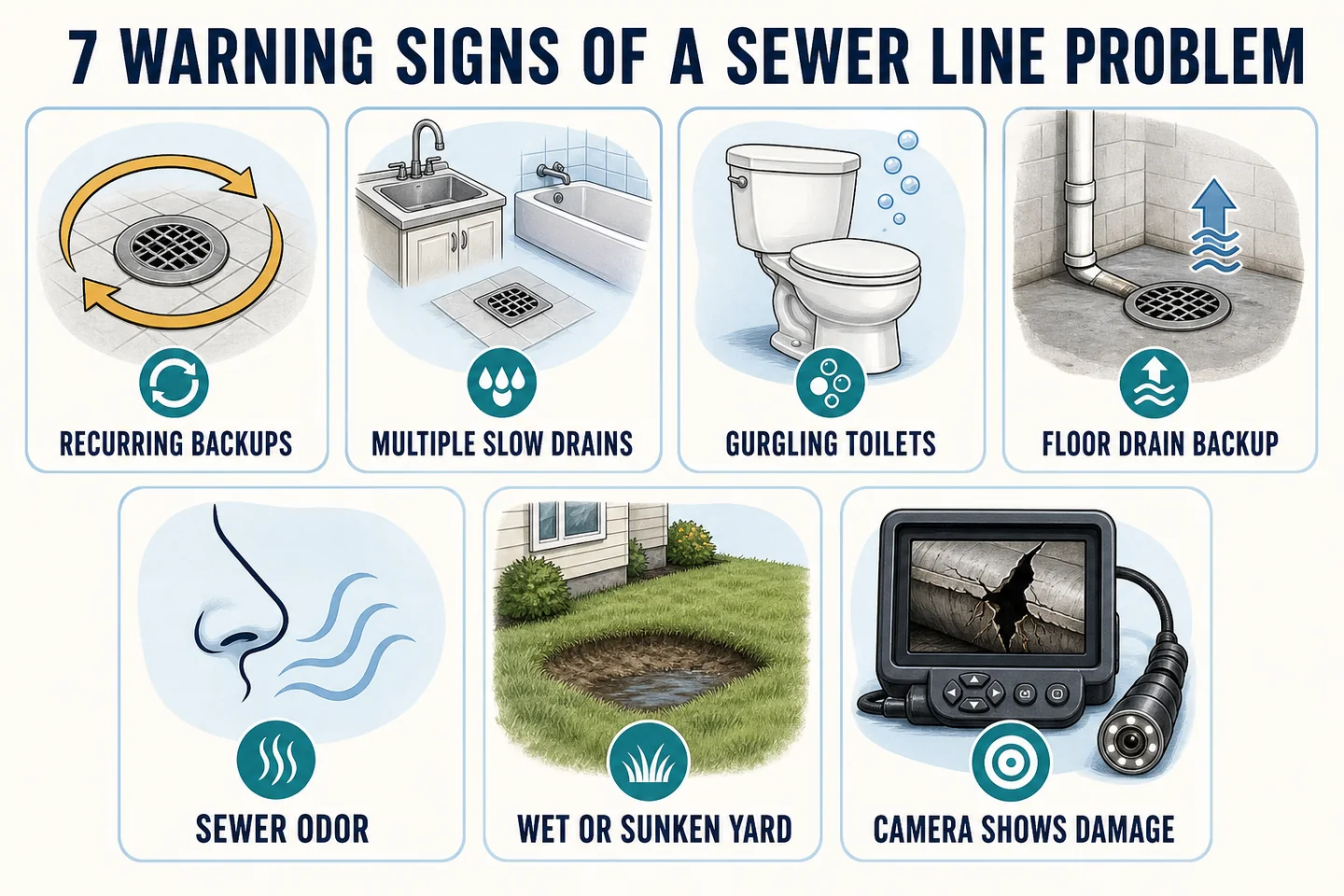
Seven warning signs of a damaged sewer line
- Backups return after cleaning. Repeated trouble may point to roots, an offset joint, a sag, scale, or structural damage.
- Several fixtures drain slowly together. Toilets, tubs, and floor drains acting up together can indicate a main drain or lateral problem.
- Toilets gurgle or water moves in another drain. Restricted flow can affect the lowest fixtures first.
- Sewage appears at a basement floor drain. Stop using fixtures and appliances that discharge to the sewer until the source is evaluated.
- Persistent sewer odor is present. A dry trap or damaged cleanout cap can also cause odor, so smell alone proves little.
- The yard develops an unexplained wet, sunken, or unusually green area. A leaking lateral is one possible cause and should be investigated.
- A camera shows cracks, missing pipe, heavy corrosion, separated joints, deformation, collapse, or standing water that remains after cleaning.
| Sewage safety: Keep people and pets away from sewage. Avoid contact, stop water use when it could worsen the backup, and do not handle electrical equipment in a wet area. Call the local sewer authority or municipality to ask whether the public main should be checked before authorizing private-lateral excavation. |
|---|
Why sewer laterals fail in your area
Established your area neighborhoods often have mature trees and older clay or cast-iron pipe. Clay joints can admit roots or shift; cast iron can corrode and collect scale. Past repairs may leave several materials in one lateral.
Soil settlement, seasonal saturation, freeze-thaw movement near shallow sections, poor bedding, heavy loads, and old excavation can also contribute. Grease, wipes, debris, and roots may restrict an otherwise serviceable line.
What a sewer camera inspection should tell you
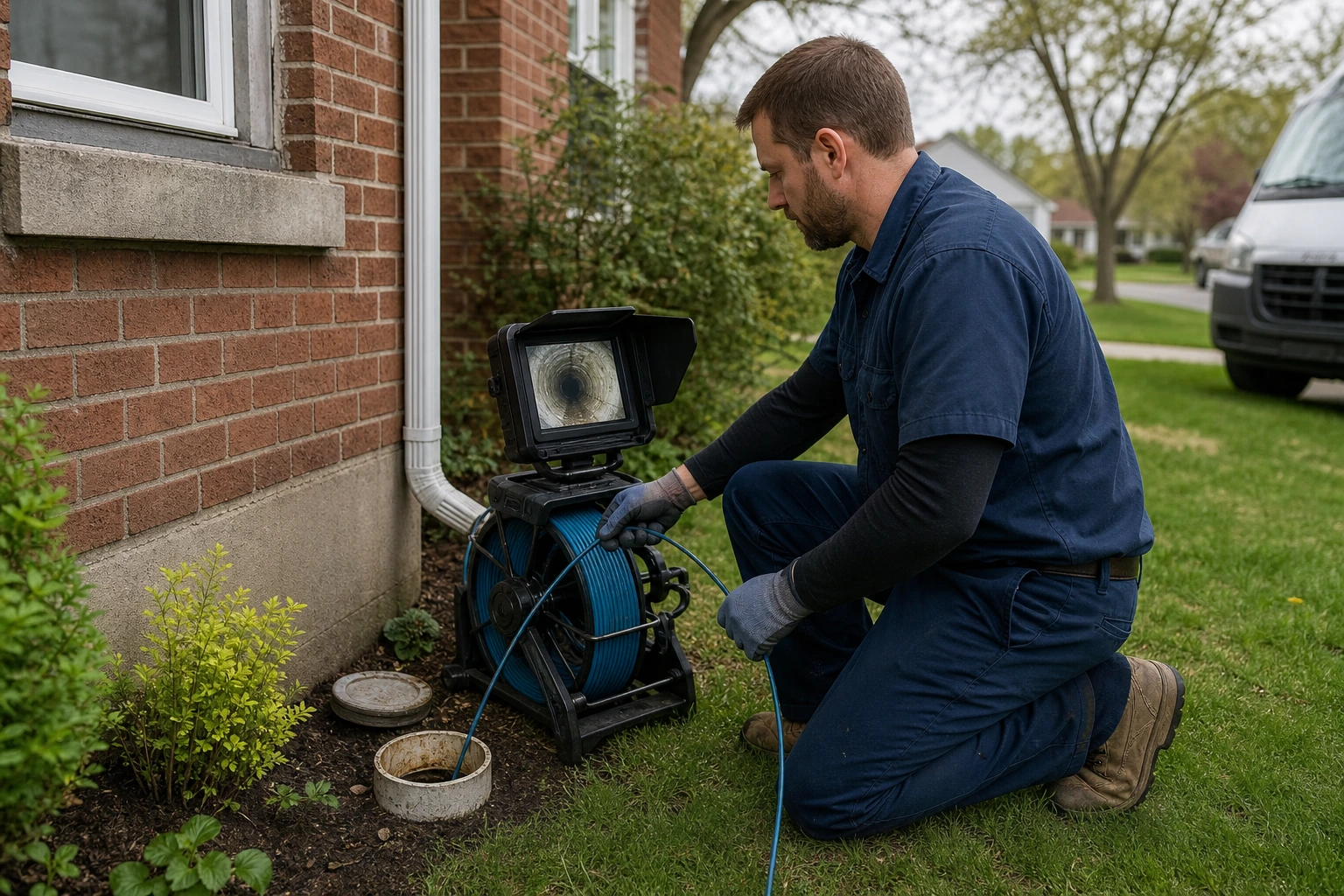
A camera inspection lets the plumber view the inside of the line from a cleanout or another access point. For a repair-or-replacement decision, ask for more than a verbal summary. A useful inspection package should identify:
- The approximate line route, inspected length, pipe diameter, and visible material
- The footage of each defect, plus surface marking when excavation is proposed
- Line depth at the repair area and any major change in depth
- Cracks, roots, offsets, corrosion, deformation, collapse, standing water, and connections
- Whether cleaning and a follow-up inspection are needed for a clear view
- A copy of the video or still images tied to the written recommendation
Camera images need context. Standing water may reflect a sag, downstream restriction, or current flow. A locator identifies the defect area, but site conditions and utility records still matter.
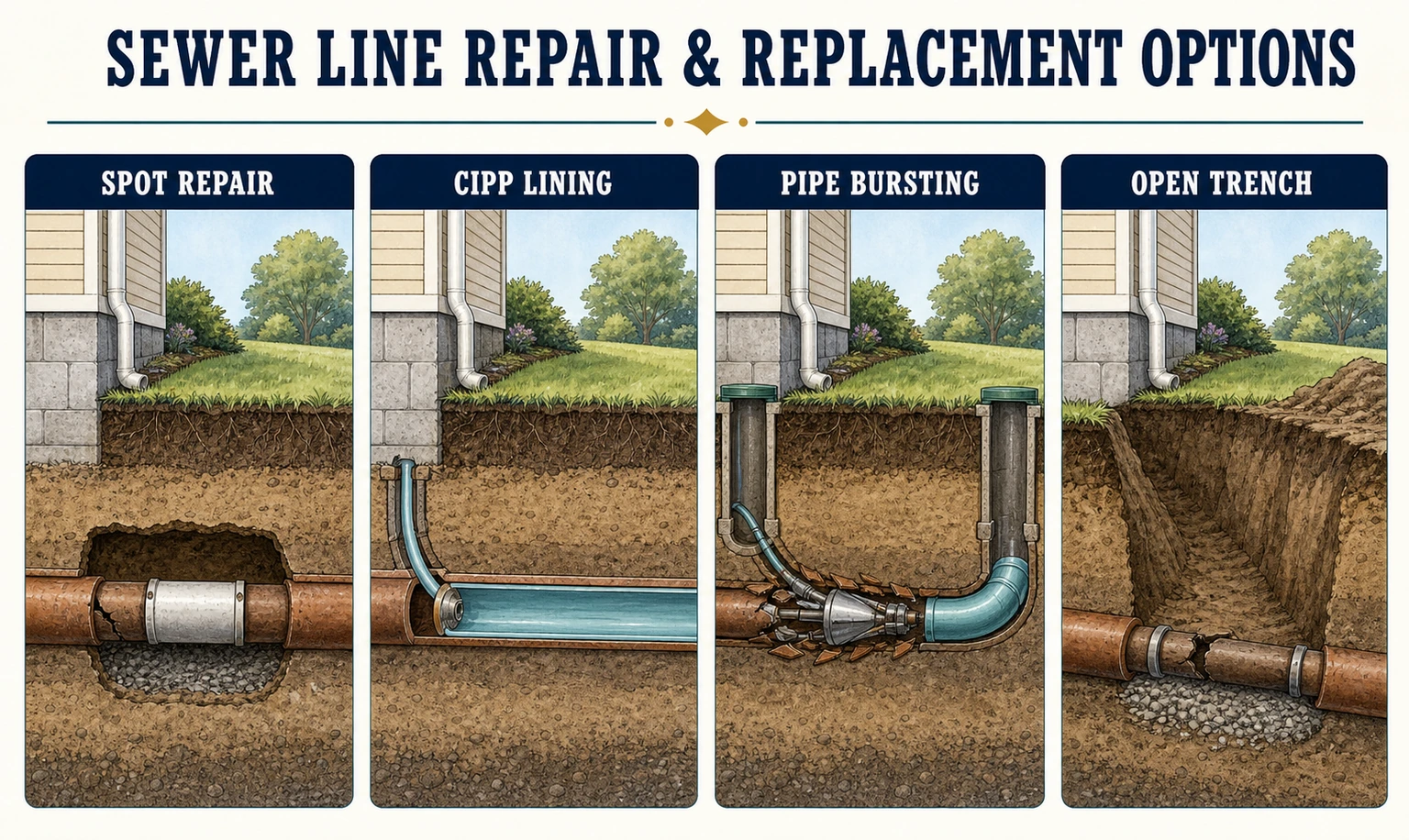
Repair and replacement options compared
| Option | Best fit | Important limitation |
|---|---|---|
| Cleaning or root cutting | Removable obstruction in a pipe worth keeping | Restores flow but does not rebuild damaged pipe |
| Excavated spot repair | One accessible defect with sound pipe on both sides | Requires digging and local surface restoration |
| CIPP lining | Cracked or root-affected host pipe that retains its shape | Does not correct every collapse, severe deformation, or grade problem |
| Pipe bursting | Continuous replacement with limited surface openings | Usually needs pits and careful review of nearby utilities and connections |
| Open-trench replacement | Collapse, regrading, complex connections, or full access needed | Most disruptive to yards, concrete, and hardscape |
When a repair is usually reasonable
A targeted repair is often the better value when the defect is isolated and surrounded by serviceable pipe. One offset joint, cracked section, failed transition, or root-entry point may not justify replacing the full lateral. The repair should reach stable pipe on both sides.
Ask what evidence supports the repair boundary and what warranty applies. A repair may solve the current defect while leaving unrelated aging pipe outside the scope; the estimate should say so.
When full replacement becomes more practical
Replacement becomes more practical when defects are widespread, cleaning gives only short relief, pipe is missing or collapsed, grade is wrong, or several old repairs are failing. It may also make sense when excavation already exposes much of a deteriorated line.
Do not decide from age alone. The contractor should explain why cleaning, spot repair, or rehabilitation will not work. The contract should also control how any method change is documented and approved.
Trenchless does not always mean cheaper—or no digging
Trenchless methods can preserve lawns, sidewalks, landscaping, and driveways, which may reduce the total disruption and restoration cost. CIPP lining uses the existing pipe as the host for a cured liner. Pipe bursting pulls a factory-made replacement pipe through the old path while breaking or splitting the old pipe.
Both methods require access. Bursting commonly needs launch and receiving pits; lining needs cleaning and preparation. Trenchless work may cost more per foot than an easy open trench but less overall when it avoids hardscape restoration. Compare complete projects.
Permits, utility marking, and who owns the problem
Responsibility depends on the address and defect location. NEORSD maintains major interceptors and treatment infrastructure; municipalities generally maintain local sewers. Private-lateral and right-of-way rules vary, so contact the local sewer authority first.
your local area requires permits for repaired sewer or drainage systems and requires plumbing or sewer contractors to meet licensing, insurance, bonding, and city-registration rules. your local area and other communities have their own permit, contractor, inspection, and right-of-way requirements. Ask who obtains the permit, schedules inspection, and restores public or private surfaces.
Before excavation, an OHIO811 notification is required so participating utilities can mark facilities. Private lines may need additional locating, records, or careful exposure.
How to compare sewer repair estimates
- Diagnosis: camera recording, defect footage, surface location, depth, pipe material, and cause
- Scope: start and end points, footage, diameter, method, material, and connections
- Access: cleanout installation, pits, trench dimensions, shoring, dewatering, traffic control, and utility conflicts
- Site work: soil removal, backfill, compaction, testing, inspection, permits, and disposal
- Restoration: lawn, trees, beds, fence, sidewalk, driveway, basement slab, flooring, and interior finishes
- Contingencies: unit prices and approval process for extra depth, hidden connections, collapse, or method changes
- Warranty: what is covered, exclusions, transfer terms, and who responds if flow or structure fails
For non-emergency work, compare two or three proposals based on the same findings. A low total may exclude cleanouts, permits, concrete, landscaping, or final verification; a high one may include unsupported work.
Frequently asked questions
Does a sewer backup mean the line is broken?
No. A blockage in the private lateral or public main can cause a backup without a broken pipe. Stop using drains, ask whether the municipality should check the main, then clean and inspect the private line as appropriate.
Can tree roots be removed without replacing the pipe?
Often, yes. Cutting or cleaning may restore flow, but roots usually entered through a joint or defect. The camera should show whether maintenance, spot repair, lining, or replacement is the better long-term plan.
How long does sewer line replacement take?
Many straightforward private-lateral projects take one to several working days. Deep excavation, street work, utilities, inspections, concrete, weather, and surface restoration can extend the schedule.
Is pipe lining the same as replacement?
No. CIPP lining rehabilitates a suitable existing host pipe by curing a structural liner inside it. Pipe bursting and open trench install a new replacement pipe.
Can a bellied sewer line be lined?
A liner follows the existing route and generally does not correct the pipe's grade. The plumber should determine whether standing water is significant and whether excavation or regrading is necessary.
Will homeowners insurance pay for sewer line work?
Coverage depends on the policy, cause, endorsements, limits, and whether the expense is pipe repair, backup damage, or both. Ask the insurer or a licensed insurance professional for a policy-specific answer before assuming coverage.
Should I replace a sewer line before selling a house?
Start with evidence. A documented defect may require repair, replacement, disclosure, or negotiation, but an older pipe that is open and structurally serviceable does not automatically need replacement.
Choose the smallest complete solution
The best sewer proposal is not automatically the least expensive spot repair or the most advanced trenchless system. It is the smallest complete scope that restores dependable flow, corrects the documented defect, protects nearby utilities and property, and leaves a clear record of what was installed.
Begin with a usable camera inspection, confirm who is responsible for the affected section, and compare methods against the same footage, depth, access, and restoration requirements. That approach gives homeowners a better chance of solving the problem once without paying for work the line does not need.
Sources
HomeYou: Plumbing Cost Guide 2026
HomeAdvisor: Sewer Line Replacement Cost 2026
Angi: Sewer Line Repair and Replacement Cost 2026
NASSCO: Sewer Lateral Rehabilitation, CIPP, and Pipe Bursting
U.S. EPA: Pipe Bursting Fact Sheet
your local municipality: Plumbing Permits
Your area Regional Sewer District: Sewer System Responsibilities