Sewage Backup Cleanup: Health Risks, Restoration Steps, and Costs
What to do first, what professional cleanup should include, and how to understand the price before you sign
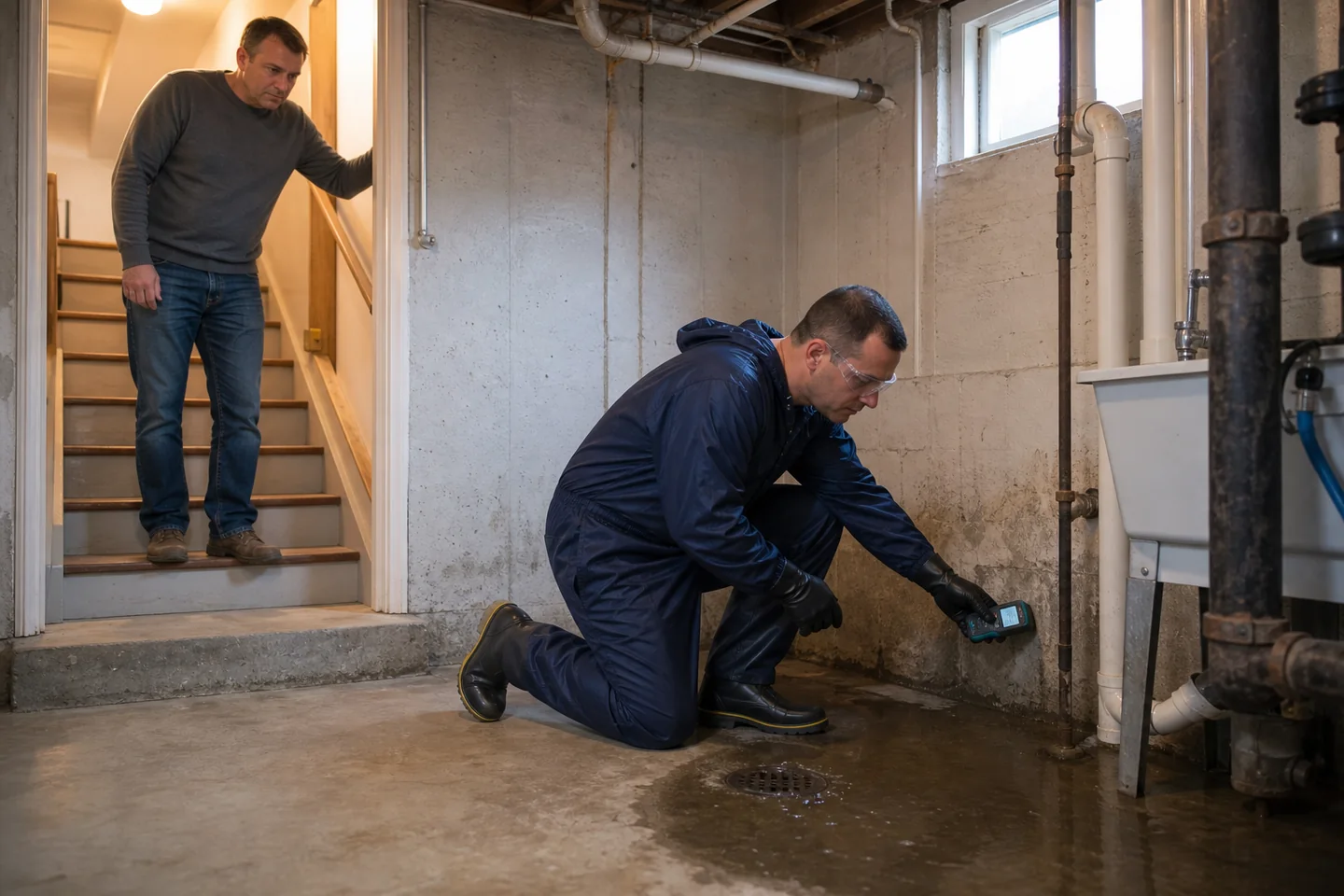
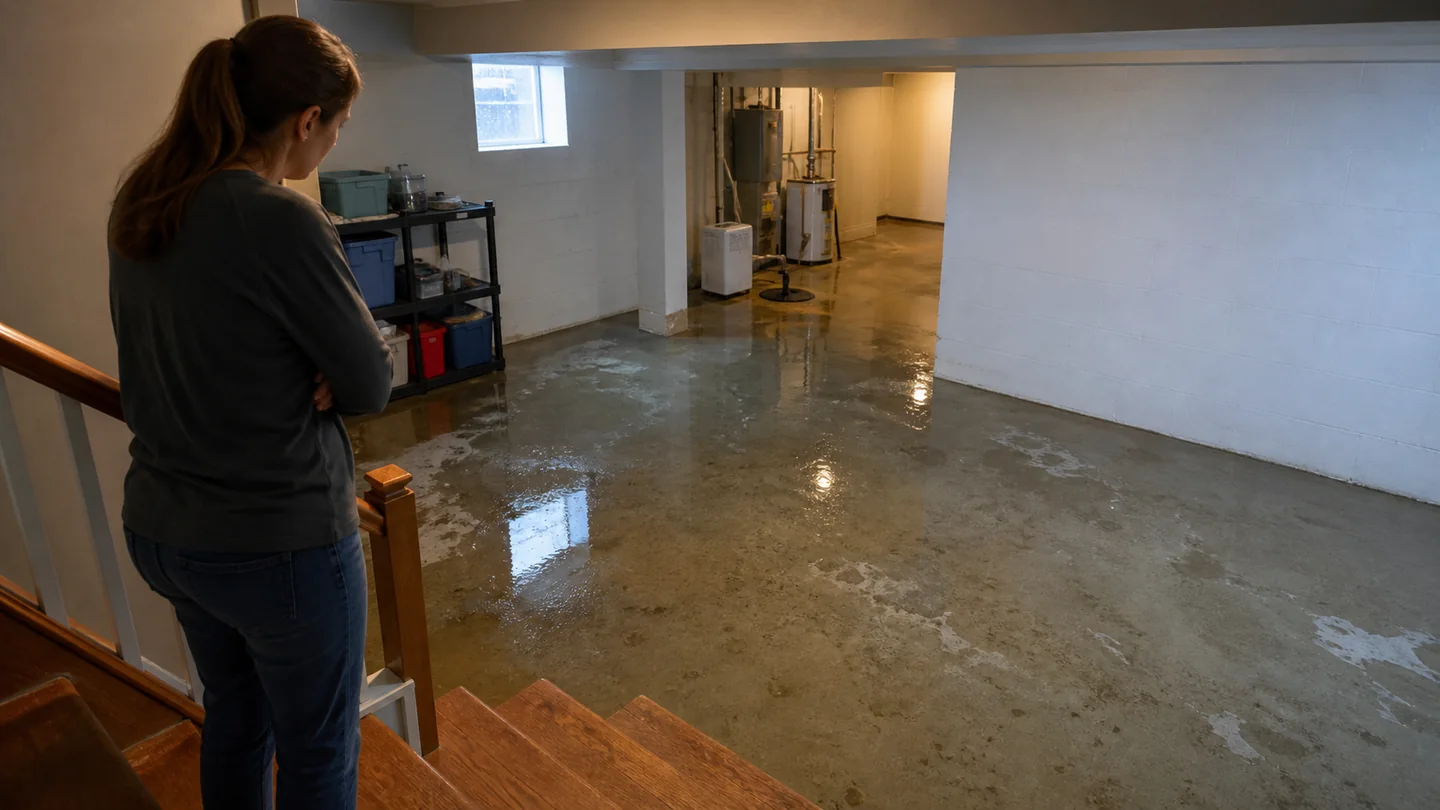
If dirty water is rising from a floor drain or lower-level toilet, keep people and pets away and stop using water in the home. Every flush, shower, dishwasher cycle, or laundry load may add water to a blocked system.
A plumber may need to stop the backup, a restoration crew may need to clean the building, and your insurer or local sewer authority may need documentation. Those are related jobs, but they are not the same job.
The short answer: treat sewage as contaminated water
Sewage can contain microorganisms and other contaminants that may make people sick. CDC guidance recommends avoiding contact and using rubber boots, waterproof gloves, and goggles if contact cannot be avoided. Open cuts should be covered with waterproof bandages, and hands should be washed with soap and water after exposure or removing protective equipment.
Not every backup requires a full basement demolition. A shallow spill on sound concrete differs from sewage that soaked carpet, drywall, insulation, furniture, or subfloor. The plan should follow actual contamination and material conditions - not fear or a one-size-fits-all script.
| Health and safety note This article provides general homeowner guidance, not medical advice. Avoid the affected area if there is standing water, electrical risk, structural damage, extensive contamination, or anyone in the household is especially vulnerable. Seek medical guidance after significant exposure, contaminated wounds, or symptoms such as vomiting, stomach cramps, or diarrhea. |
|---|
Is it safe to stay in the house?
You may be able to remain upstairs while a small basement area is isolated. Leaving may be wiser if the damage is extensive, essential utilities cannot be reached safely, or heating and cooling equipment was contaminated. Keep children, pets, older adults, people with weakened immune systems, and anyone with open wounds away. If sewage reached living space, an HVAC return, or food-storage areas, ask whether temporary relocation is appropriate.
What to do in the first hour
1. Keep everyone out of the affected area
Block access without entering contaminated water. Keep children and pets away, and avoid tracking sewage through clean rooms on shoes or clothing.
2. Stop adding water to the drain system
Stop flushing, showering, running faucets, and using water-consuming appliances. Even during heavy rain, reducing household flow keeps you from adding wastewater to an overloaded line.
3. Treat electricity as a separate emergency
Do not enter standing water to reach electrical equipment. If power cannot be turned off from a dry location, CDC guidance says an electrician should handle it. Use battery lights, not candles.
4. Photograph the route and the damage
From a safe location, photograph the source, water line, affected rooms, contents, and travel path. Note the start time, recent rain, fixtures in use, and whether neighbors reported similar trouble.
5. Call the right people
A plumber clears the source. A restoration crew extracts sewage, removes unsalvageable materials, cleans, dries, and documents the building. Contact your insurer promptly and report a suspected public-sewer problem locally.
6. Do not start spreading air through the space
A household fan can spread droplets beyond the original area. Place ventilation and drying equipment only after electrical safety and the contamination path are assessed.
Why sewer backups happen in homes
A backup can start on the private side of the system, in a local public sewer, or because stormwater is entering faster than the system can move it away.
- A blockage in the home's main drain or private sewer lateral from grease, wipes, debris, scale, or foreign objects.
- Tree roots entering cracked or separated pipe joints, especially in older clay or damaged laterals.
- A collapsed, offset, or bellied sewer line that needs more than routine snaking.
- Heavy rain, snowmelt, infiltration, or a capacity problem affecting a public or combined sewer system.
- A failed backwater valve, ejector pump, or other building drainage component.
- A saturated or damaged septic system in homes outside municipal sewer service.
Ask where the restriction or surcharge occurred and who owns that part of the system. A camera can reveal roots, breaks, offsets, and recurring obstructions, although the line may need clearing first.
Plumber or restoration company: who does what?
| Need | Typical lead professional | What you should receive |
|---|---|---|
| Stop an active backup | Plumber or drain specialist | Cause diagnosis, access method, work performed, and whether flow is restored |
| Inspect the sewer lateral | Plumber or sewer specialist | Recorded camera inspection, location and depth findings, and repair recommendations |
| Remove contaminated water | Water-damage restoration company | Affected-area measurement, extraction record, photographs, and waste handling scope |
| Remove and clean materials | Contaminated-water restoration company | Written removal boundaries, cleaning method, product records, and change authorization |
| Dry and verify the structure | Restoration company | Moisture map, equipment log, drying readings, and completion documentation |
| Rebuild the basement | Restoration contractor or remodeler | Separate reconstruction estimate, materials, permits, schedule, and warranty |
One company may handle several phases, but the estimate should still separate line clearing, contaminated-water cleanup, drying, and reconstruction.
What professional sewage restoration should look like
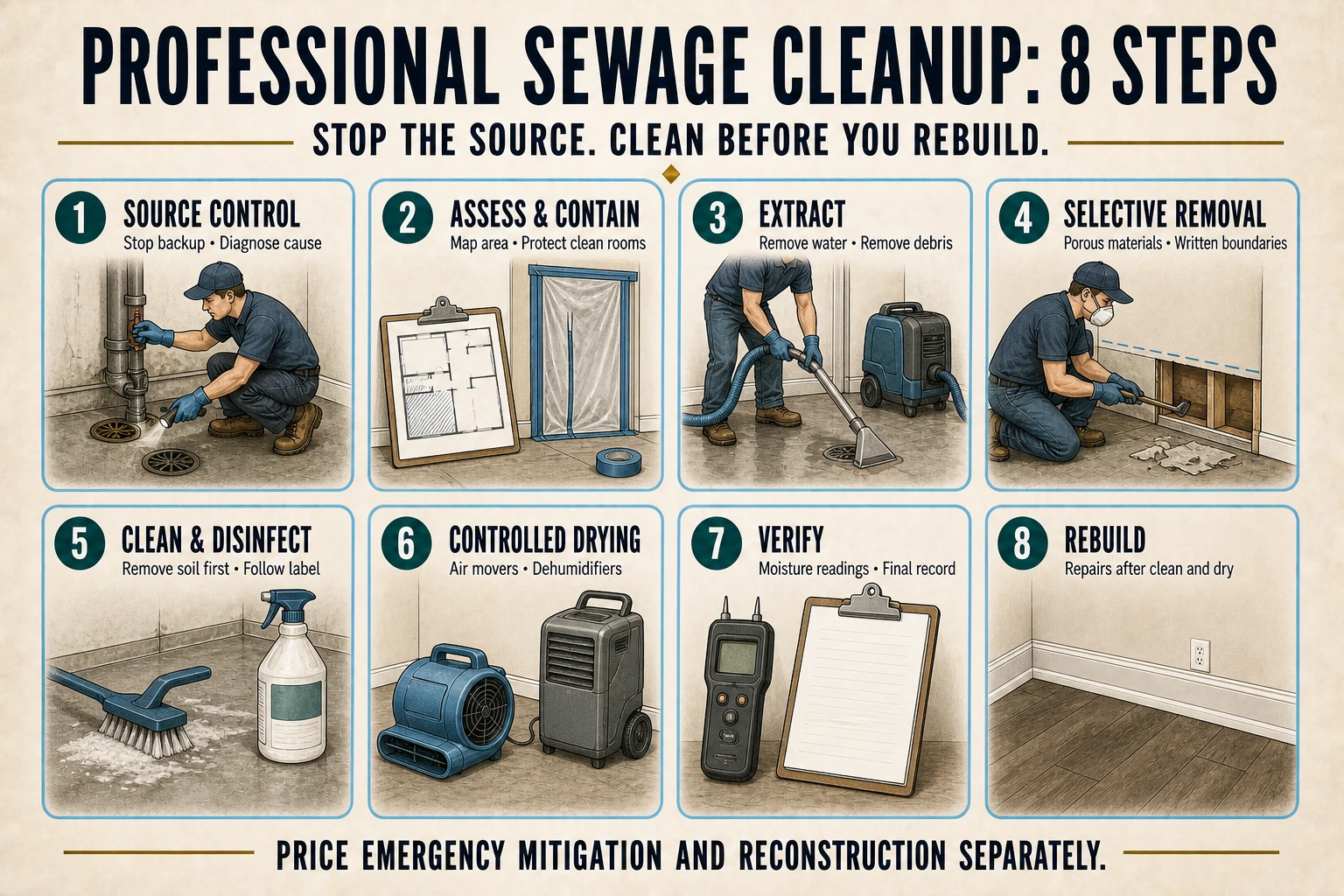
1. Source control and initial assessment
The team confirms that the backup has stopped, identifies the affected area, checks hazards, and plans how workers will enter without carrying contamination into clean rooms.
2. Documentation and containment
Expect photographs, measurements, a room-by-room scope, and a plan for moving workers, tools, and waste. HVAC equipment serving the area should be evaluated before it circulates air.
3. Extraction and removal of solid waste
Standing water and debris are removed with equipment suited to contaminated water, not a household vacuum. Wastewater and discarded materials must be handled appropriately.
4. Selective demolition
Sewage-soaked carpet, pad, drywall, insulation, paper products, and many upholstered items are difficult to clean because contamination penetrates porous material. EPA guidance notes that porous materials absorb more water, dry slowly, and can hold contaminants within their pores. Removal boundaries should follow evidence, not an arbitrary four-foot cut around every room.
5. Cleaning and disinfection
Hard surfaces are physically cleaned before an appropriate disinfectant is applied according to its label. Disinfectant cannot replace soil removal. Never mix bleach with ammonia or other cleaners.
6. Controlled drying
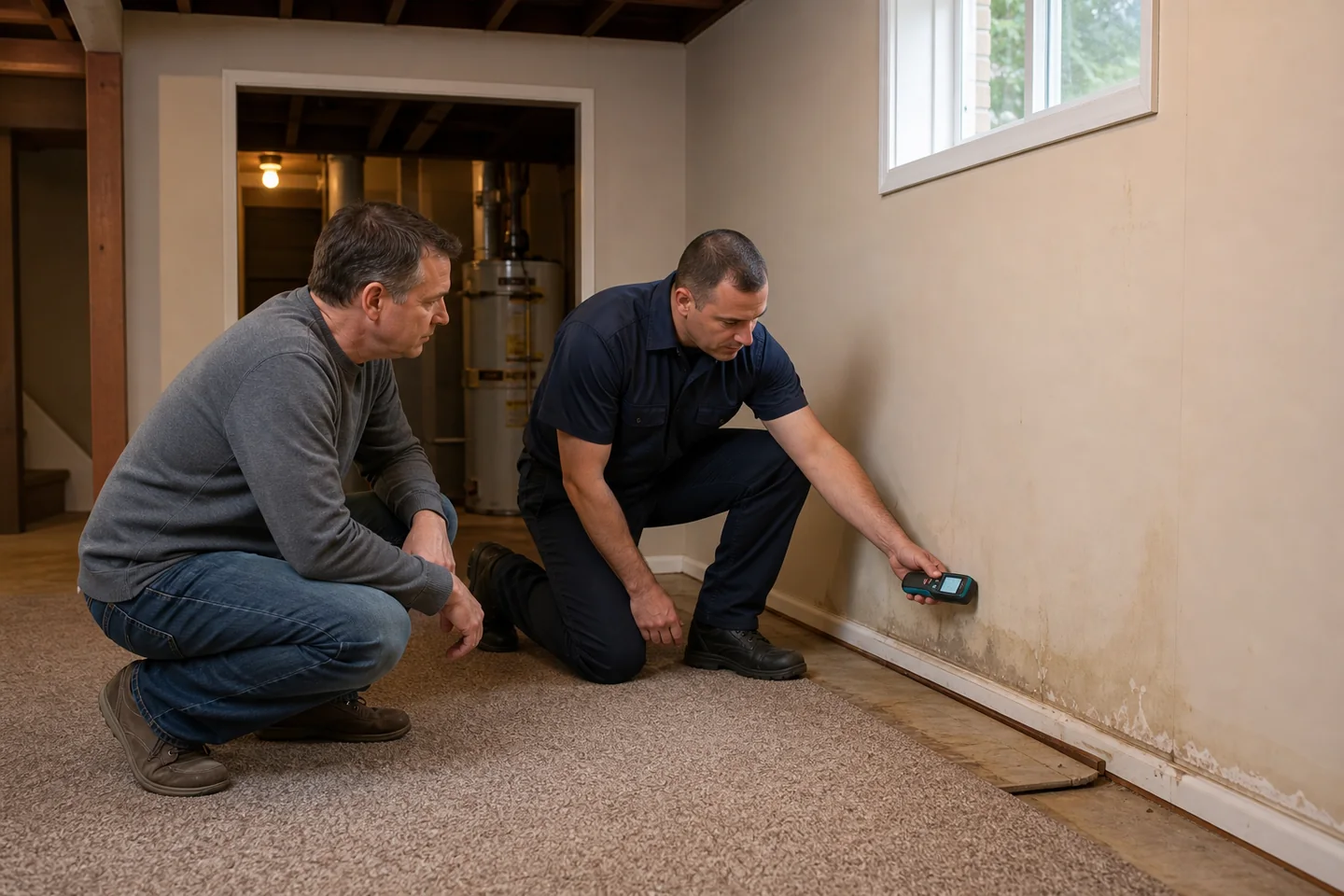
After contamination and visible soil are addressed, commercial air movers and dehumidifiers dry the remaining structure. The team should record equipment placement, operating time, and moisture changes.
7. Verification before rebuild
The area should be visibly clean, appropriately dry, and free of unresolved source problems before rebuilding. Ask for final moisture readings and an explanation of remaining staining or odor.
8. Reconstruction
Reconstruction may replace drywall, insulation, trim, flooring, cabinets, or building systems. Get a separate rebuild price if the emergency authorization covered only mitigation.
What can usually be cleaned, and what often has to go?
| Material | Likely decision after sewage contact | What changes the answer |
|---|---|---|
| Concrete, tile, metal, and other hard surfaces | Often cleanable after thorough soil removal and disinfection | Cracks, unsealed joints, coatings, inaccessible cavities, and time wet |
| Carpet and carpet pad | Commonly removed after sewage contact | Area affected, backing, installation, and whether contamination reached the subfloor |
| Drywall and insulation | Contaminated sections commonly removed | Water height, wicking, wall cavities, vapor barriers, and adjacent framing |
| Solid framing lumber | May be cleanable and dryable | Surface condition, saturation, inaccessible faces, and structural damage |
| Upholstered furniture and mattresses | Often not economical or reliable to restore | Construction, contamination depth, sentimental value, and specialist assessment |
| Washable clothing and some textiles | May be recoverable with appropriate laundering | Fabric instructions, heavy contamination, and whether safe handling is practical |
| Books, paper, cardboard, and absorbent stored goods | Commonly discarded | Value, extent of contact, and whether a specialist conservation service is justified |
If a contractor says everything must go, ask for the contamination and moisture evidence. If someone says everything can be sprayed and saved, ask how porous materials will be cleaned all the way through. The reasonable answer is material-specific.
How much does sewage backup cleanup cost in your area?
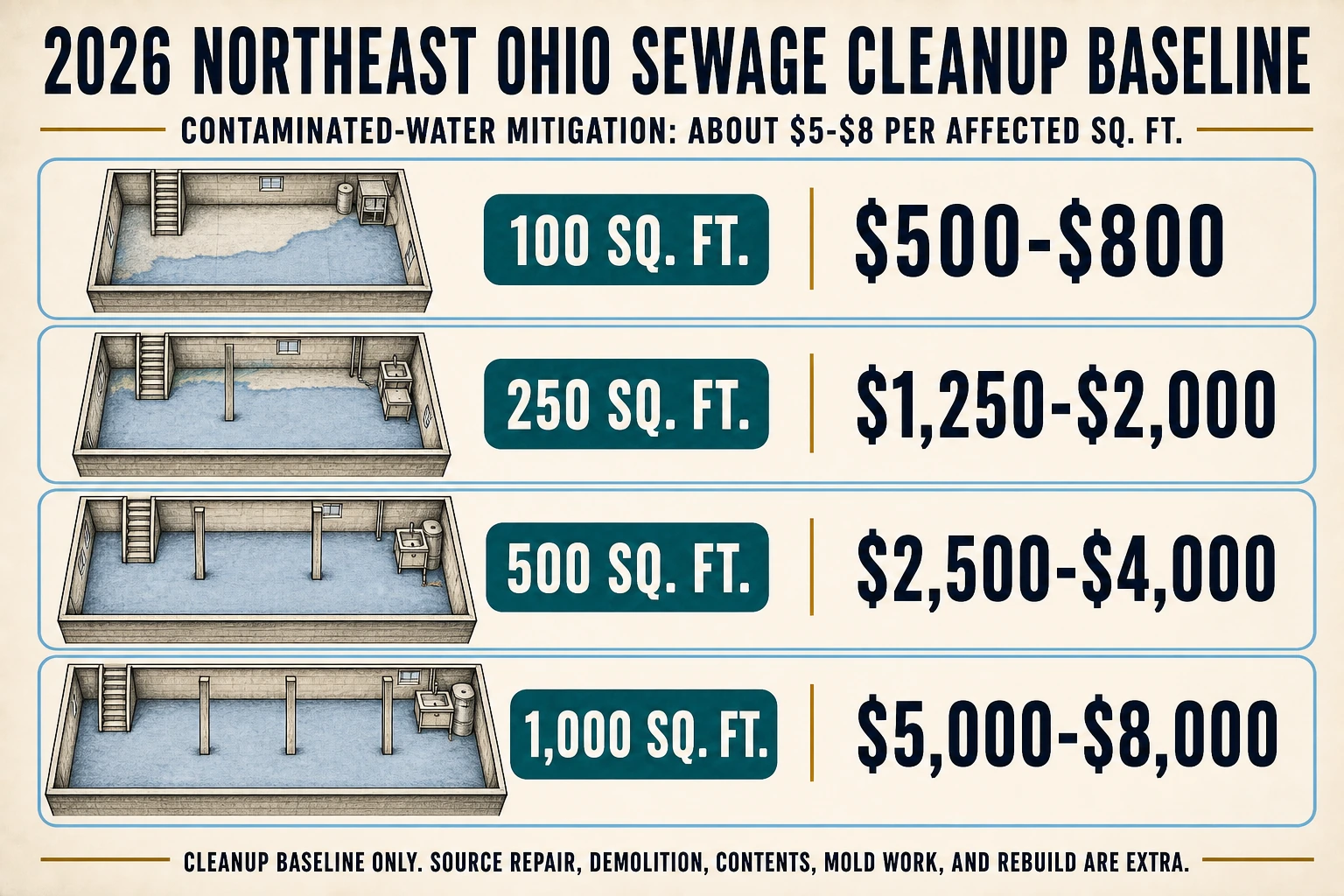
Online prices look inconsistent because they measure different work. HomeYou's current your local area sewage-cleanup page shows a narrow $241-$966 range, with $450-$591 typical. Its broader your local water utility-damage page shows $3,450-$4,018 for the modeled project and estimates contaminated Category 3 cleanup at roughly $5-$8 per affected square foot.
The smaller number may describe a limited cleaning visit; the larger one may include extraction and mitigation. Neither is a finished-basement total. Demolition, contents, plumbing, sewer repair, reconstruction, emergency timing, and mold work can be separate.
| Affected area | Cleanup baseline at $5-$8 per sq. ft. | Usually not included in this simple math |
|---|---|---|
| 100 sq. ft. | $500-$800 | Emergency minimums, source repair, demolition, contents, and rebuild |
| 250 sq. ft. | $1,250-$2,000 | Carpet or drywall removal, disposal, plumbing, and replacement finishes |
| 500 sq. ft. | $2,500-$4,000 | Finished-basement reconstruction, extensive contents, and sewer-line work |
| 1,000 sq. ft. | $5,000-$8,000 | Large loss management, mechanical systems, permits, and complete rebuild |
This is a mitigation baseline, not a quote. Forbes Home places black-water restoration around $7-$7.50 per square foot and broader mitigation around $8, supporting the your local area range only as early planning math.
The line repair can be a second bill
Cleanup does not fix the cause. Current national guides place a basic camera inspection around $125-$500, snaking around $200-$600, and residential hydro jetting around $300-$1,100. Broken or buried laterals can cost far more when excavation or slab work is involved.
Do not approve hydro jetting solely because it is more powerful. Older or damaged pipe should be evaluated first. Ask whether the price includes locating the defect, a recording of the camera inspection, clearing the blockage, and a post-cleaning camera pass.
What actually drives the cleanup price
- Affected floor area, depth, and how far water traveled behind walls or under flooring.
- Finished versus unfinished space and the amount of porous material that must be removed.
- Contaminated contents, packing, off-site cleaning, storage, and disposal.
- Emergency, overnight, weekend, and holiday response charges.
- Access, stairs, low ceilings, limited equipment routes, and the need to protect clean areas.
- Number and type of air movers, dehumidifiers, filtration devices, and equipment days.
- Whether cleanup, source repair, mold remediation, and reconstruction are separate contracts.
Ask for quantities and unit rates before work expands: affected square footage, linear feet of drywall, flooring area, equipment type and daily rate, labor categories, disposal, cleaning products, contents handling, and taxes. A lump sum can be legitimate, but it gives you less control when the scope changes.
Will homeowners insurance or the sewer authority pay?
Do not assume either one will. Sewer or drain backup coverage is often an optional homeowners endorsement with its own limit and deductible. A standard flood policy treats sewer backup differently and generally requires the backup to be directly caused by a covered flood. Your policy and loss facts control.
Report the incident promptly, photograph before major removal when safe, keep invoices, and ask the insurer to confirm the applicable endorsement and limit. A contractor can document contamination and repair cost, but cannot guarantee coverage.
Reporting a suspected public-sewer problem does not automatically make the local authority responsible. NEORSD provides a location-based contact finder because the correct agency depends on the community. Summit County publishes an emergency number and backup-report process but says some weather, private-lateral, and non-flushable-item incidents may not qualify. Preserve the incident number and follow the rules for your address.
Questions to ask before signing a cleanup contract
- Is this authorization for emergency mitigation only, or does it include demolition and reconstruction?
- What evidence shows the contamination boundary and why each material must be removed?
- What are the labor, equipment-per-day, cleaning, disposal, contents, and after-hours rates?
- Will you provide moisture maps, daily readings, photographs, product records, and final documentation?
- How will clean rooms, HVAC pathways, tools, and worker traffic be protected from cross-contamination?
- Which work requires a plumber, electrician, HVAC contractor, or permit?
- Who approves a change order before additional demolition or equipment is added?
- Am I responsible for charges the insurer or sewer authority does not pay?
- What credentials, insurance, and contaminated-water experience can I verify?
- What is excluded from the estimate, and who will price the rebuild?
Can you prevent another backup?
Not every backup is preventable, but diagnosis can reduce repeat risk. Investigate recurring clogs instead of repeatedly clearing them without a camera. Keep grease, wipes, hygiene products, paper towels, and other non-flushable materials out of drains.
A plumber may recommend root management, lateral repair, an exterior cleanout, an ejector-system correction, or a backwater valve. Each option fits a different cause. Before installing a valve, confirm local code, maintenance requirements, which fixtures it protects, and what happens if household water is used while the valve is closed.
Frequently asked questions
Is a small sewage backup safe to clean yourself?
A tiny, contained spill on a hard surface may appear manageable, but sewage still presents contamination and splash risks. If it reached porous materials, covered a meaningful area, involved electricity, or you cannot isolate it safely, professional contaminated-water experience is a practical choice.
Can I use bleach on a sewage backup?
A disinfectant may be part of cleanup, but visible soil must be removed first and the product label controls dilution, contact time, ventilation, and surface compatibility. Never mix bleach with ammonia or other cleaners.
Do I need to replace sewage-soaked drywall?
Contaminated drywall sections are commonly removed because gypsum and paper facing are porous and water can wick above the visible line. The removal boundary should reflect moisture and contamination evidence, including the wall cavity.
Why does the basement still smell after cleaning?
Odor can remain when contaminated material, trapped moisture, a dirty drain, or the source problem remains. Fragrance or deodorizer should not replace removal, cleaning, disinfection, and drying.
Should a plumber clean the basement too?
Some plumbing companies provide limited extraction or have restoration partners. Ask exactly what is included. Clearing the line does not automatically include contaminated-material removal, structural drying, documentation, or rebuilding.
How long does sewage cleanup take?
A small hard-surface loss may move quickly once the source is stopped. A finished basement can require several days of mitigation and drying, followed by separate reconstruction. The company should explain the milestones instead of promising one universal timeline.
Does sewer-backup insurance cover the damaged sewer line?
Not necessarily. Coverage for interior backup damage and coverage for the failed service line can be different products with different limits and exclusions. Ask the insurer to identify the exact coverage for each expense.
The practical next step
Start with safety and source control. Then get the loss documented before cleanup erases the clues: affected area, water route, materials, photographs, moisture readings, plumbing findings, incident numbers, and invoices.
You do not need the company with the scariest warning or the fastest sales paperwork. You need a team that can explain what is contaminated, what can be saved, what must be removed, what each phase costs, and what will prevent the same problem from returning.
Sources and cost methodology
Health, utility, insurance, and cost sources were reviewed in August 2026. Cost pages are planning references, not bids. The square-foot table is straightforward arithmetic using HomeYou's current $5-$8 your local area Category 3 cleanup benchmark; it intentionally excludes plumbing, demolition, contents, reconstruction, and other scope that varies by property.
CDC: Safety Guidelines for Floodwater
CDC: Protecting Workers Handling Human Waste
CDC: Safety Guidelines for Reentering a Flooded Home
CDC: Guidelines for Cleaning Safely After a Disaster
EPA: Sanitary Sewer Overflow Frequently Asked Questions
EPA: Mold Cleanup in Your Home
EPA: Guidance Report for Cleaning Flood-Damaged Houses
Your area Regional Sewer District: Sewer and Flooding Contact Finder
Summit County: Sanitary Sewer Backup Information
NAIC: Homeowners Insurance Shopping Tool
HomeYou: Sewage Cleanup Cost in your local area
HomeYou: Water Damage Cleanup Cost in your local area
Forbes Home: Water Damage Restoration Cost
Forbes Home: Water Mitigation vs. Restoration