
Roof Ventilation, Attic Moisture, and Mold: What Homeowners Need to Know
How to separate roof leaks, condensation, blocked airflow, and mold before paying for the wrong fix
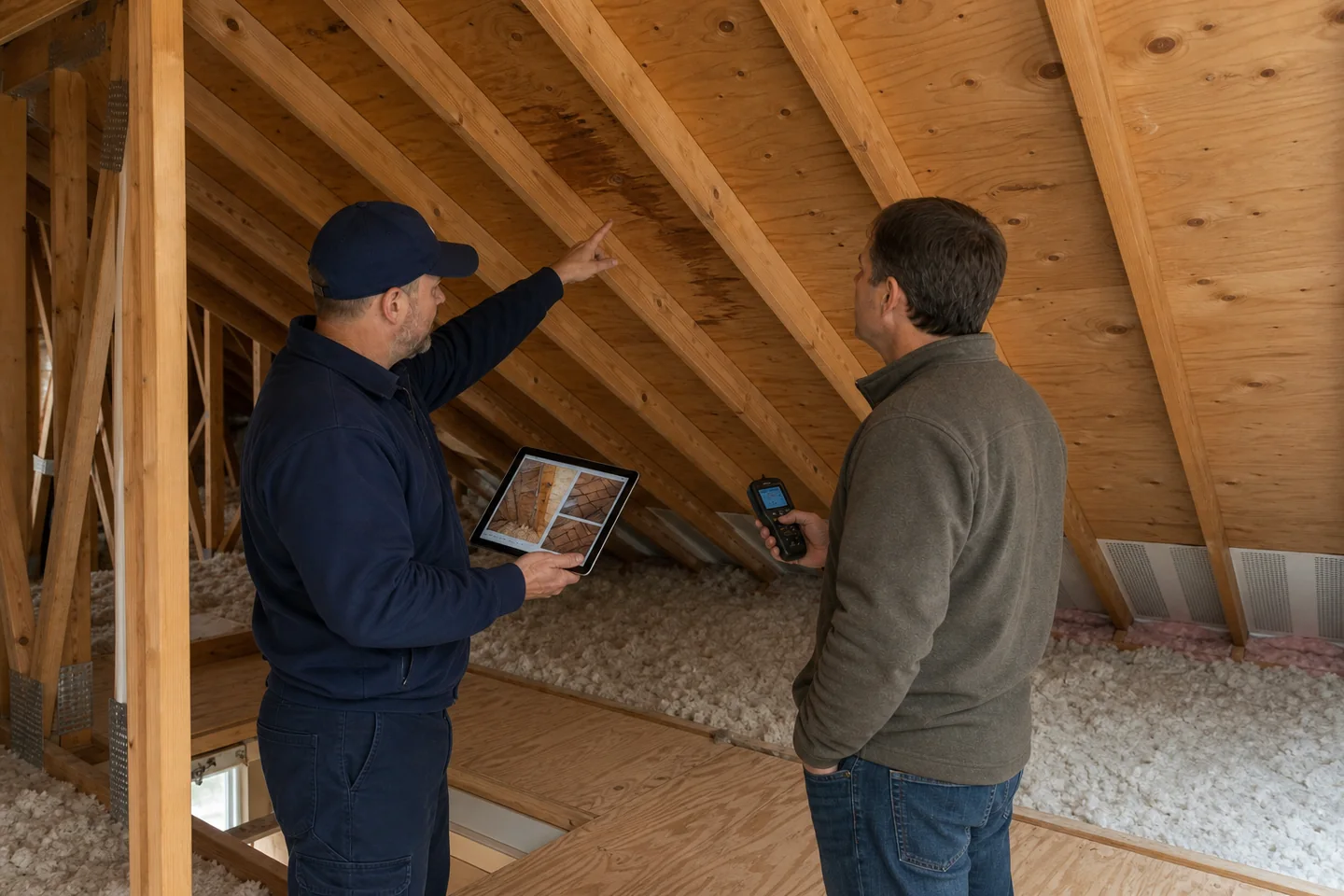
You open the attic and find dark roof sheathing, rusty nail tips, damp insulation, or a musty smell. The first explanation you hear may be, 'You need more vents.' Sometimes that is right. Quite often, it is only part of the story.
Attic moisture can enter through the roof, rise from rooms below, discharge from a bathroom fan, or collect behind blocked airflow. Mold is the consequence, not the diagnosis. Cleaning without correcting the source resets the clock.
The short answer: ventilation is a system, not a vent count
A conventional vented attic needs a reasonably airtight ceiling below, insulation at the attic floor, clear intake openings near the eaves, and exhaust openings higher on the roof. Bathroom, kitchen, and dryer exhaust must terminate outdoors. If one piece is missing, adding a roof vent may not solve the moisture problem.
Here's the thing: air carries moisture. During a cold winter, warm indoor air can leak through an attic hatch, recessed light, wiring hole, plumbing opening, or wall cavity. When it reaches cold sheathing, water vapor can condense or freeze. A roof can be watertight and the attic can still become wet.
Four moisture sources that can look surprisingly similar
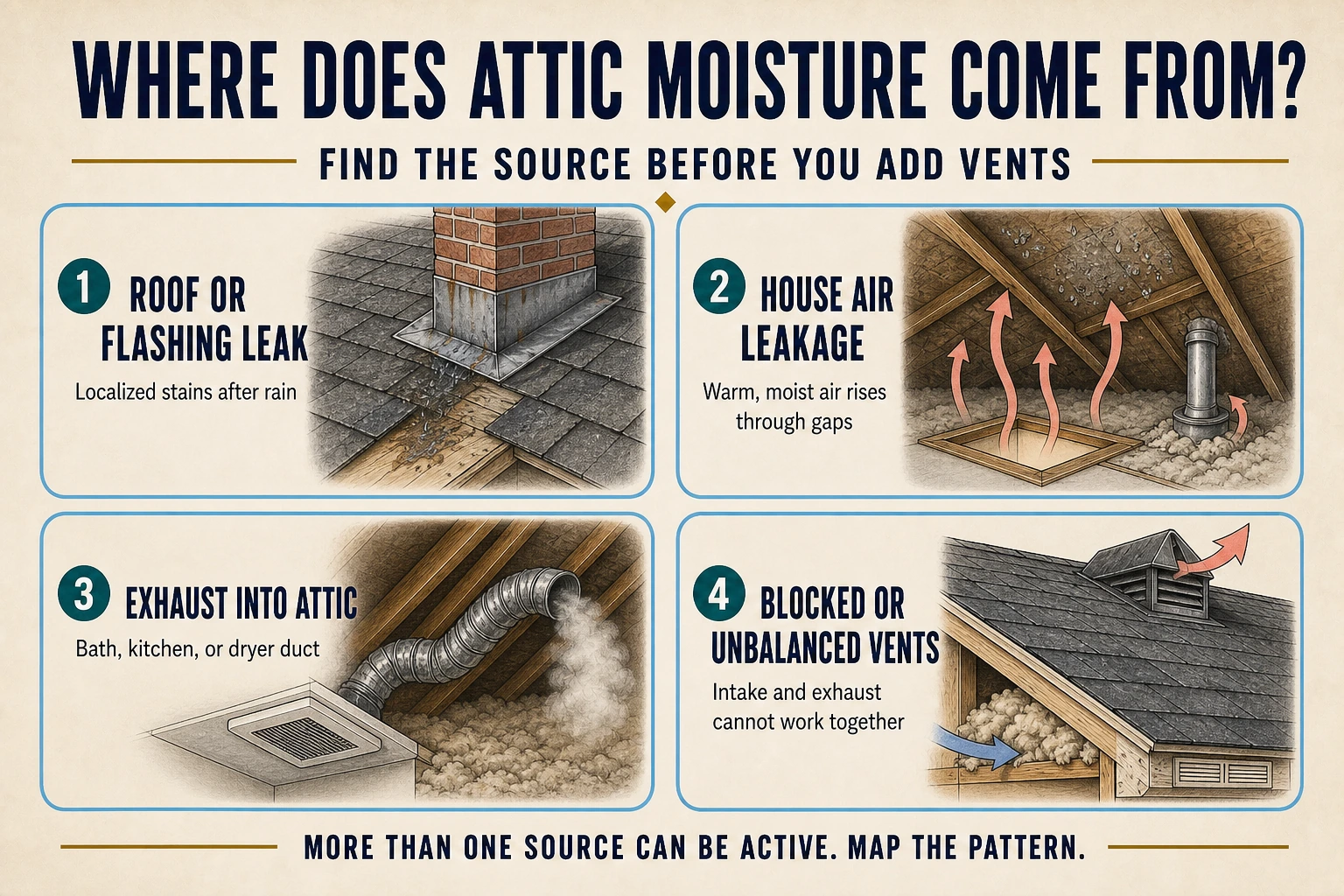
| Possible source | Clues that support it | What should be checked next |
|---|---|---|
| Roof or flashing leak | Localized staining below a valley, chimney, vent, fastener, or damaged roof area; worse after rain | Exterior covering, flashing, underlayment, penetrations, and moisture path |
| Indoor air leakage | Frost or darkening around nail tips and penetrations; broad winter condensation; dirty insulation near gaps | Attic-floor air barrier, hatch, top plates, wiring, plumbing, chases, and indoor humidity |
| Exhaust duct into attic | Concentrated moisture near a bath, kitchen, or dryer duct; loose joint; duct ends inside | Route, insulation, slope, termination, damper, fan operation, and exterior cap |
| Blocked or unbalanced vents | Covered soffit vents, missing baffles, heavy exhaust with little intake, isolated damp roof areas | Net free vent area, intake-to-exhaust balance, baffles, roof geometry, and local code |
More than one source can be active. A flashing leak may wet one section while warm air around the attic hatch creates frost elsewhere. A useful inspection maps the pattern instead of forcing every stain into one explanation.
What a healthy vented attic is trying to do
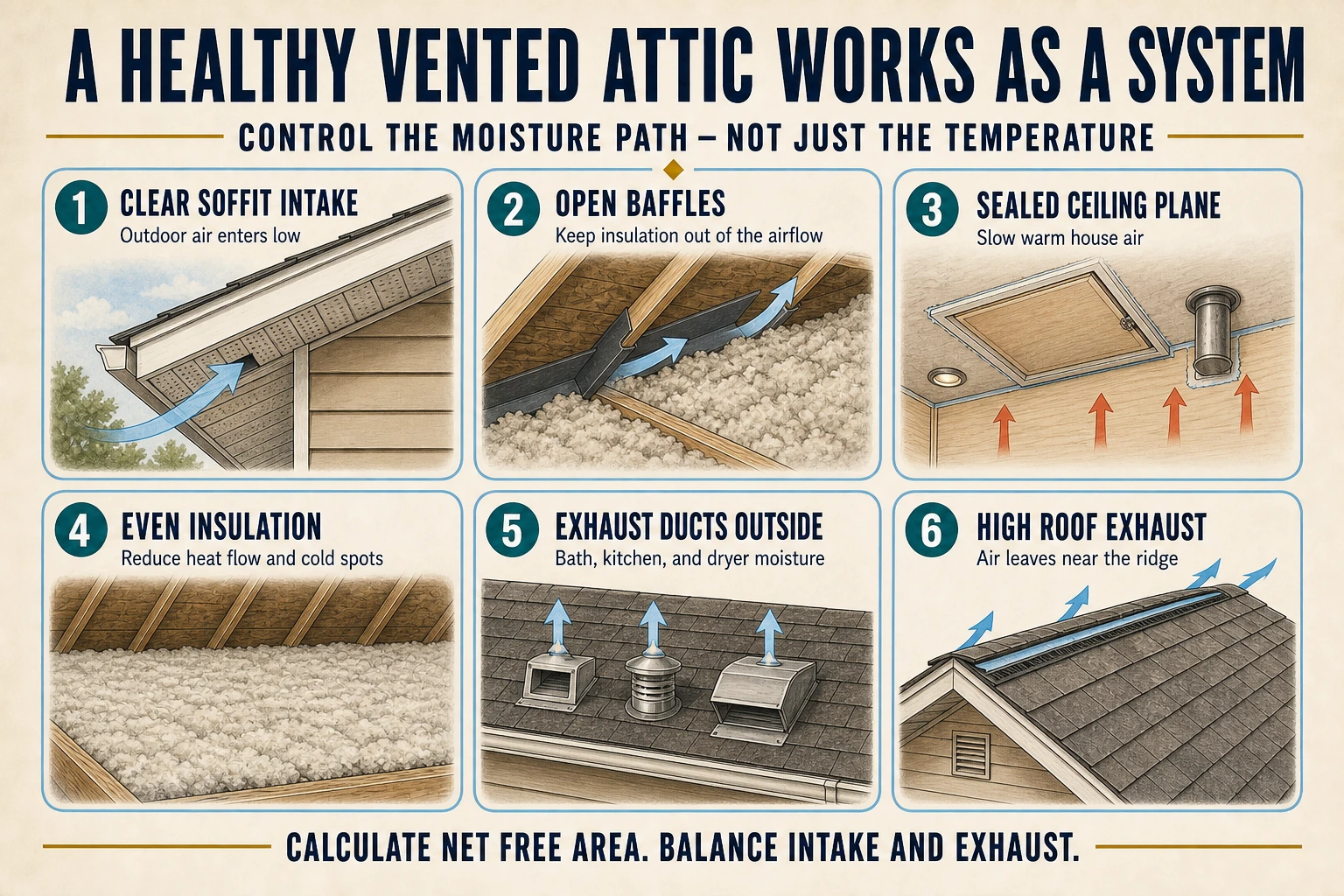
Intake starts low
Soffit or eave vents admit outdoor air near the bottom of the roof. Their published net free area matters more than the visible size of the grille because screens and louvers reduce the actual opening. Intake vents covered by insulation are vents in name only.
Exhaust finishes high
Ridge vents or properly placed upper roof or gable vents let air leave near the high point. Adding exhaust without enough intake can pull air from easier openings, including leaks in the ceiling below. That is one reason a powered fan is not an automatic upgrade.
The attic floor should slow house air
The ceiling plane separates conditioned rooms from the vented attic. Air sealing around hatches, plumbing stacks, wiring, dropped soffits, chimneys, and other penetrations limits the warm, moisture-laden air that reaches cold sheathing. Insulation reduces heat flow, but insulation alone is not an air barrier.
Baffles keep the path open
Baffles, sometimes called rafter vents, preserve a channel between soffit intake and the attic. They also keep loose insulation from drifting into the eaves. The U.S. Department of Energy recommends baffles in rafter bays that have soffit vents.
Moist exhaust belongs outside
A bathroom fan that ends under the insulation or points toward a roof vent is not vented outdoors. The duct should reach an approved exterior termination with appropriate sealing, insulation, slope, and a working damper. DOE guidance specifically warns against dumping bathroom, kitchen, or dryer moisture into the attic.
What roof ventilation ratios actually mean
The your state roof-ceiling rule lists a baseline minimum net free ventilating area of 1 square foot for every 150 square feet of vented attic space. A 1-to-300 ratio is allowed when the stated conditions are met, including how upper and lower ventilation is distributed. Those are code calculations, not a promise that a particular attic will stay dry.
Net free area, or NFA, is the unobstructed opening after screens and louvers are considered. A vent package should show the attic floor area, the ratio being used, each product's published NFA, and the planned split between intake and exhaust. Counting plastic grilles is not a calculation.
Signs worth investigating before mold spreads
| What you notice | What it may suggest | How urgent is it? |
|---|---|---|
| Active dripping or wet insulation | Roof leak, condensation, or duct discharge | Prompt; protect electrical components and identify the source |
| Frost on nails or sheathing | Warm indoor air reaching cold attic surfaces | Investigate air leaks, indoor humidity, insulation, and ventilation |
| Dark or spotted sheathing | Mold, old staining, dirt, soot, or material variation | Document and evaluate moisture; color alone is not a species test |
| Rusty fasteners | Repeated condensation or past wetting | Look for the wider pattern and current moisture readings |
| Musty odor | Possible hidden damp material or microbial growth | Trace the source; avoid running contaminated HVAC equipment |
| Ice dams | Roof warming from air leaks, insulation gaps, or complex heat flow | Address the heat and moisture path, not only the exterior ice |
| Sagging or soft decking | Prolonged wetting, decay, or structural damage | Keep off the roof and obtain prompt professional evaluation |
A five-minute check can narrow the possibilities
From a safe attic platform or access opening, use a flashlight and take wide photos in every direction. Photograph stains with enough surrounding structure to show their location.
- Note whether the condition is localized below a roof detail or spread across several roof planes.
- Check whether bath or dryer ducts end inside the attic, have loose joints, or show condensation.
- Look for insulation blocking soffit vents and for missing, crushed, or displaced baffles.
- Photograph the attic hatch, plumbing and wiring penetrations, recessed fixtures, and open wall chases.
- Record indoor humidity and outdoor conditions; one reading is context, not a complete diagnosis.
- Do not disturb vermiculite insulation, questionable wiring, extensive mold, or weak decking.
Mold testing is often less useful than homeowners expect
If you can see mold-like growth and can identify a moisture problem, a generic test kit often does not change the first steps: stop the moisture, dry the materials, and clean or remove affected material safely. EPA says visible mold usually does not require sampling and notes that there are no federal airborne mold limits for declaring a home compliant.
Testing can make sense when the source is unclear, health or legal questions require a documented protocol, hidden contamination is suspected, or a qualified professional needs post-remediation verification. If testing is proposed, ask what decision the result will change.
Can you clean attic mold yourself?
It depends. EPA says an area smaller than about 10 square feet can often be handled by a homeowner following its cleanup guidance. Attics add complications: limited access, porous sheathing, insulation, nails, wiring, respiratory exposure, and the possibility of a continuing roof or condensation problem.
Professional help is the safer choice for larger or recurring areas, significant water damage, contaminated HVAC components, sewage-related water, structural decay, or anyone with health concerns. CDC says damp and moldy environments may cause no symptoms or may trigger nasal, throat, eye, skin, cough, or wheezing symptoms; people with asthma, mold allergies, immune compromise, or chronic lung disease may face greater risk.
Cleaning without moisture control is not remediation
Painting over growth, fogging the attic, or spraying a chemical does not repair a roof leak, reconnect an exhaust duct, or seal ceiling penetrations. Porous material that cannot be cleaned and dried may need removal. Ask the remediator to define containment, cleaning method, damaged-material removal, drying target, and how the moisture source will be corrected.
The repair order matters
| Order | Action | Why it comes here |
|---|---|---|
| 1 | Stop bulk water and correct unsafe conditions | Drying and cleaning will not hold while water is still entering |
| 2 | Document the moisture pattern and affected materials | The pattern helps separate roof, duct, air-leak, and ventilation causes |
| 3 | Dry, clean, or remove damaged material safely | Mold and wet porous materials need an appropriate scope |
| 4 | Air seal the ceiling plane and route exhaust outdoors | This reduces moisture delivered from the house |
| 5 | Restore calculated intake, exhaust, baffles, and insulation | The designed attic system can work only after the sources are controlled |
| 6 | Verify after cold weather or heavy rain | Follow-up conditions show whether the cause was actually corrected |
Do you need a powered attic fan?
Not necessarily. Passive soffit and ridge ventilation has no motor and can work well when the pathway, sizing, and ceiling air barrier are right. ENERGY STAR warns that an attic fan in a poorly sealed attic with blocked intake can pull conditioned air out of the house, increasing energy use.
A fan may be part of a designed solution for a difficult roof or specific heat and moisture condition, but ask for the intake calculation, controls, electrical scope, and combustion-safety considerations. Do not confuse an attic fan, which ventilates the attic, with a whole-house fan, which moves air through the living space.
What attic moisture work may cost in 2026
These national planning ranges are not local quotes. Access, attic size, pitch, electrical work, contamination, hidden damage, permits, and the number of systems involved can move the price.
| Service | Published 2026 planning range | What the proposal should clarify |
|---|---|---|
| Roof vent installation | $200-$750 per vent; about $475 average | Vent type, count, published NFA, roof cuts, flashing, intake balance, and warranty |
| Ridge vent installation | $300-$650; about $500 average | Linear length, compatible intake, ridge opening, shingle replacement, and weather protection |
| Attic fan installation | $369-$914; about $625 average | Why passive venting is insufficient, intake, controls, wiring, sealing, and operating cost |
| Attic air sealing | $250-$750 in one 2026 guide | Accessible penetrations, insulation handling, combustion safety, and verification |
| Attic insulation | $1,700-$2,500; about $2,100 average | Air sealing first, removal needs, R-value, baffles, ventilation clearance, and depth markers |
| Bathroom vent installation | $240-$560; additional ductwork may cost $250-$950 | Fan capacity, duct material and route, insulation, exterior cap, electrical work, and permit |
| Attic mold remediation | $1,000-$4,000; severe cases may reach $7,000 | Area, containment, material removal, cleaning, drying, source repair, and verification |
Compare scopes by cause. Roof repair, duct correction, air sealing, vent work, insulation, and remediation should be itemized instead of bundled into one unexplained number.
Permits and local requirements
The your local municipality says residential permits are required for reroofing and for many electrical, HVAC, and exterior alterations. A small repair, a new ridge vent during reroofing, a powered fan, and a newly routed bathroom exhaust may not follow the same permit path. Confirm the exact scope with the local building department before work begins.
Local rules differ. The proposal should identify who obtains permits, performs electrical or HVAC work, and provides the final closeout record.
Questions to ask before sharing your contact information
- What evidence points to a roof leak, indoor air leakage, exhaust discharge, or ventilation imbalance?
- Will you provide wide and close photos showing the moisture pattern and each affected roof plane?
- What are the attic floor area, required NFA, installed intake NFA, and installed exhaust NFA?
- Are the soffit vents open, and where are baffles missing or blocked?
- Do all bathroom, kitchen, and dryer ducts terminate outdoors, and are the ducts sealed and insulated?
- What air leaks will be sealed before insulation is added, and how will combustion safety be handled?
- If mold testing is recommended, what decision will the result change?
- Which work stops the source, which work removes damage, and which items are optional upgrades?
- Who handles permits, electrical work, cleanup, final photos, and workmanship warranties?
Frequently asked questions
Does mold in the attic mean the roof is leaking?
No. A roof leak is one possibility, but warm house air, a disconnected exhaust duct, blocked intake vents, or several causes together can create similar staining. The location and timing of moisture matter.
Will adding a ridge vent fix attic moisture?
Only if the attic is intended to be vented, the ridge vent has adequate intake, soffit paths are open, and indoor moisture sources are controlled. Adding exhaust alone may leave the real problem untouched.
Should my attic be the same temperature as outdoors in winter?
A vented attic is generally intended to stay cold, but there is no single temperature difference that diagnoses every house. Sun, snow cover, ducts, insulation, air leakage, and roof design all affect readings.
Is black staining always toxic black mold?
No. Color does not identify a mold species or its health risk, and some dark areas may be old staining, dirt, or soot. Visible growth still deserves moisture correction and safe cleanup.
Do I need an air test before mold removal?
Usually not for visible growth. EPA says sampling is often unnecessary and there are no federal airborne mold limits. Testing should answer a defined question rather than serve as an automatic add-on.
Can I put new insulation over damp or moldy insulation?
Do not bury a moisture problem. Wet material needs drying or removal as appropriate, the source must be corrected, and air sealing and ventilation paths should be addressed before the final insulation layer.
Can an attic fan make moisture worse?
It can if intake is inadequate or the ceiling below leaks air. The fan may pull more warm, moist house air into the attic. Ask for a system calculation rather than choosing a fan by wattage alone.
Who should inspect the problem?
The cause may cross trades. A roofer can assess exterior water entry and roof vents; a home-performance or insulation professional can evaluate air leakage and thermal details; an HVAC contractor handles exhaust routing; and a qualified remediator addresses larger mold scopes.
The practical next step
Do not start with the product. Start with the moisture path. A useful assessment should explain where the water came from, why it collected, what material was affected, and how the proposed work prevents a repeat.
If the answer is 'more vents,' ask for the math. If the answer is 'mold treatment,' ask how the source will be fixed. If the answer is 'new insulation,' ask what happens before it is installed. Those questions keep a reasonable repair from turning into a cycle of repeated work.
Sources
U.S. Department of Energy: Consumer Guide to Durable Attics
Building Science Education: Air Sealing Attic Access
Building Science Education: Baffles
Building Science Education: Eaves Sealed in Cold Climates
ENERGY STAR: About Attic Ventilation
ENERGY STAR: Attic Air Sealing Project
U.S. EPA: Mold Cleanup in Your Home
U.S. EPA: Mold Testing or Sampling
U.S. EPA: Biological Contaminants and Indoor Air Quality
CDC: Mold and Possible Health Effects
applicable state and local codes: Rule 4101:8-8-01, Roof-Ceiling Construction
your local municipality: Department of Building and Housing
Angi: Roof Vent Installation Cost (2026)
Angi: Ridge Vent Installation Cost (2026)
Angi: Attic Fan Installation Cost (2026)
Angi: Attic Insulation Cost (2026)