How Much Does a New Roof Cost?
Realistic 2026 planning ranges, the costs that quotes often leave unclear, and how to compare roof estimates fairly
If you have searched for the price of a new roof, you have probably seen numbers that are thousands of dollars apart. One calculator says a your local area roof costs around $7,000. A contractor's guide says $15,000. Your neighbor paid something else entirely.
That does not automatically mean someone is being dishonest. It usually means the estimates are pricing different roofs, different materials, or different scopes. The useful question is not just, 'What is the average?' It is, 'What should be included for a roof like mine?'
The short answer: plan for a range, not one magic number
For a conventional asphalt-shingle replacement in your area, a practical early planning range is roughly $8,000-$20,000 for many ordinary single-family homes. A small, simple, walkable roof may come in below that range. A large, steep, cut-up roof with premium shingles or extensive wood replacement can go well above it.
That $8,000-$20,000 band is a planning synthesis, not a quote. Current online benchmarks illustrate why. HomeYou's your local area page lists about $6,262-$8,078 for its modeled project, while its broader 2026 replacement guide lists $9,548-$19,327 nationally. Other local published guides reach roughly $21,000 for standard homes. The spread is the point: you need the measured roof and the written scope before an average becomes useful.
A local starting point by measured roof area
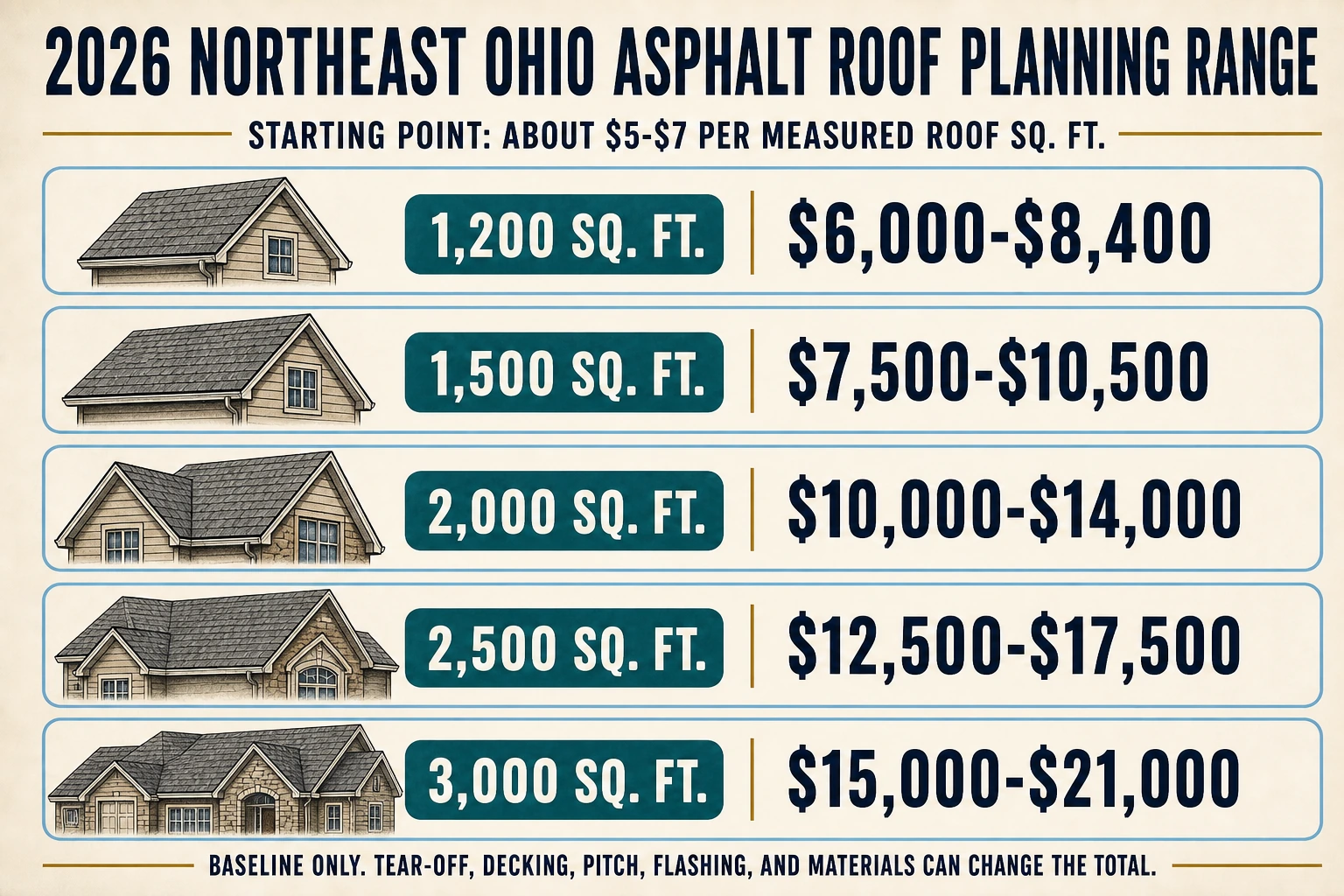
HomeYou's current your local area and your local area cost pages use a starting benchmark of about $5-$7 per square foot for shingle installation. Applied to measured roof surface area, that produces the planning table below. It is best used as a baseline for a straightforward asphalt-shingle job, not as a promise that tear-off, damaged decking, difficult access, premium products, or every roof detail is included.
| Measured roof surface | Baseline at $5-$7 per sq. ft. | What can move it higher |
|---|---|---|
| 1,200 sq. ft. (12 squares) | $6,000-$8,400 | Small-job minimums, steep pitch, two layers, garage tie-in, or deck repair |
| 1,500 sq. ft. (15 squares) | $7,500-$10,500 | Dormers, valleys, chimney flashing, access, or upgraded shingles |
| 2,000 sq. ft. (20 squares) | $10,000-$14,000 | Complex geometry, ventilation correction, skylights, or wood replacement |
| 2,500 sq. ft. (25 squares) | $12,500-$17,500 | Multiple stories, steep sections, premium system components, or extra tear-off |
| 3,000 sq. ft. (30 squares) | $15,000-$21,000 | Large crews, staging, extensive flashing, carpentry, or specialty materials |
A roofing 'square' means 100 square feet of roof surface. It does not mean 100 square feet of living space. Ask the estimator to show the measured roof squares and the waste factor separately so you know what the price is based on.
Why your home's square footage is a poor shortcut
A 1,600-square-foot ranch and a 1,600-square-foot two-story house can have very different roof areas. Add a garage, porch, overhangs, dormers, valleys, or a steep pitch, and the gap gets wider.
Most professional estimates use aerial measurements, field measurements, or both. The proposal should state the roof area, not make you reverse-engineer it from a total price. If two contractors measure 20 and 27 squares on the same straightforward roof, ask them to explain the difference before comparing cost per square.
What a complete asphalt-shingle replacement should spell out
Here is the thing: 'new roof' is not a standardized package. One bid may include full tear-off, new flashing, ridge ventilation, and a workmanship warranty. Another may cover little more than shingles and labor.
- Removal of the existing roof covering, number of layers included, disposal, and dump fees.
- Inspection of the exposed deck and a written unit price for replacing damaged plywood or boards.
- Underlayment plus ice-and-water protection at the locations required by code and the selected system.
- Drip edge, starter shingles, field shingles, and matching hip-and-ridge shingles by product name.
- New or reused flashing at walls, valleys, chimneys, skylights, plumbing stacks, and other penetrations.
- Attic intake and exhaust work, including the reason for any change and the ventilation calculation.
- Permit responsibility, property protection, magnetic nail cleanup, final inspection, and debris removal.
- Manufacturer material coverage and the contractor's separate workmanship warranty.
The National Roofing Contractors Association recommends detailed proposals that identify materials, removal, flashing, ventilation, installation method, schedule, payment procedure, and warranty. If a low bid leaves those items blank, it is not yet an apples-to-apples price.
The seven cost drivers that matter most
1. Roof size, height, pitch, and access
More roof area means more shingles, underlayment, labor, and disposal. Steep or high roofs require slower work and more safety equipment. Tight driveways, landscaping, limited dumpster placement, and difficult material delivery can also add labor.
2. Tear-off layers and disposal
Removing one layer from a simple roof is different from stripping multiple layers, old felt, and embedded fasteners. Re-covering the old shingles can appear cheaper, but it hides the deck and may not be permitted or warranty-compatible. NRCA notes that code often limits how many roof coverings may be installed before a full replacement is required.
3. Decking you cannot fully see yet
Soft, delaminated, or widely spaced decking may not be clear until the shingles come off. This is where estimates can change legitimately - and where vague contracts create arguments. Ask for the included amount, the per-sheet or per-board price, who approves additional work, and how it will be photographed.
4. Flashing, chimneys, skylights, and valleys
A plain gable roof has fewer details than a roof with several valleys, a masonry chimney, wall intersections, skylights, and low-slope transitions. Those details take time and are common leak locations. Reusing serviceable flashing can be reasonable in some systems; automatically reusing everything to hold down the bid is a different decision.
5. Ventilation, soffits, and roof-edge repairs
A ridge vent does not work well without adequate intake, and cutting in more exhaust is not a substitute for checking the attic system. Rotten fascia, damaged soffits, blocked intake, bathroom ducts ending in the attic, or missing baffles can add scope. The proposal should separate necessary roof work from optional ventilation or exterior upgrades.
6. Shingle line and complete roofing system
Basic three-tab shingles, mainstream architectural shingles, designer shingles, and impact-rated products do not cost the same. The shingles are only one part of the system. Starter, underlayment, ice barrier, ridge caps, vents, fasteners, and installation requirements affect the final price and warranty eligibility.
7. Season, schedule, and weather protection
Roofing in your area can be done outside peak summer, but cold temperatures affect handling and sealing requirements. A responsible cold-weather plan may include careful storage, hand-sealing where required, and smaller daily tear-off areas. A rushed emergency schedule after a major storm may also cost more than a planned replacement.
Why do roofing costs vary by market?
Not necessarily. Current your local area and your local area benchmarks are close enough that the individual roof usually matters more than the city name. your local area, your local area, Warren, and nearby communities may have different permit procedures and contractor rules, but every useful estimate still starts with roof measurement and scope.
Repair, re-cover, or full tear-off?
| Option | When it may make sense | What to verify |
|---|---|---|
| Targeted repair | A localized issue on an otherwise serviceable roof | Roof age, matching materials, flashing condition, deck damage, and repair warranty |
| Re-cover | A code- and manufacturer-permitted roof with one suitable existing layer | Layer count, deck condition limits, added weight, flashing details, appearance, and warranty |
| Full tear-off | Widespread wear, leaks, uncertain deck, multiple layers, or a complete system upgrade | Removal scope, deck allowance, dry-in plan, components, ventilation, cleanup, and closeout |
A single leak does not prove you need a full roof. It could be failed flashing, a damaged penetration, or a small wind-damaged area. On the other hand, repeated repairs on a brittle, aging roof can become expensive without buying much time. Ask the inspector to separate the local defect from the condition of the whole system.
The decking allowance deserves its own line
Many homeowners focus on the shingle brand and miss the biggest unknown: the wood underneath. One quote may include a few sheets. Another may charge for every sheet. A third may say 'wood extra' without a price.
So what should you actually do? Ask every bidder to use the same format: number of sheets or board feet included, unit price beyond the allowance, approval method, and photo documentation. You may still have a change order, but it should not be a surprise formula invented after the roof is open.
How to compare three roof quotes without getting lost
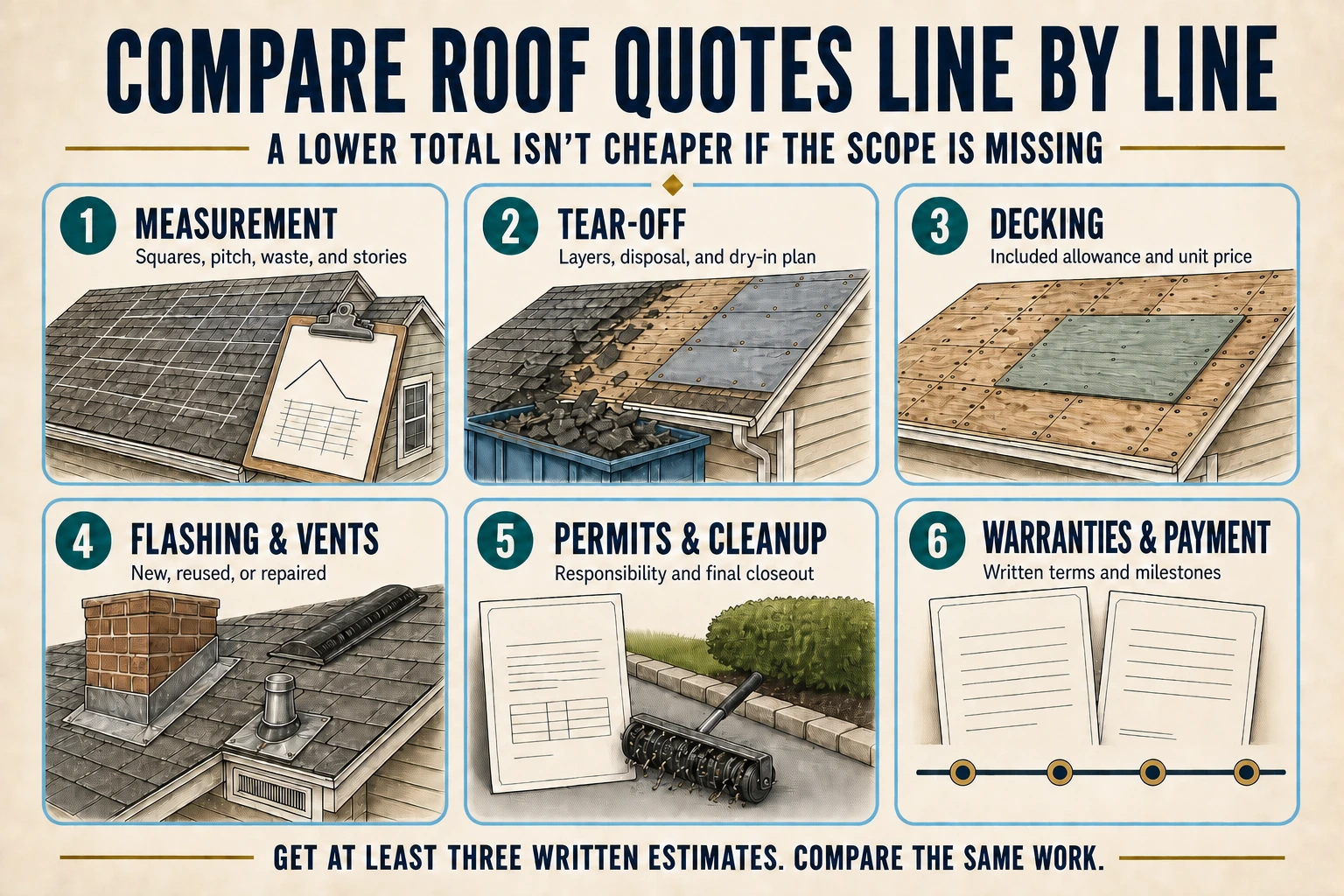
| Compare this | Good evidence | Red flag or open question |
|---|---|---|
| Measurement | Roof squares, pitch, waste, stories, and diagram | Only the home's living area or a round total |
| Tear-off | Layer count, disposal, deck inspection, and dry-in plan | Removal assumed but not written |
| Materials | Manufacturer and exact product lines for every component | 'Lifetime shingle' with no product name |
| Decking | Included allowance plus unit prices and approval process | 'Additional wood as needed' with no price |
| Flashing | New, reused, or repaired details listed by location | No mention of chimney, walls, valleys, or skylights |
| Ventilation | Existing and proposed intake/exhaust calculation | More roof vents with no intake review |
| Permits | Responsible party, fee treatment, and inspection closeout | Homeowner told to handle permits without explanation |
| Warranty | Separate material and workmanship terms in writing | A verbal 'lifetime' promise |
| Payment | Milestones tied to materials, progress, and completion | Full payment, cash, or wire transfer demanded upfront |
A higher quote can be the better value if it includes necessary details that the lower quote omits. It can also simply be overpriced. The written scope is what lets you tell the difference.
What about metal roofing?
Metal usually costs more upfront than asphalt, but exposed-fastener panels and concealed-fastener standing seam are not equivalent. Compare the same tear-off, decking, ventilation, trim, penetration, warranty, and permit scope. A complete asphalt system cannot be compared fairly with a metal panel price that excludes trim or substrate work.
Will insurance pay for a new roof?
Insurance may cover sudden damage from a covered event, subject to your policy, deductible, exclusions, depreciation, and documentation. It generally does not turn normal aging or neglected maintenance into a covered loss.
Do not let a contractor promise that the roof will be 'free' or that your deductible can disappear. Photograph damage, contact your insurer, read the estimate line by line, and keep invoices and change orders. The contractor's job is to price and perform legitimate work; the insurer decides coverage under the policy.
Permits and contractor requirements are local
The your local municipality says a residential permit is required to reroof a home. your local area also lists roofs among projects that need building permits and requires home-improvement contractors working on one-, two-, and three-family homes to be licensed locally. your local area-area projects commonly run through Summit County Building Standards, but jurisdiction depends on the exact address.
Your state does not impose one statewide home-improvement-contractor license for every residential roofing job, although many cities register or license contractors. Before signing, confirm the permit office, contractor registration, liability insurance, workers' compensation status, and who schedules inspections.
How much should you pay upfront?
There is no universal deposit. Use a written, proportionate payment schedule tied to clear milestones. The Federal Trade Commission and your state Attorney General warn against full payment upfront and recommend written estimates, proof of insurance, and a detailed contract. your state's three-business-day cancellation right applies to many home-solicitation sales, but not every contract, so review the notice and exceptions.
Questions to ask before giving anyone your contact information
- Is this an on-site estimate, an aerial estimate, or only a preliminary online range?
- How many roof squares, what pitch, and what waste percentage are you pricing?
- How many existing layers are included in tear-off and disposal?
- What decking allowance is included, and what are the written unit prices for more?
- Which exact shingle, underlayment, ice barrier, starter, ridge cap, flashing, and vent products are included?
- Will chimney, wall, valley, skylight, and pipe flashing be replaced or reused?
- What permit and inspection does my exact address require, and who handles it?
- What is covered by the manufacturer warranty, and what is covered by your workmanship warranty?
- What could become a change order, and who must approve it before the work continues?
- What are the deposit, progress-payment, final-payment, cleanup, and lien-release terms?
Frequently asked questions
How accurate is an online roof-cost calculator?
It can be useful for early budgeting, especially if it uses measured roof area. It cannot see layers, soft decking, flashing, access, ventilation, or local permit details. Treat it as a screening range until someone inspects the property and writes the scope.
How long does a typical roof replacement take?
Many straightforward asphalt-shingle roofs can be completed in a few working days, but size, pitch, crew, weather, wood repair, inspections, and specialty details can extend the schedule. Ask how the home will be protected if work spans overnight or rain is forecast.
Are gutters included in a new roof price?
Usually not unless the proposal says so. Gutter removal, reinstallation, replacement, guards, fascia repair, and downspout work should be listed separately.
Does a more expensive shingle always mean a better roof?
No. Product quality matters, but correct deck preparation, flashing, fastening, ventilation, and installation matter too. A premium shingle cannot compensate for weak details.
Is the lowest roof quote a bad choice?
Not necessarily. A lean local contractor may price efficiently. The bigger question is whether the measurement, materials, labor, permits, insurance, cleanup, warranties, and change-order rules are truly equivalent.
Why did the price change after tear-off?
The most common legitimate reason is concealed deck or structural damage. The contract should already state unit prices and approval rules. A large unexplained increase with no photos, measurements, or written change order deserves scrutiny.
The practical next step
Start with the roof, not the average. Get the measured area, layer count, deck condition, flashing details, ventilation needs, and material system into writing. Then compare at least three estimates line by line.
You do not have to choose the cheapest bid or the most expensive one. You need the proposal that explains the roof you have, the work it needs, what could change, and who stands behind the installation.
Sources and pricing methodology
Pricing was reviewed in August 2026. Online cost pages are planning tools, not bids. The article's $8,000-$20,000 working range is an editorial synthesis of current local and national published ranges, with explicit allowances for the fact that roof size and scope differ. The size table is simple arithmetic using the $5-$7 per-square-foot starting benchmark published on current your local area and your local area HomeYou pages.
HomeYou: Roof Replacement in your local area, your state - 2026 Costs
HomeYou: Roofing Contractors in your local area, your state - Cost Breakdown
HomeYou: Roofing Cost Guide 2026
National Roofing Contractors Association: Homeowner Roofing Resources
your local municipality: Department of Building and Housing
City of your local area: Building Department
Your state Attorney General: Home Improvement Consumer Tips
Your state Attorney General: Three-Day Cancellation FAQ
Federal Trade Commission: How to Avoid a Home Improvement Scam
applicable state and local codes: Residential Roof Assemblies and Coverings