How Long Does a Roof Last—and When Should You Replace It?
Material lifespans, warning signs, 2026 costs, and a practical repair-versus-replacement decision
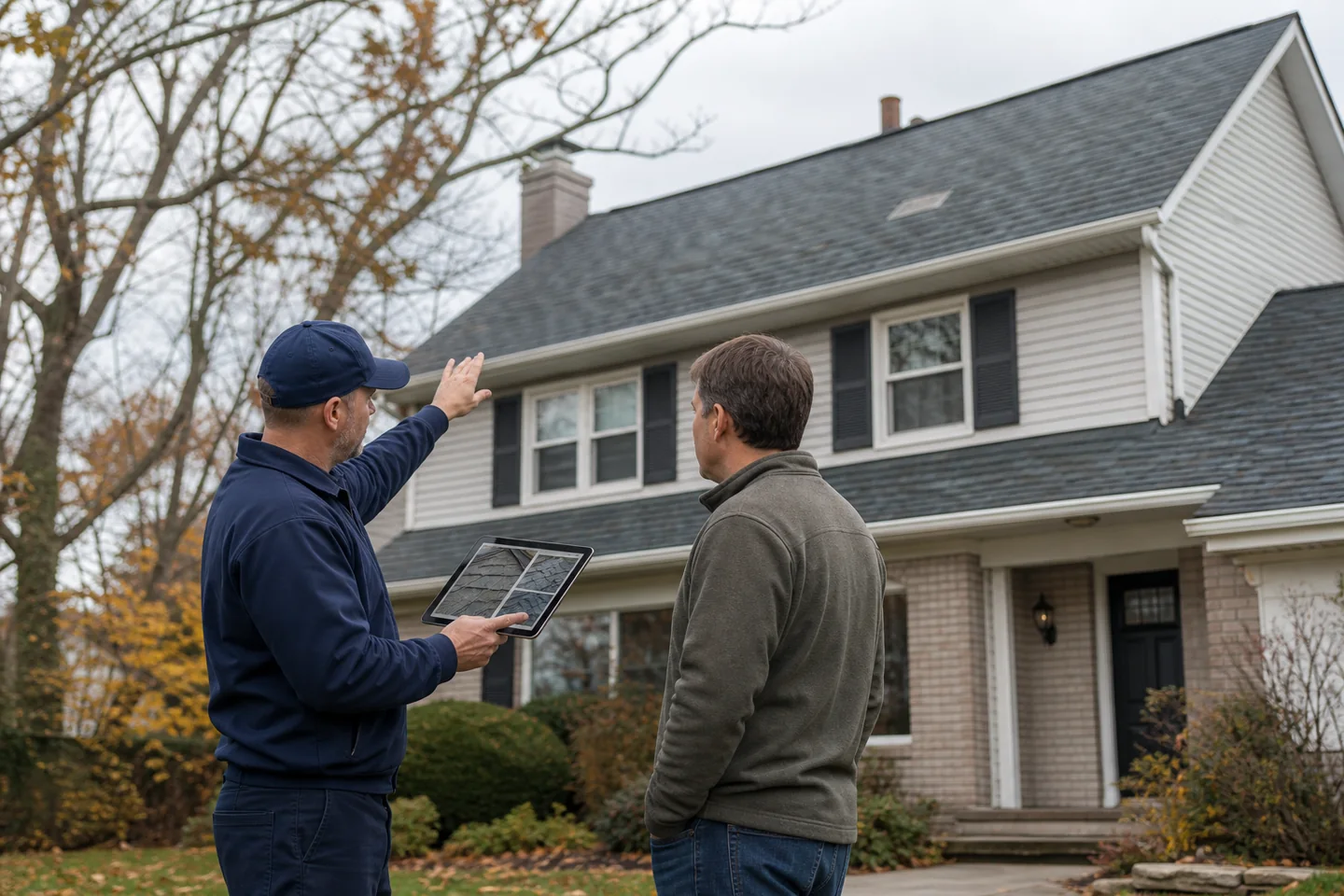
If your roof is approaching 20 years old, you may be hearing two very different messages. One says to replace it before it leaks. The other says that age is just a number and you should leave it alone until there is a problem.
Age helps you plan, but it does not diagnose worn shingles, failed flashing, poor ventilation, storm damage, or weak decking. A well-installed roof can remain serviceable near the upper end of its expected range. A newer roof can fail early if the materials, details, or attic conditions are wrong.
The short answer: most asphalt roofs are planned in decades, not by one expiration date
GAF's residential guidance places asphalt shingles at roughly 20 to 30 years and metal roofing at 50 years or more. Those are broad planning ranges, not promises for a specific your local area, your local area, your local area, your local area, or Warren home.
A standard asphalt roof that is 12 years old and has one damaged flashing detail may need a focused repair. A 22-year-old roof with widespread cracking, repeated leaks, soft decking, and several previous patches may be a better replacement candidate. The condition pattern matters more than the birthday alone.
Here's the thing: a roof is a system. The visible covering is only one part. Underlayment, flashing, decking, ventilation, fasteners, valleys, drip edge, and penetrations all affect whether water stays outside.
How long common roofing materials may last
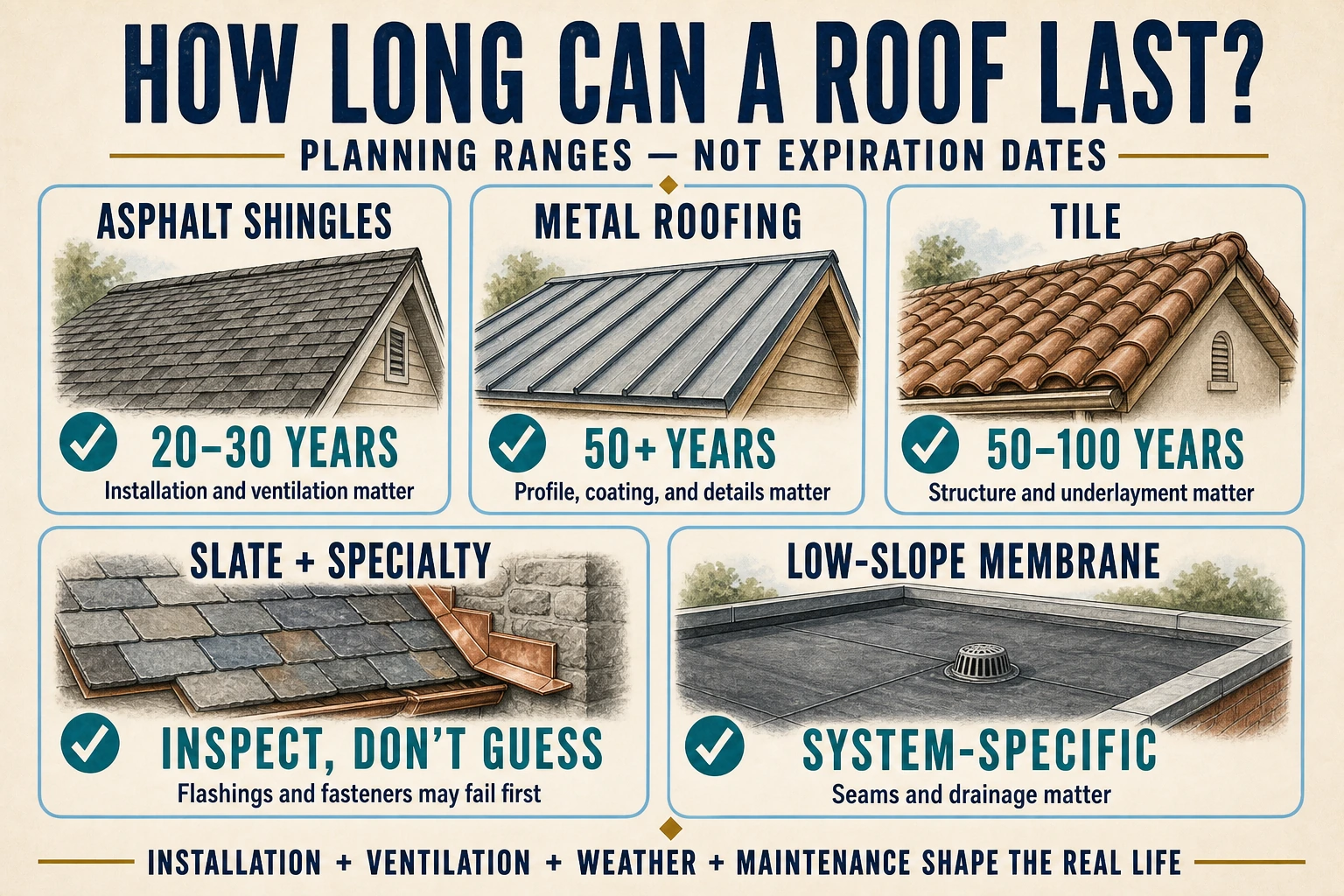
| Roof covering | Published planning life | What usually decides the real outcome |
|---|---|---|
| Asphalt shingles | About 20-30 years | Shingle grade, installation, ventilation, exposure, maintenance, and repairs |
| Metal roofing | 50 years or more | Metal and coating, seam or fastener design, flashing, corrosion exposure, and workmanship |
| Clay or concrete tile | About 50-100 years | Structure, freeze-thaw suitability, broken units, flashing, and underlayment condition |
| Slate or historic specialty roof | Potentially many decades | Slate quality, fasteners, flashings, substrate, and specialist repairs; avoid judging only by age |
| Low-slope membrane | System-specific | Membrane type, seams, drainage, penetrations, ponding, installation, and maintenance |
Why seasonal weather can shorten—or expose—the roof's weak points
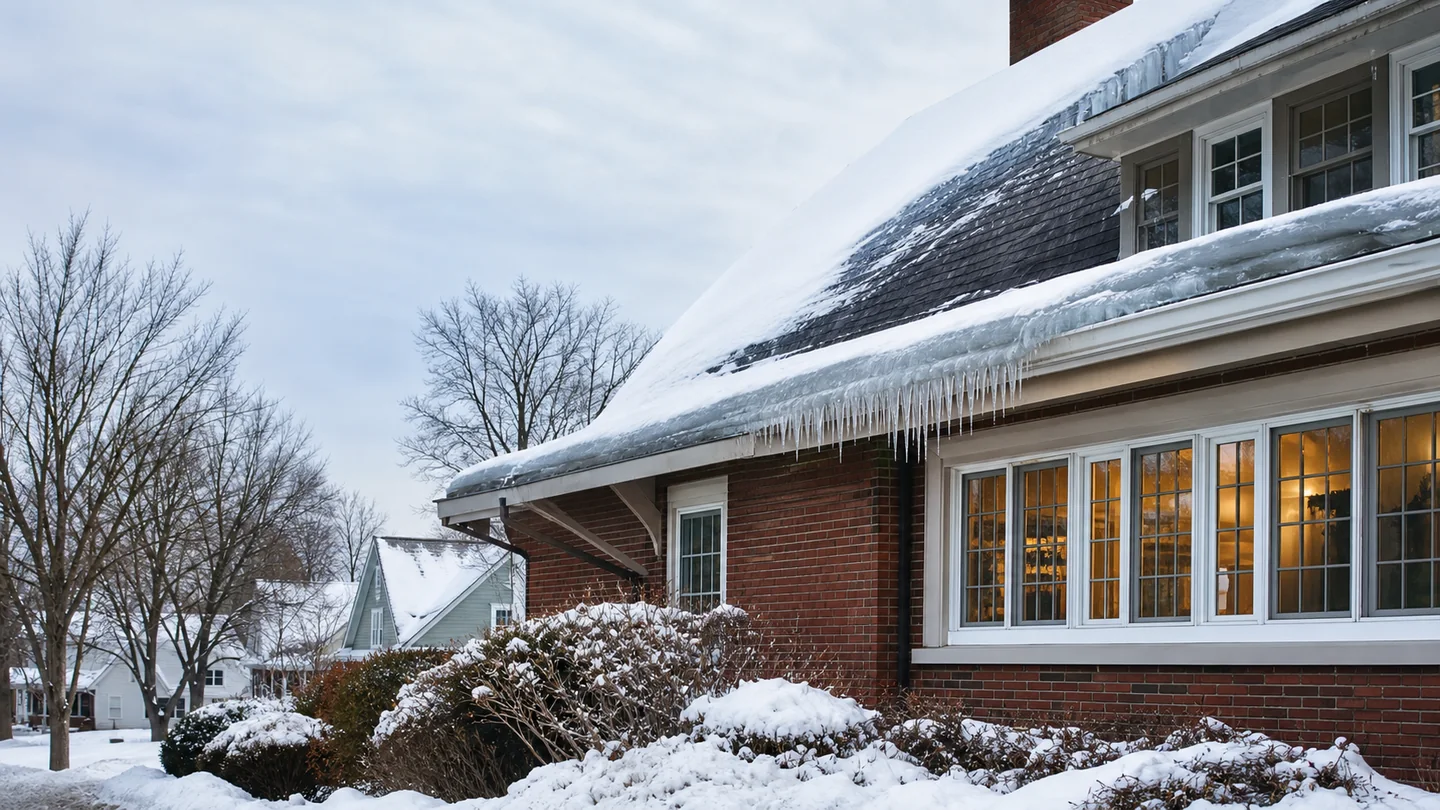
your local area's National Weather Service climate normals include about 63.8 inches of snow in a typical year. Snow by itself does not mean a roof is failing, but repeated wetting, freezing, thawing, wind, and temperature swings test every edge, seam, nail, and flashing detail.
Freeze-thaw cycles punish small openings
Water that reaches a crack or poorly sealed detail can freeze, expand, and reopen the path. Valleys, chimney flashing, skylights, plumbing vents, sidewalls, and eaves deserve more attention than the middle of an otherwise uniform roof.
Ice dams are often an attic problem as well as a roof problem
The U.S. Department of Energy explains that heat escaping into a vented attic can warm the roof deck, melt snow, and let the water refreeze at colder eaves. Air sealing, insulation, ventilation, and appropriate eave protection work together. Replacing shingles without addressing the heat path may leave the cause in place.
Wind reveals weak sealing and edge details
Lifted tabs, missing shingles, loosened ridge caps, and damage along rakes or eaves may appear after a storm. One localized patch can make sense on a younger roof. Repeated lifting across several slopes suggests a broader installation, aging, or exposure issue that should be documented.
Shade and debris keep parts of the roof wet
Leaves in valleys, clogged gutters, and overhanging branches can slow drainage and hold moisture. Dark staining or moss is not automatic proof that the entire roof has failed, but heavy growth can hide surface condition and signal a maintenance or drainage problem.
Seven signs that matter more than the calendar
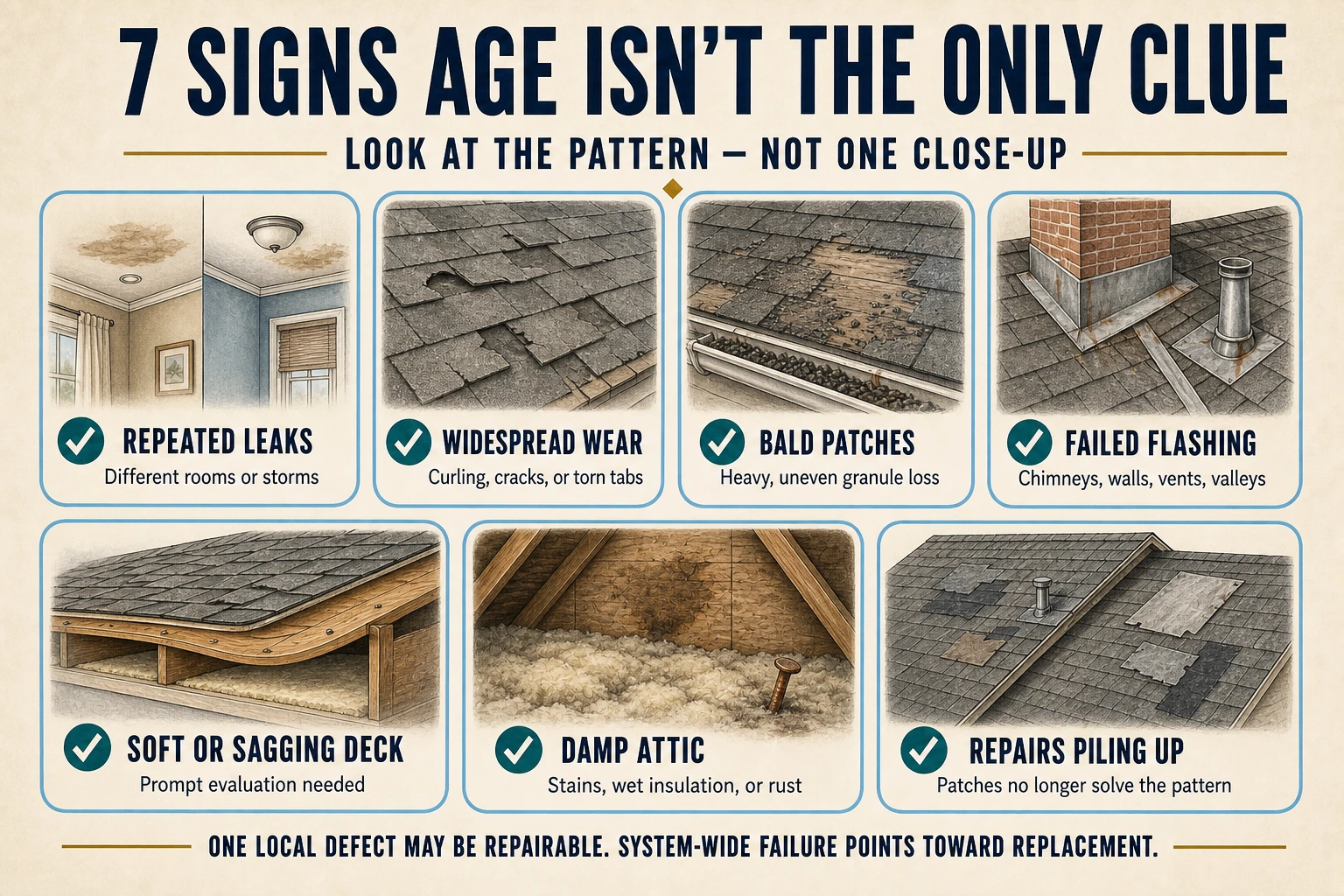
1. Leaks are recurring or appearing in different places
One traceable leak around a boot or flashing detail may be repairable. Water showing up in multiple rooms, after different storms, or despite previous repairs suggests that the failure is no longer isolated. Remember that water can travel along decking or framing before it becomes visible inside.
2. Shingle damage is widespread
A few missing shingles after wind do not automatically require replacement. Curling, cracking, torn tabs, exposed mat, or loss across several roof planes is a different pattern. Ask for wide photos that show the distribution, not only close-ups of the worst shingle.
3. Granule loss is heavy and uneven
Some loose granules are normal, especially around installation and as shingles age. Bald patches, exposed asphalt, or concentrated granules in gutters combined with other wear are more meaningful. Granules alone should not become a sales script without roof-wide context.
4. Flashing and penetrations keep needing attention
Chimneys, skylights, vent pipes, wall intersections, and valleys interrupt the roof covering. If sealant is doing the job that shaped flashing should do, or repairs keep failing at the same detail, ask whether the assembly needs to be rebuilt instead of caulked again.
5. The decking feels soft, sags, or shows daylight
Visible sagging, soft decking, daylight through the roof boards, or decayed wood calls for prompt professional evaluation. The concern may extend beyond the covering to moisture damage or structure. Do not climb onto a questionable roof to confirm it yourself.
6. The attic shows moisture that the roof surface does not explain
Damp insulation, darkened sheathing, rusted fasteners, condensation, or a musty odor can point to leakage, air movement, or ventilation trouble. A roof estimate that never considers the attic may miss why the system aged early.
7. Repairs are becoming a pattern instead of a solution
A roof can be repairable and still be a poor repair investment. Add the recent repair history, the remaining condition, and the likely next weak points. If each visit addresses another failing area on an older roof, replacement may provide a clearer endpoint.
Repair or replace? Use the pattern, not a slogan
| What the inspection finds | Repair may make sense when | Replacement becomes easier to justify when |
|---|---|---|
| Localized storm or flashing damage | Damage is confined, matching material is available, and the surrounding roof remains sound | Damage crosses several planes or exposes broad deck and underlayment problems |
| Older asphalt shingles | Wear is limited, leaks are traceable, and the repair has a realistic service life | Cracking, curling, granule loss, patches, and leaks are widespread |
| Leak near chimney, vent, or skylight | The covering is sound and the failed flashing can be rebuilt correctly | Several details have failed or the surrounding deck and shingles are deteriorated |
| Attic moisture or ice dams | The roof is sound and air sealing, insulation, ventilation, or a local detail can be corrected | Decking and covering are damaged and the assembly needs coordinated rebuilding |
| Metal or slate issue | A specialist can replace limited panels, fasteners, flashings, or individual units | Corrosion, seam failure, substrate damage, or incompatible past repairs are extensive |
What a useful roof inspection should cover
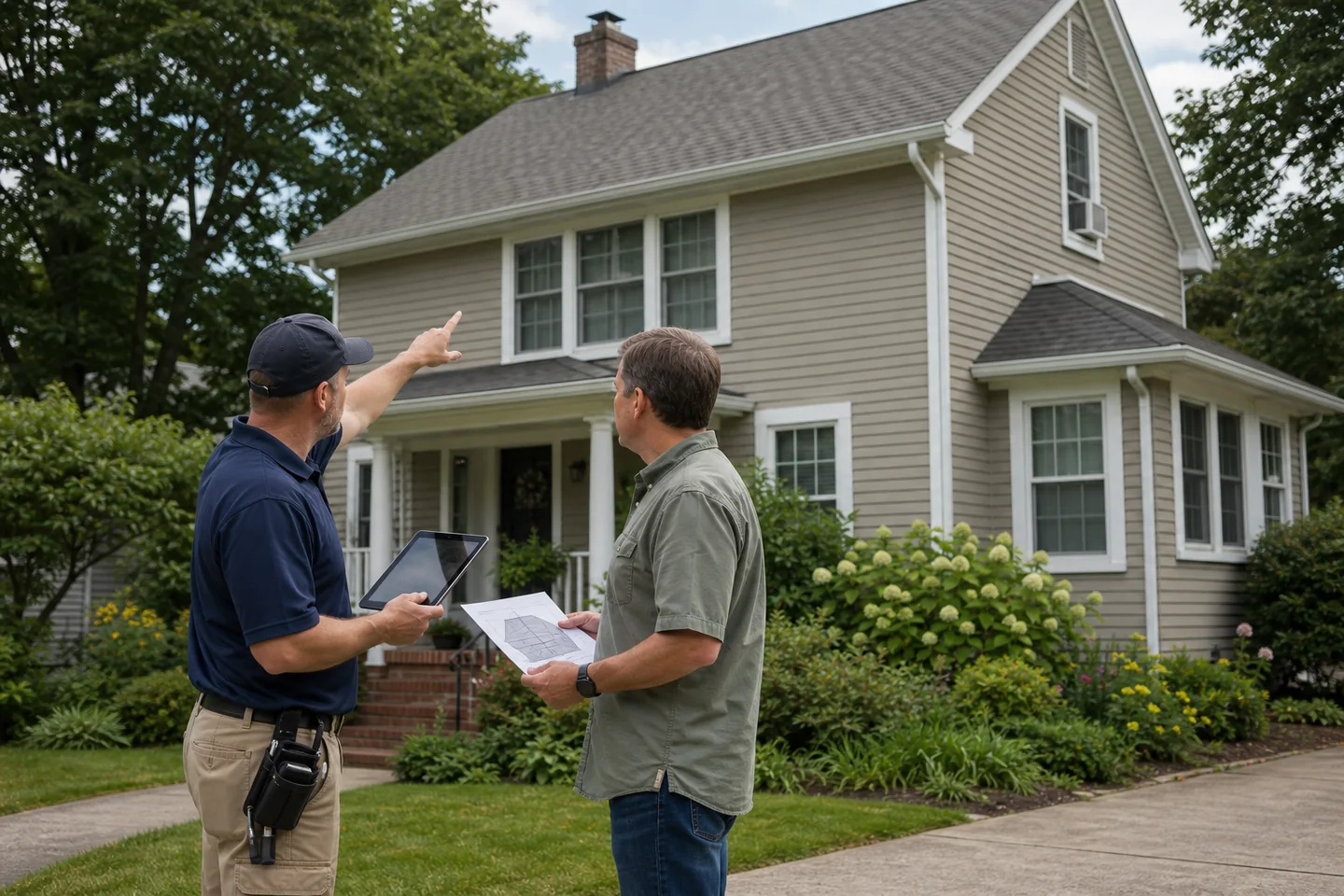
A free estimate and a paid inspection are not always the same service. An estimate prices a proposed job. A fuller inspection is intended to identify condition and may include a written report, photos, attic observations, and documentation needed for a sale, warranty, or insurance discussion.
- Roof age, material, number of layers, and known repair or leak history
- Wide and close photos of every accessible slope, ridge, valley, eave, rake, and penetration
- Shingle or panel condition, fasteners, seal strips, flashings, drip edge, and roof-to-wall transitions
- Gutters and downspouts where drainage or granule collection affects the diagnosis
- Accessible attic signs such as damp decking, stains, ventilation paths, insulation gaps, and daylight
- Decking condition and a written unit price for replacement discovered after tear-off
- A clear statement of what can be repaired, what should be monitored, and what supports replacement
Stay off the roof. Steep slopes, brittle materials, wet surfaces, frost, and hidden weak decking make homeowner roof walks risky. Ground photos, binoculars, attic observations, and professional access are safer ways to start.
What roof work may cost in 2026
Published numbers are national planning ranges, not promises for a your area address. Roof area is not the same as floor area, and pitch, height, valleys, dormers, chimneys, tear-off layers, access, decking, ventilation, and material all affect the quote.
| Service | Published 2026 planning range | What to confirm |
|---|---|---|
| Standard roof inspection | $125-$358; about $252 national average | Whether attic access, photos, written findings, certification, drone work, or infrared imaging is included |
| Roof repair | $395-$1,966; about $1,173 average | The exact failure, repair area, matching material, flashing method, and repair warranty |
| Leak repair | $360-$1,550 | Whether the price fixes the entry point and any damaged decking or interior materials |
| General roof replacement | $5,800-$11,600; about $8,600 average | Roof size, material, tear-off, disposal, permit, decking allowance, ventilation, and flashings |
| Shingle roof replacement | $7,500-$24,000 | Shingle type, roof complexity, removal, reinforcement, permit, and warranty system |
| Metal versus asphalt | About $22,000 metal average vs. $10,500 asphalt average in one 2026 guide | Metal type and profile, exposed or concealed fasteners, coating, trim, substrate, and complete scope |
Those replacement ranges overlap and sometimes conflict because publishers are not pricing the same roof. A simple one-story asphalt roof and a steep, cut-up roof with dormers, multiple layers, deteriorated decking, and chimney work should not share one average.
Compare itemized local proposals. The lowest number may exclude tear-off, permit, flashing, ventilation changes, decking, or cleanup. The highest number may include a premium material or warranty system you did not request.
What should be included in a replacement proposal
- Measured roof area in squares, roof planes, pitch, stories, and access assumptions
- Exact manufacturer, product line, color, underlayment, leak barrier, starter, ridge cap, and ventilation components
- Number of existing layers, tear-off and disposal, protection for siding and landscaping, and magnetic nail cleanup
- Flashing scope at chimneys, walls, valleys, skylights, vents, and pipe penetrations; identify anything reused
- Decking replacement allowance or unit price, plus the approval process for hidden damage
- Permit responsibility, inspection, schedule, weather protection, cleanup, and final photo documentation
- Manufacturer material coverage, contractor workmanship warranty, registration steps, exclusions, and transfer terms
A warranty is not the same thing as expected roof life
A product described as “lifetime” does not guarantee that every component will remain problem-free for the life of the house. Warranty terms can be prorated, limited to manufacturing defects, or dependent on approved accessories, ventilation, installation, registration, and contractor status.
Read the actual warranty and separate material coverage from workmanship coverage.
Local permits and requirements
The your local municipality says a residential permit is required to reroof a home. Its permitting guidance separately lists limited same-material shingle replacement of no more than 10% of the roof area among minor repair examples. Confirm the current requirement for your exact scope before work begins.
your local area, your local area, your local area, Warren, and surrounding municipalities may use different applications, registration rules, inspections, and fees. The proposal should state who obtains the permit and provide the closed permit or final approval when the work is complete.
Questions to ask before giving anyone your contact information
- Are you recommending replacement because of age, or because of documented condition across the roof?
- Can you show wide photos of every affected slope and explain why a focused repair would or would not work?
- Did you inspect accessible attic conditions, ventilation paths, and signs of deck moisture?
- How many roofing squares and existing layers are included, and is full tear-off assumed?
- Which flashings will be replaced, which will be reused, and how are chimneys, walls, valleys, and vents handled?
- What is the decking replacement unit price, and who must approve extra work before it begins?
- Does the quote include permit, disposal, property protection, cleanup, final photos, and warranty registration?
- What material and workmanship warranties apply, and what conditions can void them?
Frequently asked questions
Does a 20-year-old asphalt roof need to be replaced now?
Not automatically. Twenty years places many asphalt roofs in the period where planning and closer inspection make sense, but condition decides the next step. A sound roof with limited, repairable damage is different from one with widespread wear and repeated leaks.
Can a roof be failing even if it does not leak?
Yes. The covering can show widespread deterioration before water reaches finished rooms, and attic moisture may not be visible downstairs. On the other hand, age or staining alone does not prove failure. Look at the full system.
Are granules in the gutter a sign that I need a new roof?
They can be part of the evidence, especially with bald spots and widespread aging, but some shedding is normal. Ask whether the granule loss is concentrated, whether the mat is exposed, and how the rest of the roof looks.
Should I replace my roof before another winter?
If the roof has active leaks, loose materials, failed flashing, or weak decking, delaying can increase damage. A serviceable roof should not be replaced solely because winter is coming. Use the inspection findings and realistic scheduling.
Can new shingles be installed over the old roof?
Sometimes local rules and the existing assembly allow an overlay, but it can limit the ability to inspect decking and may affect weight, details, appearance, and warranty options. Ask for a tear-off comparison and confirm the permit requirements.
Is metal automatically the better long-term choice?
No. Metal can offer a much longer planning life, but profiles, coatings, fasteners, flashing design, installer experience, and upfront cost vary widely. Compare complete systems and how long you expect to own the home.
How often should I have the roof inspected?
GAF recommends regular inspections and an inspection after a significant storm. The useful interval depends on age, material, tree exposure, past leaks, and warranty terms. An older roof or a new symptom deserves faster attention.
Will insurance pay for an old roof?
Coverage depends on the policy and cause of loss. Sudden storm damage and age-related wear are not treated the same. Photograph the condition, reduce further damage when safe, and contact the insurer before authorizing permanent storm repairs if a claim may be involved.
The practical replacement rule
Use age to schedule the conversation, not to force the answer. A good assessment should show whether the problem is isolated, whether the surrounding roof can support a durable repair, and what risks remain afterward.
If replacement is justified, compare the same system: measured area, tear-off, decking rules, underlayment, eave protection, flashings, ventilation, permit, cleanup, and warranty. That is how you compare roofs instead of sales presentations.
Sources
GAF: Residential Roofing FAQs and Material Lifespans
GAF: How Often Should You Replace Your Roof?
GAF: Residential Roof Warranty Comparison
National Weather Service your local area: Climate Normals
U.S. Department of Energy: Eaves Sealed in Cold Climates
your local municipality: Department of Building and Housing
your local municipality: Construction Permits
Angi: Roof Inspection Cost (2026)
Angi: Roof Replacement Checklist and Costs (2026)