How to Prevent Mold After Water Damage: A 24–48 Hour Action Plan
What to do now, what can wait, and how to tell whether the structure is actually dry
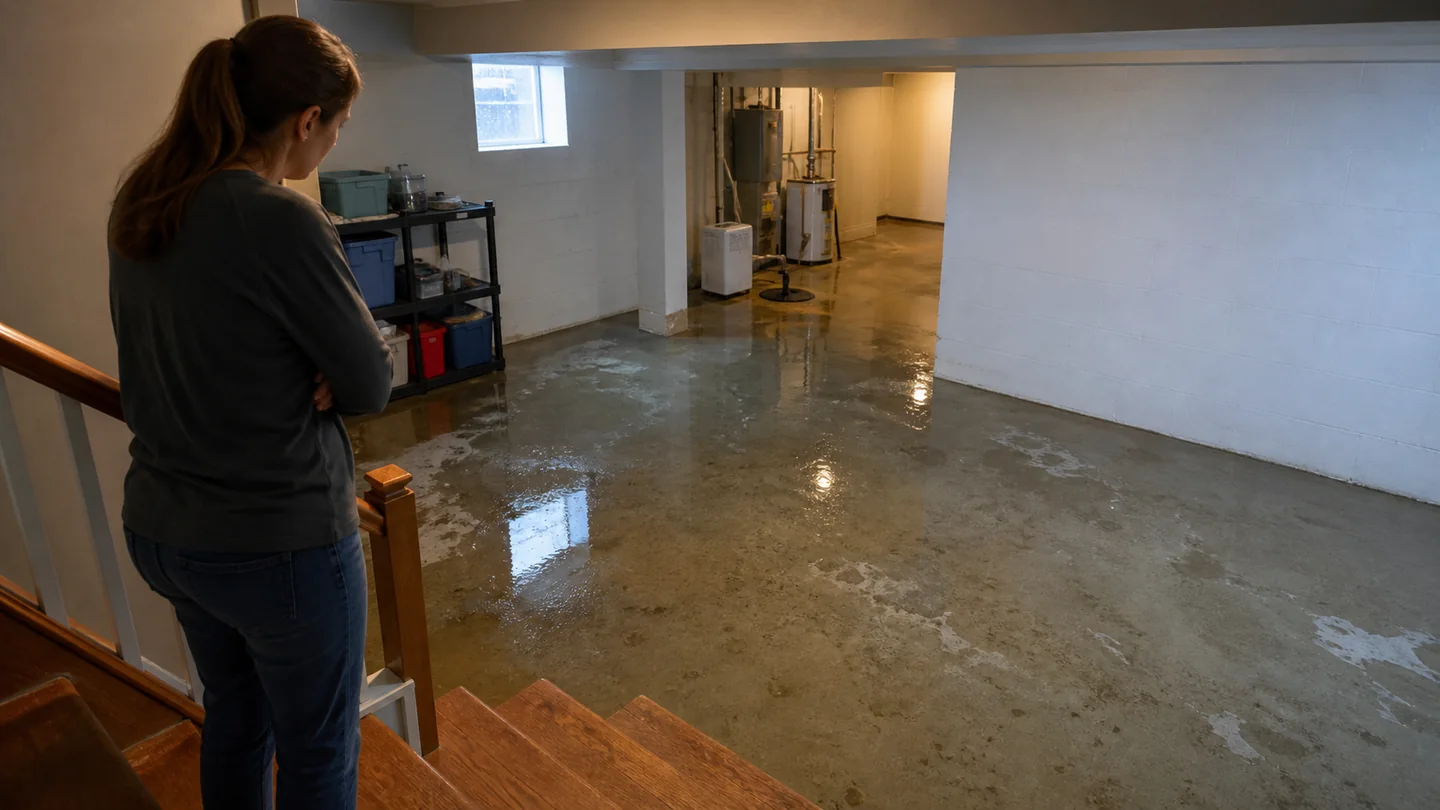
The leak has stopped. The floor looks better. You have towels everywhere and a fan pointed at the wall. Is that enough to prevent mold?
Maybe—but the surface is only part of the story. Water can move beneath flooring, into drywall, and behind baseboards before the room looks dramatic. The goal is to remove it, expose wet materials, and confirm that the structure is drying within 24–48 hours.
That window matters, but it isn't a countdown to guaranteed mold at hour 49. Conditions vary. Use the timeline to move deliberately, not to panic or approve every proposed repair.
The short answer: remove water, expose wet materials, and verify drying
EPA and CDC recommend drying water-damaged areas and belongings within 24–48 hours when possible. Stop the source, extract standing water, move wet contents, open trapped areas, and lower humidity. Spraying a wet wall isn't a substitute.
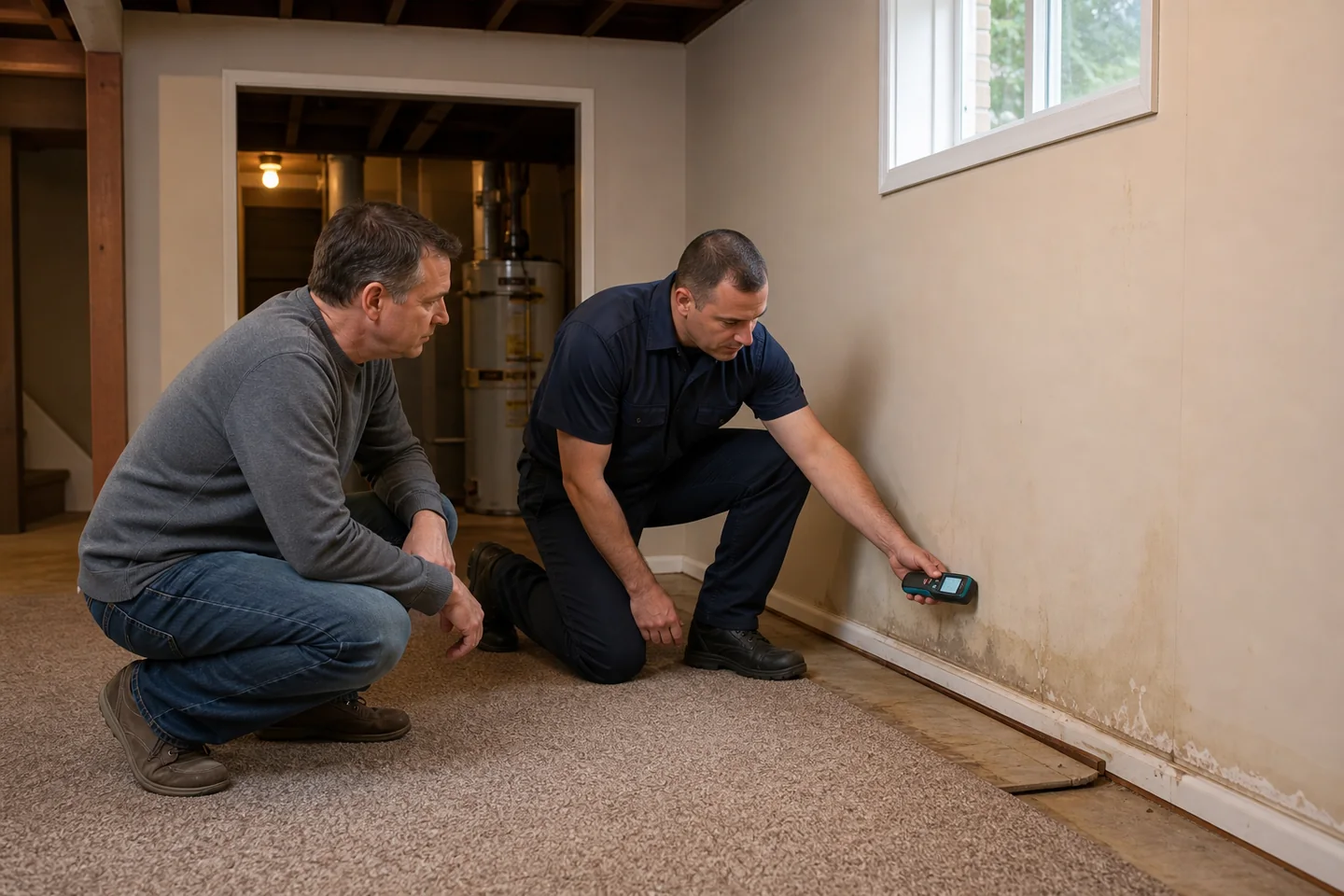
Here's the thing: a room can feel dry while drywall backing or carpet pad stays wet. A credible plan uses moisture readings and repeated checks before materials are closed up.
| A practical timing note The 24–48 hour guidance is a prevention target, not a warranty. If you discover damage after two days, keep drying and get the extent assessed. Being late changes the inspection and cleanup questions; it does not mean the entire room automatically needs demolition. |
|---|
First question: what kind of water entered the home?
The source changes what is safe to save and whether ordinary fans are a good idea. A newly broken drinking-water supply line is not the same cleanup problem as a dishwasher discharge, a sewer backup, or outdoor floodwater.
| Likely source | What it means | Reasonable next move |
|---|---|---|
| Clean supply water | Starts with a low contamination level, although it can deteriorate as it sits or contacts dirty materials | Stop the source, document, extract, and begin controlled drying quickly |
| Used appliance or drain water | May contain detergent, food residue, or other contaminants | Limit contact and ask how materials will be cleaned as well as dried |
| Sewage or outdoor floodwater | Can contain disease-causing organisms, chemicals, and debris | Keep people and pets out; use a professional experienced with contaminated-water losses |
If the source is unclear, do not decide the cleanup method from color alone. A ceiling drip below a bathroom could be supply water or fixture wastewater.
Your 0–48 hour action plan
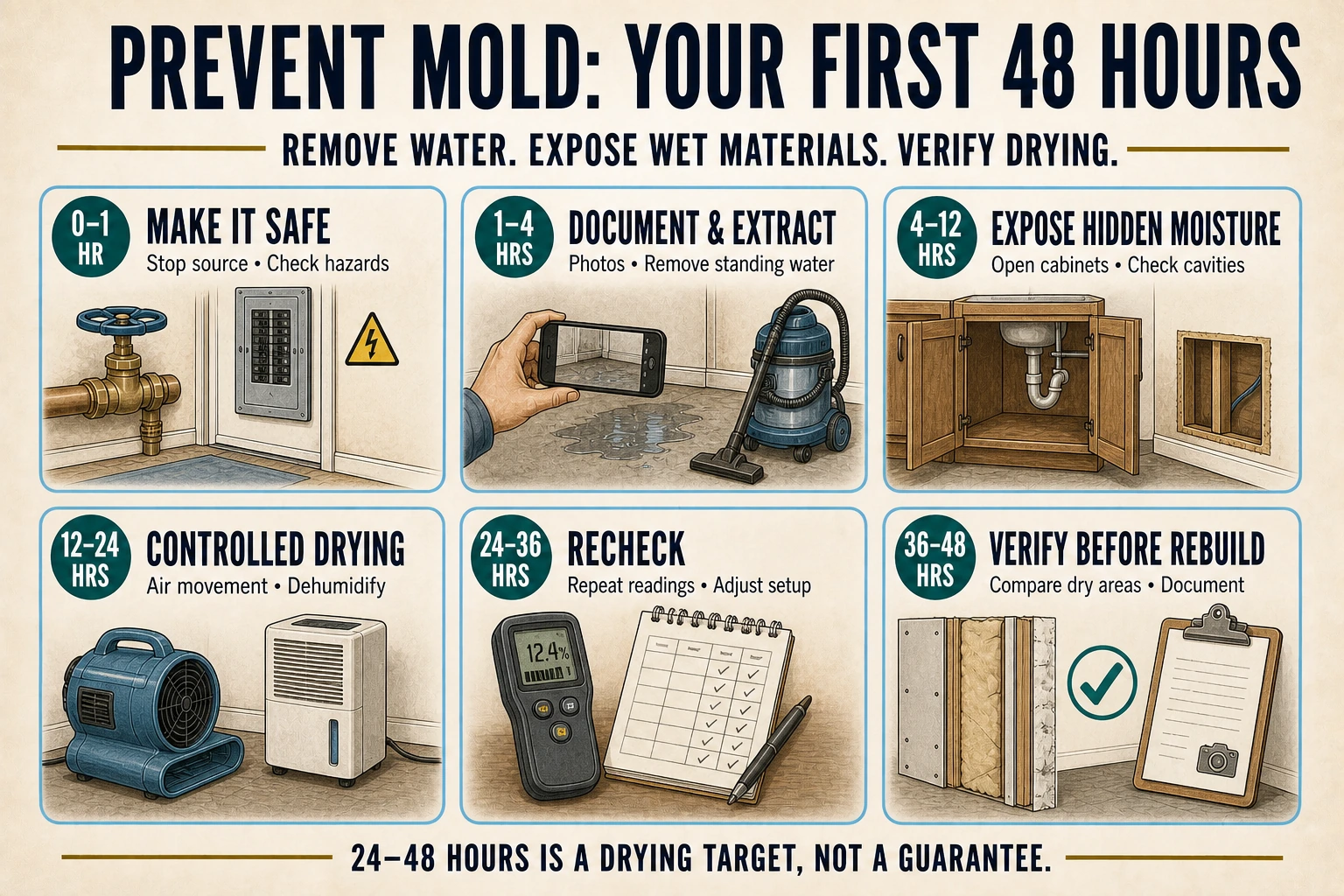
0–1 hour: make the area safe and stop the source
Shut off the fixture or main water supply if you can reach it safely. Never enter standing water to reach a breaker or appliance. Leave if there is electrical, structural, sewage, or gas risk.
Move children and pets away. With sewage, floodwater, or an uncertain drain source, avoid contact and don't blow household fans across it.
1–4 hours: document first, then remove standing water
Photograph the source, water line, rooms, materials, and belongings. Note when you found the loss and stopped the water. If a claim may be involved, contact your insurer promptly; the policy and loss facts control coverage.
For a small clean-water spill, towels, a mop, or a wet-dry vacuum may be enough if power is safe. Larger losses need faster extraction. Move wet contents where they can dry without wetting another room.
4–12 hours: expose the places water likes to hide
Open cabinets, move furniture from wet walls, and check closets, adjoining rooms, the ceiling below, and the wall's opposite side. Baseboards and hard flooring can hide wet layers.
Selective opening may be needed, but more demolition isn't automatically better. Ask what moisture evidence supports each removal.
12–24 hours: build a drying system, not a fan collection
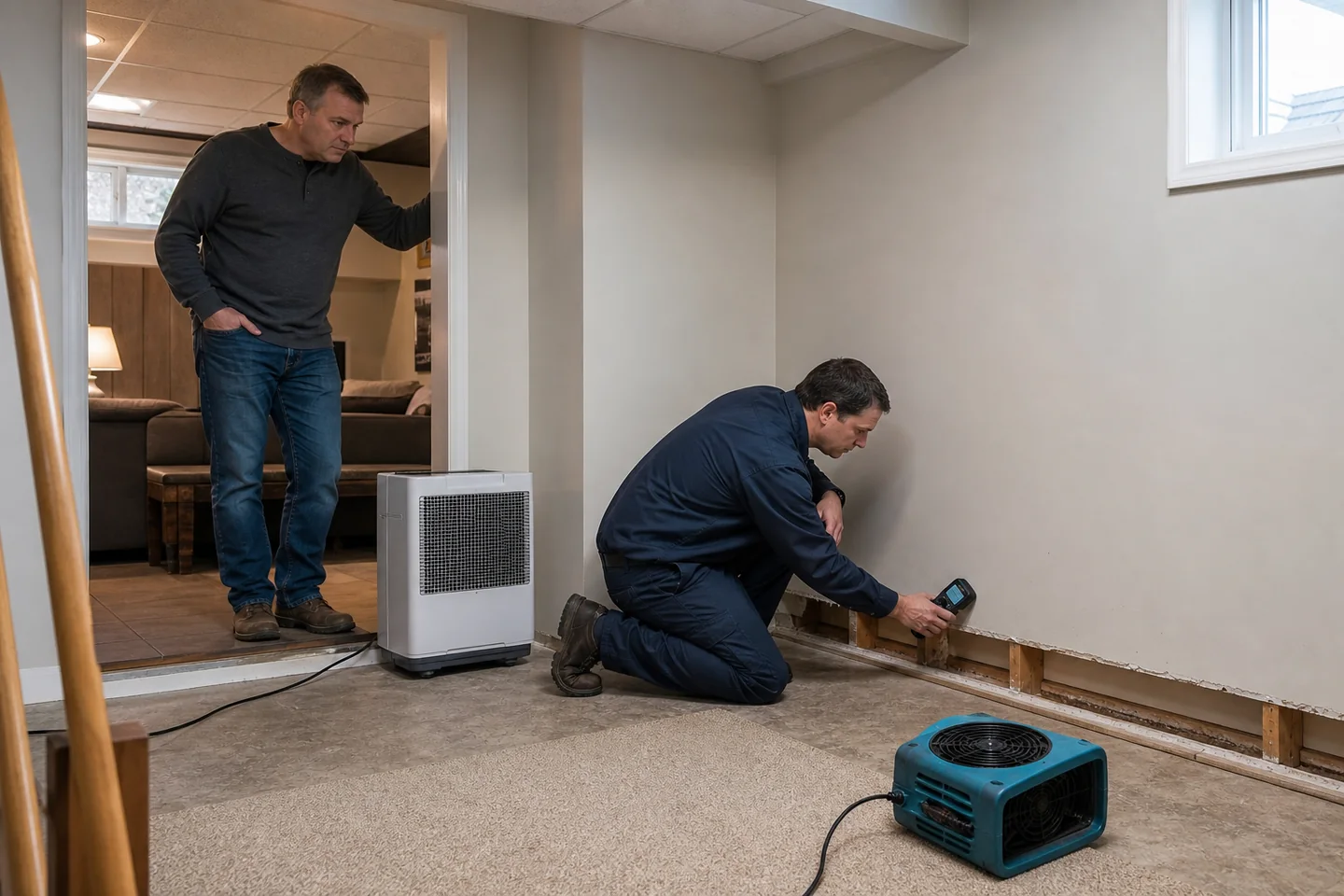
Air movement helps moisture leave clean surfaces; dehumidification removes it from the air. You often need both. Close windows when outdoor air is more humid. seasonal weather can change that answer quickly.
Don't rely on HVAC alone. If the system was flooded or may contain mold, have it evaluated before operation because it could distribute contamination.
24–36 hours: check what is improving—and what isn't
Recheck wall bases, subfloor, carpet backing, cabinets, and adjoining areas. Equipment drying open concrete may not reach insulation inside a wall.
Repeat readings at the same locations. If nothing changes, the source may remain active, moisture may be trapped, or water may have traveled farther.
36–48 hours: verify progress before you start rebuilding
Don't rebuild merely because two days passed. Materials should be appropriately dry and comparable to a known-dry area. Mold, odor, swelling, staining, or stubborn readings deserve another look.
Save photographs, readings, equipment records, receipts, and the written scope. They help compare estimates and support an insurance discussion.
After 48 hours: don't panic, but don't cover the problem
If the area remains wet, keep drying and assess for visible or hidden growth. CDC says a flooded home not dried within 24–48 hours should be treated as likely to have mold. That calls for caution, not automatic whole-room removal.
If mold is present, fix the source, remove growth appropriately, and dry the area. Don't cover it with paint, caulk, or new material.
Fans and dehumidifiers: what actually helps?
| Tool or step | What it does well | Where homeowners get tripped up |
|---|---|---|
| Water extraction | Removes bulk water faster than evaporation | A household vacuum may be unsafe or unsuitable, especially with contaminated water |
| Air mover or fan | Moves air across exposed, clean wet surfaces | It does not remove humidity and may spread existing mold or contamination |
| Dehumidifier | Pulls moisture from the air so materials can keep releasing water | Capacity, temperature, drainage, and room closure affect performance |
| Ventilation | Can exchange damp indoor air for drier outdoor air | Humid summer air or wind-driven rain can make conditions worse |
| Heat | Can increase evaporation under controlled conditions | Heat without dehumidification can move moisture into other materials and spaces |
For clean water, extract first, expose wet materials, then use air movement and dehumidification together. If mold or contaminated water is present, plan cleanup and containment before strong airflow.
What can dry in place, and what often needs removal?
It depends on the water source, how long the material was wet, whether all sides can dry, and whether contamination penetrated the material. The answer should be material-specific.
| Material | Possible approach after clean water | Reasons removal becomes more likely |
|---|---|---|
| Concrete, tile, and metal | Extract, clean, and dry; check cracks and joints | Contaminated water, coatings that trap moisture, inaccessible seams |
| Solid wood framing | Often can be cleaned and dried in place | Decay, structural damage, deep contamination, or inaccessible surfaces |
| Drywall | A small, promptly dried area may be salvageable | Swelling, crumbling, mold, dirty water, wet insulation, or a closed cavity |
| Fiberglass or cellulose insulation | Assessment depends on type and wetting | Matting, contamination, slow drying, or inability to verify the cavity |
| Carpet and pad | Clean-water carpet may be recoverable with prompt extraction | Wet pad, delamination, odor, mold, sewage, or floodwater |
| Laminate and engineered flooring | Limited clean-water exposure may dry if opened promptly | Swollen edges, trapped underlayment, adhesive failure, or dirty water |
| Cabinets and vanities | Open, clean, and dry if construction allows | Particleboard swelling, trapped water, contamination, or wet wall cavities |
Porous items are the hardest call. EPA says mold can grow into absorbent materials, making complete cleaning difficult. Be skeptical of claims that a spray saves everything—or that every damp item must go.
How do you know the structure is actually dry?
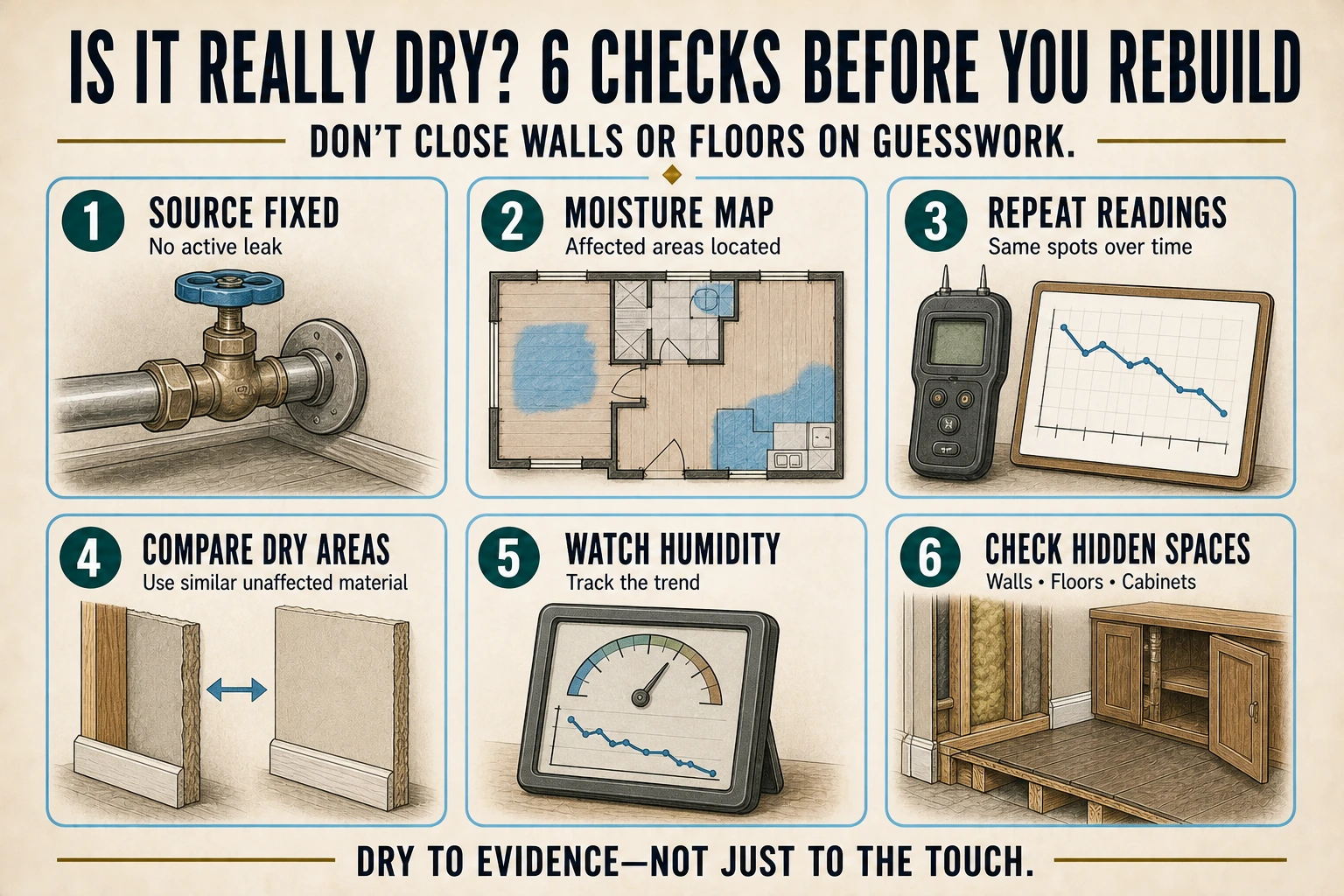
Touch cannot clear a wall cavity. Compare meter readings with similar, known-dry materials. Targets vary by material and instrument, so one universal percentage for wood, drywall, and concrete isn't credible.
- A room-by-room moisture map showing where readings were taken.
- Initial, daily, and final readings from the same locations.
- Indoor relative humidity and temperature trends, plus outdoor conditions when relevant.
- A comparison with unaffected material of the same type.
- An explanation of any area that could not be measured or inspected.
- Final photographs and written confirmation that the source problem was corrected.
Before closing the assembly, ask to see the readings and the decision rule behind them.
Do you need mold testing?
Not necessarily. EPA says sampling is usually unnecessary when mold is visible because no federal air limit creates a pass-or-fail result. The immediate work is correcting moisture and removing growth.
Testing may help when the source is unclear, a dispute needs a protocol, or a specialist is checking a complex condition. Ask what decision it will change. A lab report doesn't stop a leak or prove a wall is dry.
Should you use bleach to prevent mold?
Bleach isn't a universal prevention step. EPA does not recommend routine biocide use for mold cleanup. On many hard surfaces, clean with detergent and water, then dry completely. Spraying porous drywall or carpet doesn't dry it.
If a product fits the situation, follow its label and ventilate safely. Never mix bleach with ammonia or another cleaner. Killing growth isn't the same as removing it; dead mold can still trigger reactions.
When professional help is a sensible next step
You don't need a restoration company for every spill. Help makes more sense when damage is large, hidden, contaminated, hard to dry, or risky to occupants.
- Sewage, outdoor floodwater, or water with an uncertain contamination source entered the building.
- Standing water is near electrical equipment, the structure is damaged, or safe access is uncertain.
- Mold covers more than about 10 square feet—EPA's rough homeowner-versus-larger-project threshold—or extends into multiple cavities.
- Water reached HVAC equipment or mold may be near an intake or inside ducts.
- A basement, wall system, insulation layer, subfloor, or finished ceiling is wet beyond what you can expose and measure.
- A musty odor, swelling, staining, or high readings persist even though the surface looks dry.
- Someone with asthma, serious allergies, chronic lung disease, or a weakened immune system would be exposed during cleanup.
CDC says people with immune suppression, lung disease, asthma, COPD, or significant allergies should not clean mold. Direct symptoms or exposure questions to a health professional.
What does drying and mold prevention cost in your area?
HomeYou's current your local area page lists a typical project range of about $3,602–$3,887 and a modeled 215-square-foot flood-cleanup total near $3,460–$4,030. Its planning rates are roughly $2–$4 per square foot for Category 1 water, $3–$5 for Category 2, and $5–$8 for Category 3.
These are market-model references, not a bid or mold-remediation total. Hidden cavities, demolition, contents, contaminated water, equipment days, emergency timing, and rebuilding change the price.
| Cost item | What should be described | Common surprise |
|---|---|---|
| Emergency visit and extraction | Call-out charge, labor minimum, affected area, and extraction method | After-hours rates or minimum charges |
| Drying equipment | Equipment type, quantity, daily rate, and expected monitoring days | Automatic extensions without a written update |
| Selective removal | Square or linear footage, material, labor, disposal, and reason | Reconstruction is priced separately |
| Mold remediation | Containment, removal, cleaning, filtration, and verification approach | Testing and rebuild may be separate services |
| Reconstruction | Replacement materials, permits, trades, schedule, and warranty | The emergency authorization did not include it |
Ask which charges are fixed or unit-priced and who authorizes changes. A lower bid may omit monitoring or rebuild; a higher one isn't automatically more complete.
Questions to ask before giving a company your contact information
- Will you inspect on site before giving a final scope, or is the phone number only a starting range?
- What is the water source and category, and could that classification change as more areas are opened?
- Will I receive a moisture map with initial, daily, and final readings?
- Which materials do you expect to save, which might be removed, and what evidence supports each decision?
- What are your labor minimums, equipment daily rates, monitoring charges, disposal fees, and after-hours rates?
- How will you avoid spreading contamination through clean rooms or the HVAC system?
- Is mold assessment, remediation, testing, or post-remediation verification included—or separate?
- Does the authorization cover mitigation only, or also reconstruction?
- Who approves change orders, and can I receive them before additional work begins?
- What documentation will I receive, and are you promising insurance coverage you cannot control?
A useful estimate explains observations, planned work, progress measures, and exclusions. You shouldn't have to sign a broad authorization just to understand the approach.
Frequently asked questions
Can mold really start growing within 24 hours?
It can begin quickly under favorable conditions, which is why EPA and CDC recommend drying within 24–48 hours when possible. That guidance is a prevention target, not a precise biological timer for every home.
If everything dries, does that kill existing mold?
Drying stops the moisture that supports active growth, but it does not remove visible mold or contaminated material. If growth is present, clean or remove it appropriately and correct the source.
Can wet drywall be saved?
Sometimes. A small clean-water area caught quickly may dry without swelling or loss of strength. Removal is more likely when drywall is soft, crumbling, moldy, contaminated, backed by wet insulation, or impossible to verify inside the cavity.
Should I pull up wet carpet?
For clean water, quick extraction and access to the pad and subfloor may make recovery possible. Carpet and pad exposed to sewage or floodwater are commonly discarded. Delamination, odor, time wet, and subfloor moisture also affect the decision.
Can fans make mold worse?
Fans help dry clean, exposed surfaces. If visible mold or contaminated water is present, strong airflow can spread particles or contamination, so cleanup and containment should be planned first.
Is black mold more dangerous than other mold?
Color alone does not tell you the species or the health risk. CDC and EPA guidance focuses on fixing moisture and addressing any indoor mold growth rather than identifying danger by color.
Do I have to leave the house?
Not for every small, isolated clean-water loss. Leaving may be prudent when there is sewage, major flooding, electrical or structural danger, widespread mold, HVAC involvement, or vulnerable occupants who cannot avoid exposure.
Will homeowners insurance cover mold prevention work?
It depends on the cause, timing, policy language, limits, exclusions, and endorsements. Document the loss and contact the insurer promptly. A restoration company can describe damage and costs but cannot guarantee coverage.
The practical next step
Start with three facts: where the water came from, how far it traveled, and which materials are still wet. Then choose the least invasive plan that can still measure and verify the hidden areas. Quick action matters, but documented action is what keeps quick work from turning into guesswork.
If the loss extends beyond what you can safely extract, expose, and monitor, compare written scopes. Look for a company that can explain what it will save, what it may remove, how it will prove drying, what each day of equipment costs, and where the emergency work ends.
Sources and cost methodology
Health and cost sources were reviewed in August 2026. Government guidance supports the safety and moisture-control recommendations. Local cost figures are planning references from HomeYou, not guaranteed prices; the page's modeled project and category rates can describe different scopes. Always compare the written work included in each estimate.
EPA: A Brief Guide to Mold, Moisture and Your Home
EPA: Mold Cleanup in Your Home
EPA: Is Sampling or Testing for Mold Necessary?
EPA: Should You Have the Air Ducts in Your Home Cleaned?
CDC: Mold Cleanup Guidelines and Recommendations
CDC: Dry Off Wet Items After a Storm
CDC: Safety Guidelines for Reentering a Flooded Home
CDC: Guidelines for Cleaning Safely After a Disaster
CDC/NIOSH: Mold Testing and Remediation