Prefab vs. Custom Tile Walk-In Showers: Which Is Better for Your Bathroom?
2026 national planning ranges: $3,000-$6,000 prefab; $8,000-$15,000+ custom tile
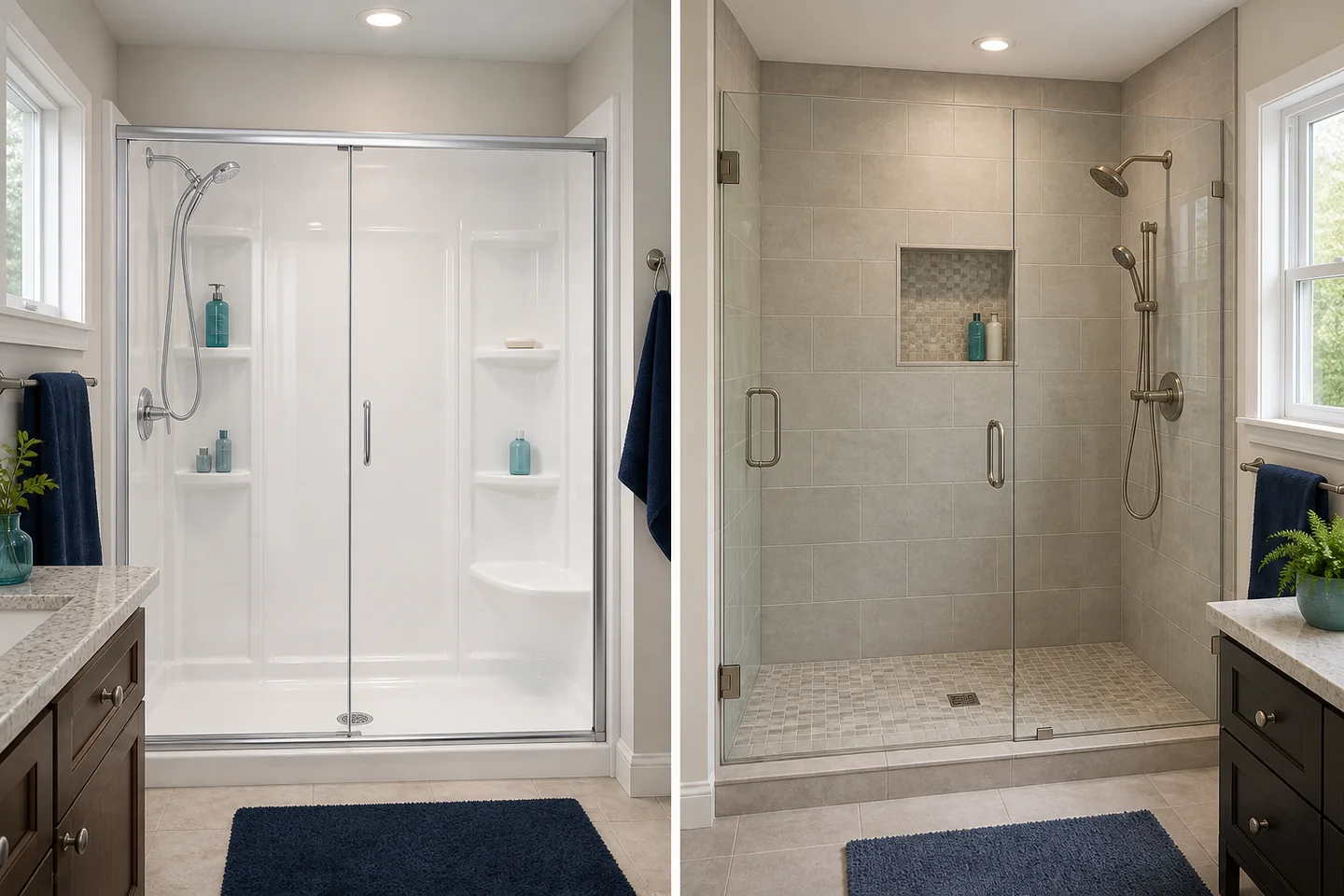
If you're comparing a prefab walk-in shower with custom tile, you've probably noticed that every answer sounds a little too simple. Prefab is called cheaper and easier. Tile is called better and more valuable. Neither statement tells you whether the shower will fit your bathroom, stay dry, feel safe, or make sense for what you want to spend.
Here's the useful answer: prefab is usually the practical choice when you want a faster installation, predictable surfaces, and less grout to maintain. Custom tile earns its higher price when the room needs a made-to-fit layout or you care enough about the design, dimensions, and details to pay for more labor. The quality of either option still depends on what happens behind the finished surface.
First, make sure everyone means the same thing by 'prefab'
Prefab can describe a one-piece fiberglass or acrylic stall, a multi-piece base-and-wall kit, or a higher-end panel system cut to fit the room. Those aren't interchangeable products. A one-piece unit may work well in new construction but be too large to move through the doors and hallways of an existing home. Multi-piece systems are more renovation-friendly because installers can assemble them inside the bathroom.
Custom tile is built in place. The visible tile is only the finish. Under it, the shower still needs a properly sloped base, a drain connection, a compatible waterproofing system, sealed transitions, and a sound wall substrate. Tile and grout aren't substitutes for waterproofing.
The quick comparison most homeowners are looking for
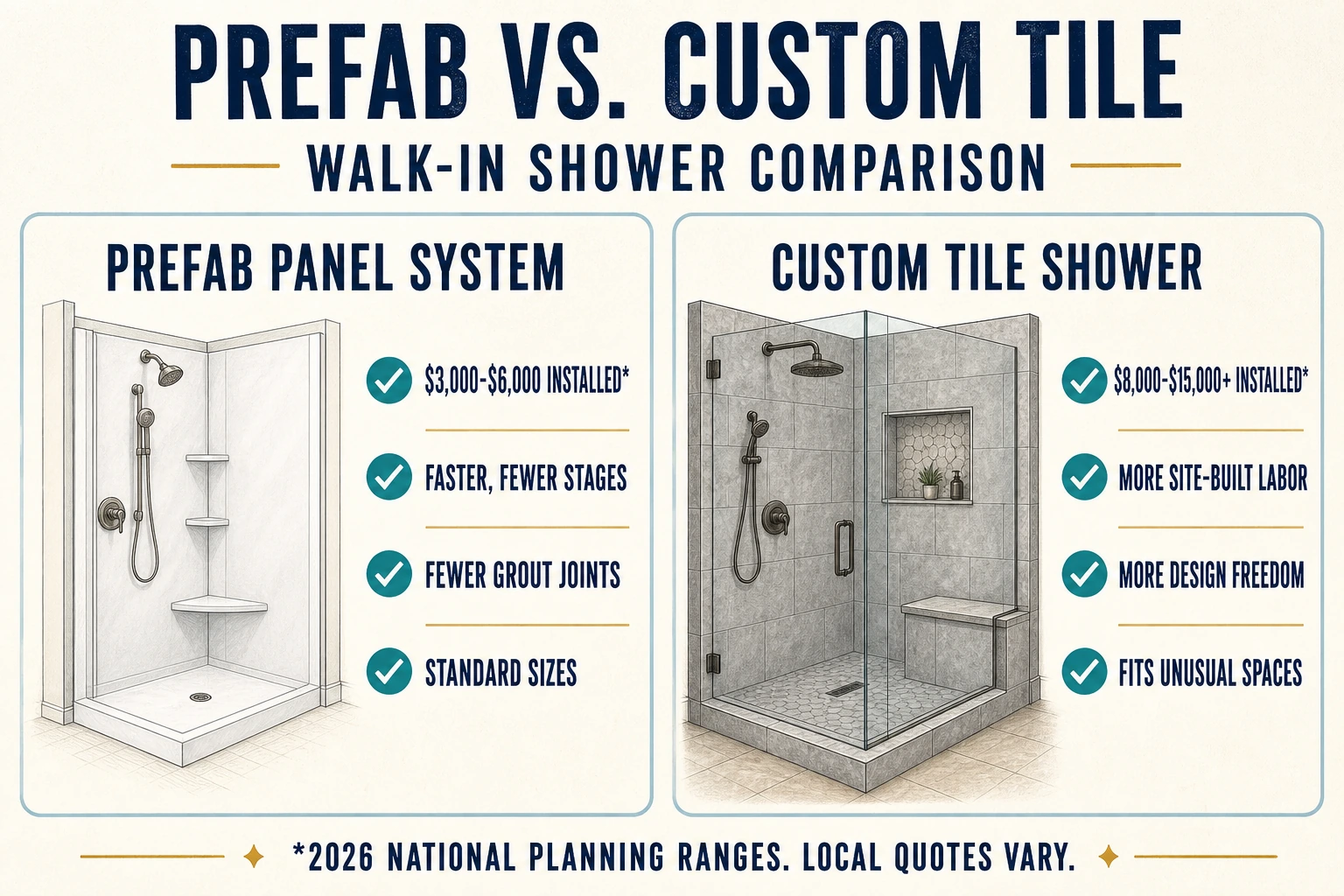
| What matters | Prefab or panel system | Custom tile shower |
|---|---|---|
| Upfront cost | Usually lower when the footprint and plumbing stay similar | Usually higher because waterproofing, layout, tile setting, and finishing require more labor |
| Design freedom | Limited to available sizes, colors, textures, and accessory locations | Broad control over size, tile, niches, benches, drains, borders, and glass |
| Cleaning | Few or no grout joints; generally straightforward to wipe down | More joints and corners; maintenance depends on tile, grout, and detailing |
| Fit in an older room | Works best when a manufactured size fits the opening with manageable adjustments | Can accommodate irregular dimensions and unusual layouts |
| Project disruption | Installation is often more direct once demolition and prep are complete | More site-built stages, inspections, setting, curing, and finish work |
| Future repairs | A damaged proprietary panel or base may require a matched part or larger replacement | Individual tile or grout can be serviceable, but hidden waterproofing failures are disruptive |
| Accessibility | Low-threshold models are available, but dimensions are product-specific | Can be tailored for entry, slope, seat, controls, blocking, and clearances |
What do prefab and custom tile showers cost in 2026?
For national planning, This Old House lists professionally installed prefab showers around $3,000 to $6,000 and custom tile walk-in showers around $8,000 to $15,000 or more. Angi's broader 2026 guide places many complete shower installations between $4,448 and $12,373, while noting that the type, size, demolition, permits, tile, pan, doors, and plumbing all change the total.
These aren't your area quotes, and they shouldn't be treated like a menu. A basic alcove replacement that keeps the drain and valve in place is a different project from removing a cast-iron tub, repairing a soft subfloor, moving plumbing, building a bench, and ordering frameless glass.
The bigger question is what the estimate includes. A low number may exclude the door, valve, trim, permit, disposal, painting, or repairs found after demolition. A higher number may include those items plus a better wall system and warranty. Compare scope line by line before comparing totals.
The four decisions that move the price fastest
Keeping the existing footprint and plumbing is usually the simplest way to control cost. Once the drain, supply lines, or shower valve moves, the project can involve more floor and wall work. In an older your local area, your local area, your local area, your local area, or Warren home, opening the walls may also uncover corroded piping, old repairs, or framing that isn't square.
Glass is another major variable. A curtain or framed door is different from custom frameless glass measured after the finished surfaces are complete. Benches, recessed niches, multiple showerheads, ceiling tile, linear drains, and curbless entries can also move a shower out of the basic price tier.
Tile choice matters, but labor and preparation often matter more than the price printed on one box. Small mosaics, patterns, uneven handmade tile, natural stone, and many corners require additional planning, cuts, and finishing. With prefab, upgrades tend to come from thicker materials, better surface finishes, custom-fit panels, integrated shelving, doors, and accessories.
If you hate cleaning grout, be honest about it now
Prefab walls appeal to homeowners who want fewer joints and a surface that can usually be cleaned without scrubbing rows of grout. That doesn't make them maintenance-free. Corners, door tracks, silicone joints, drains, and textured floors still need attention, and harsh cleaners can damage some finishes.
Custom tile creates more joints, especially with small tile. Modern grout and good installation can make care easier, but the shower still needs regular cleaning and ventilation. Natural stone may have product-specific sealing and cleaner requirements, while many porcelain and ceramic options are less demanding.
So what should you actually do? Ask to see and touch the proposed surface. Find out which cleaners are allowed, which joints use flexible sealant, and what maintenance the warranty requires. Choose the shower you're willing to care for, not the one that looks best in a photo for five minutes.
Waterproofing matters more than the surface you see
A prefab receptor is manufactured to collect and direct water to the drain, but its seams, plumbing penetrations, wall transitions, and connection to the surrounding bathroom still have to be installed correctly. A custom tile shower has more site-built connections, so coordination between the base, membrane, drain, walls, niche, curb, and glass becomes especially important.
Your state plumbing requirements call for shower floors or receptors to use waterproof, nonabsorbent materials and require site-built shower floors to be lined and made watertight. Manufacturer instructions also matter because components are tested as systems, not as a random collection of products.
Ask who is responsible for waterproofing, which named system will be used, and whether all parts are compatible. Also ask how the base will be tested before the finished shower hides the work. A beautiful tile layout can't compensate for a weak drain connection or a poorly detailed corner.
Custom tile wins on fit, but prefab may still fit better than you expect
Custom tile is the clear favorite for an angled wall, unusual footprint, oversized shower, precise niche layout, or design that needs to match the rest of the bathroom. It can also make better use of a room where standard bases leave awkward gaps.
Prefab isn't limited to a shiny one-piece stall. Multi-panel acrylic, composite, and solid-surface systems can offer convincing patterns, built-in storage, and cleaner transitions. Some can be cut or ordered for an existing alcove, although they still have product limits.
What about a low-threshold or curbless shower?
Not necessarily every prefab or tile shower can become truly curbless. The floor structure, drain location, available slope, bathroom layout, and water-containment plan all matter. Prefabricated sloped trays are available in multiple dimensions and drain positions, and custom mortar bases can be shaped for unusual spaces. Either approach must integrate with the floor and waterproofing.
If safer bathing is part of the goal, don't stop at the curb. Entry width, slip resistance, a handheld shower, reachable controls, a properly placed seat, and solid blocking for grab bars can matter just as much. Federal ADA standards can provide useful design references, but a private residential bathroom isn't automatically an ADA project. Design around the actual user and confirm local requirements.
A future grab bar shouldn't be screwed into tile with no planned support behind it. Ask where blocking will be installed and have its location documented before the walls are closed.
Which option is more durable? It depends on the failure you're trying to avoid
A good prefab system avoids hundreds of grout joints and arrives with many of its water-handling surfaces already formed. It can still be scratched, cracked, poorly supported, or incorrectly sealed. If a proprietary panel or base is damaged years later, matching the material may be difficult.
A well-built tile shower can last a long time and allows individual finish repairs, but it has more workmanship-dependent details. Cracked grout doesn't always mean the waterproofing has failed, and fresh grout won't repair a leaking membrane below it. The same nuance applies to prefab: replacing a bead of sealant can solve a maintenance issue, but it won't correct a moving or damaged base.
There is a middle option, and it often makes sense
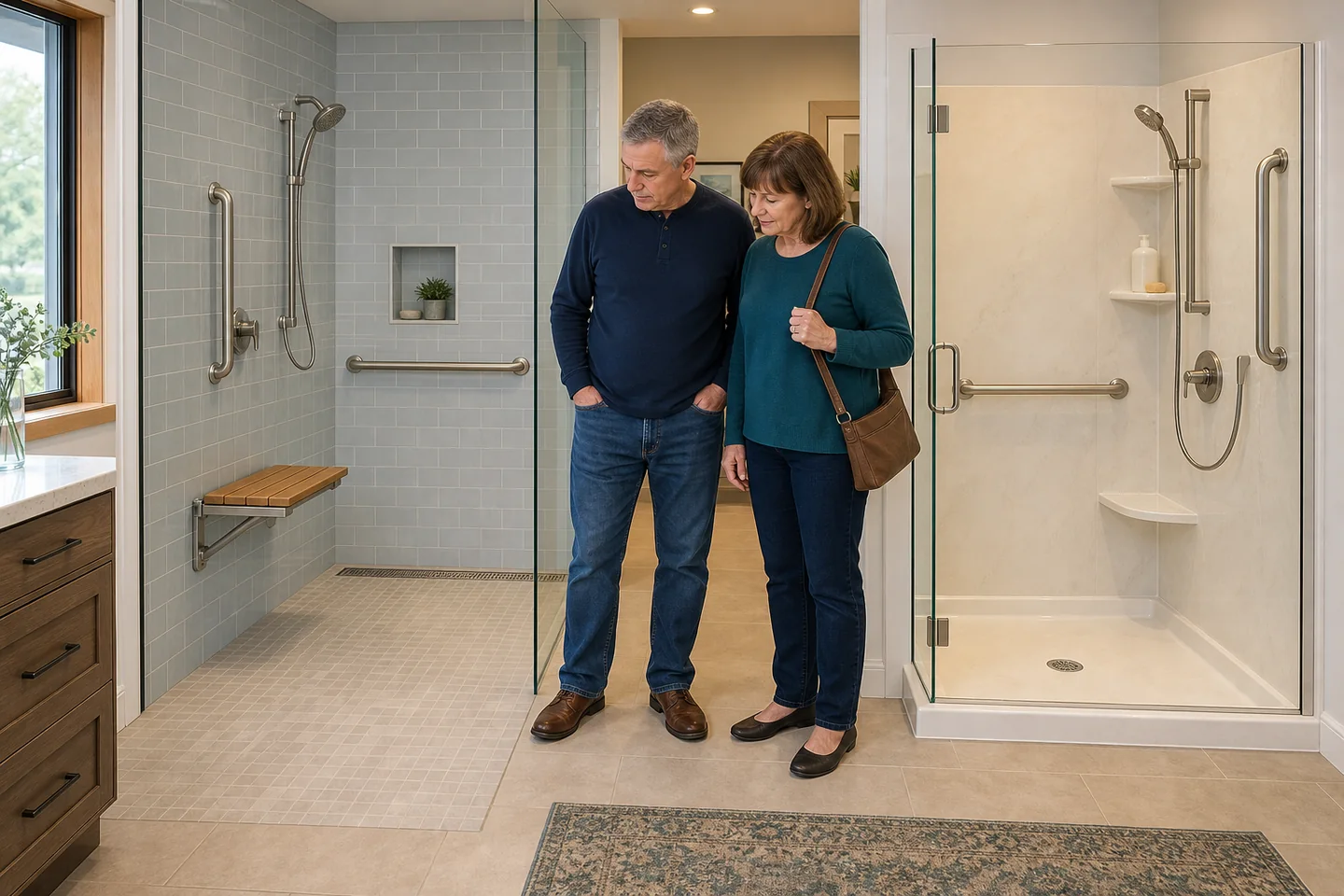
You don't always have to choose an all-prefab stall or an all-tile shower. A manufactured shower base with tiled walls can reduce the complexity of a site-built pan while preserving much of the custom look. Large-format wall panels with a separate base can provide a tailored appearance with fewer joints than traditional tile.
Could you repair the shower you already have?
Sometimes. A sound shower with failed surface sealant, a worn door sweep, a serviceable valve, or limited grout damage may not need complete replacement. Repair becomes less convincing when the base moves, water appears outside the enclosure, framing is soft, tile is loose across a wider area, or the layout no longer works safely.
Questions to ask before you give anyone the job
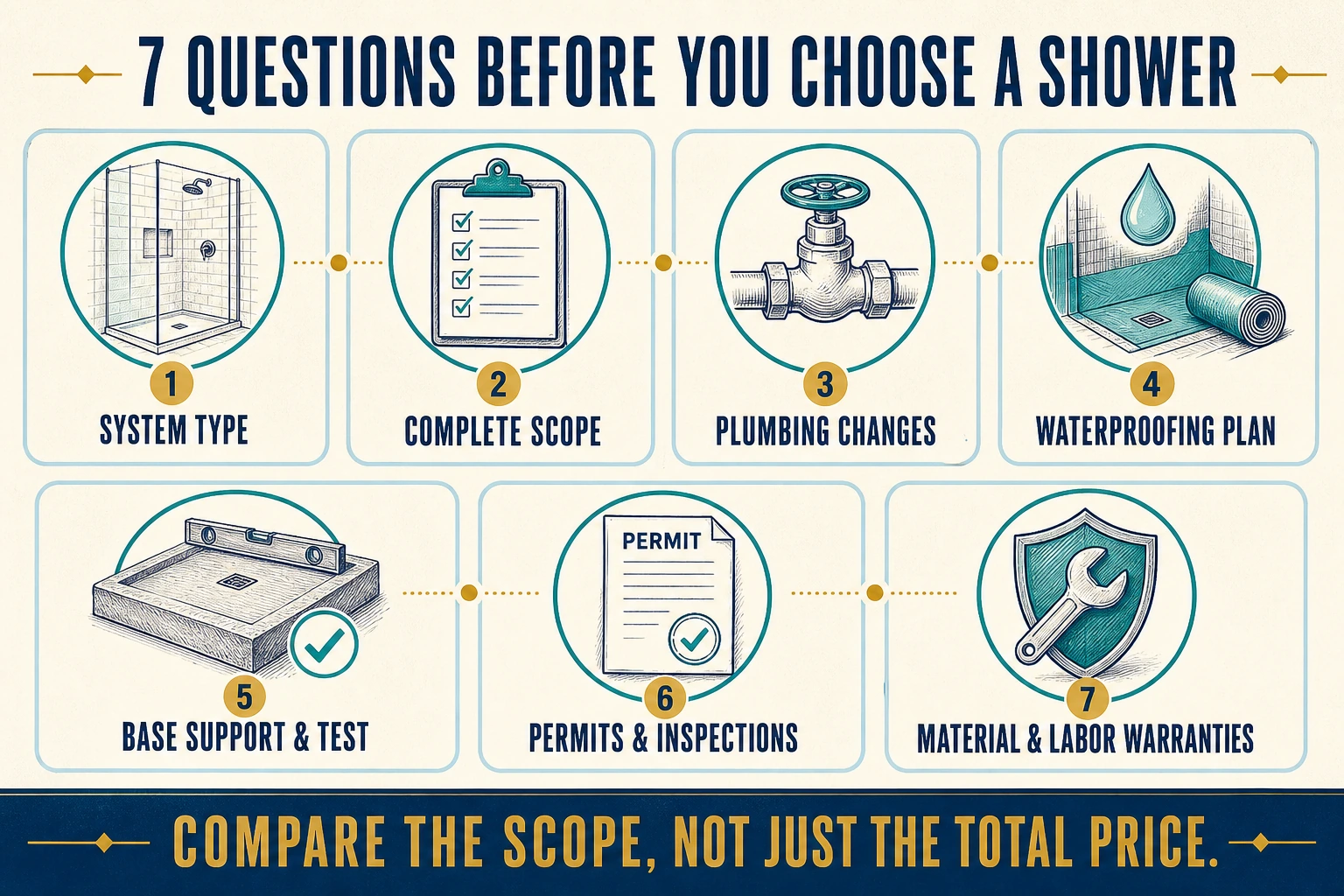
- Is this a one-piece unit, multi-piece kit, custom-fit panel system, hybrid shower, or fully site-built tile assembly?
- What exactly is included in demolition, disposal, plumbing, wall repair, waterproofing, glass, trim, painting, and cleanup?
- Will the drain and valve stay where they are, and what changes if they need to move?
- Which waterproofing and drain system will be used, and who is responsible for the complete installation?
- How will the base be supported, sloped, connected, and tested before the finish work covers it?
- Are permits and inspections needed in my municipality, and who handles them?
- What happens if demolition reveals rot, damaged subflooring, unsafe wiring, or outdated plumbing?
- What cleaning and maintenance does the manufacturer require, and what can void the warranty?
- What do the product and labor warranties cover, and who handles a service call later?
Ask for allowances to be identified rather than buried. If tile, glass, fixtures, or accessories are listed only as a dollar amount, find out what happens when your actual selection costs more. A clear quote makes it easier to compare options without giving anyone permission to start work.
Frequently asked questions
Is a prefab shower always the cheapest option?
Usually, but not automatically. A premium custom-fit panel system can cost more than basic tile, and hidden repairs, glass, plumbing changes, or difficult access can erase part of the expected savings. Compare complete installed scopes.
Does a custom tile shower add more value?
It can support the look and expectations of a higher-end bathroom, but value depends on workmanship, design, the rest of the home, and what a future buyer prefers. Don't assume every dollar spent returns a dollar at resale.
Is tile itself waterproof?
No. Tile and grout are finish materials. A custom shower needs a compatible waterproofing assembly below or directly behind the tile, connected correctly to the drain and detailed at every seam and penetration.
Which shower is easier to clean?
Prefab and large-panel systems usually have fewer joints, so routine cleaning is simpler. Tile can still be practical if you choose low-maintenance materials, limit grout lines, ventilate the bathroom, and follow the grout and tile manufacturer's care instructions.
Can either option be curbless?
Potentially. Prefabricated sloped trays and custom bases can both support low-entry designs, but floor structure, slope, drain location, waterproofing, and water containment determine what works in a specific bathroom.
Do I need a permit in your area?
Possibly. Requirements vary by municipality and scope. Plumbing relocation, structural changes, electrical work, and larger remodels may trigger permits or inspections. Ask the contractor and verify with your local building department.
So which walk-in shower is better for your bathroom?
Choose prefab or a panel system when your opening works with an available product, you want fewer grout joints, and a more controlled budget and schedule matter more than unlimited design freedom. Choose custom tile when the space is unusual, the details matter, or the shower needs dimensions and features that manufactured systems can't provide cleanly.
If neither description feels quite right, price a hybrid. Then compare the same basics across every proposal: the complete scope, the waterproofing plan, maintenance, accessibility, hidden-damage terms, schedule, and warranty. That's enough information to make a confident decision without pretending you're already ready to buy.
Sources
This Old House: How Much Does a Shower Remodel Cost? (2026)
This Old House: How Much Does a Walk-In Shower Cost? (2026)
Angi: How Much Does Shower Installation Cost? (2026 Data)
applicable state and local codes: Shower Floors and Receptors
Schluter: Using a Prefabricated Shower Tray and Ramp
Schluter: Shower System Installation Handbook
ADA.gov: 2010 ADA Standards for Accessible Design
your local municipality: Home Building, Rehabilitation, and DIY Permits