Storm-Damage Roof Inspection Checklist: What to Check and Document
A safe, evidence-first guide to exterior checks, attic clues, documentation, insurance questions, and 2026 costs
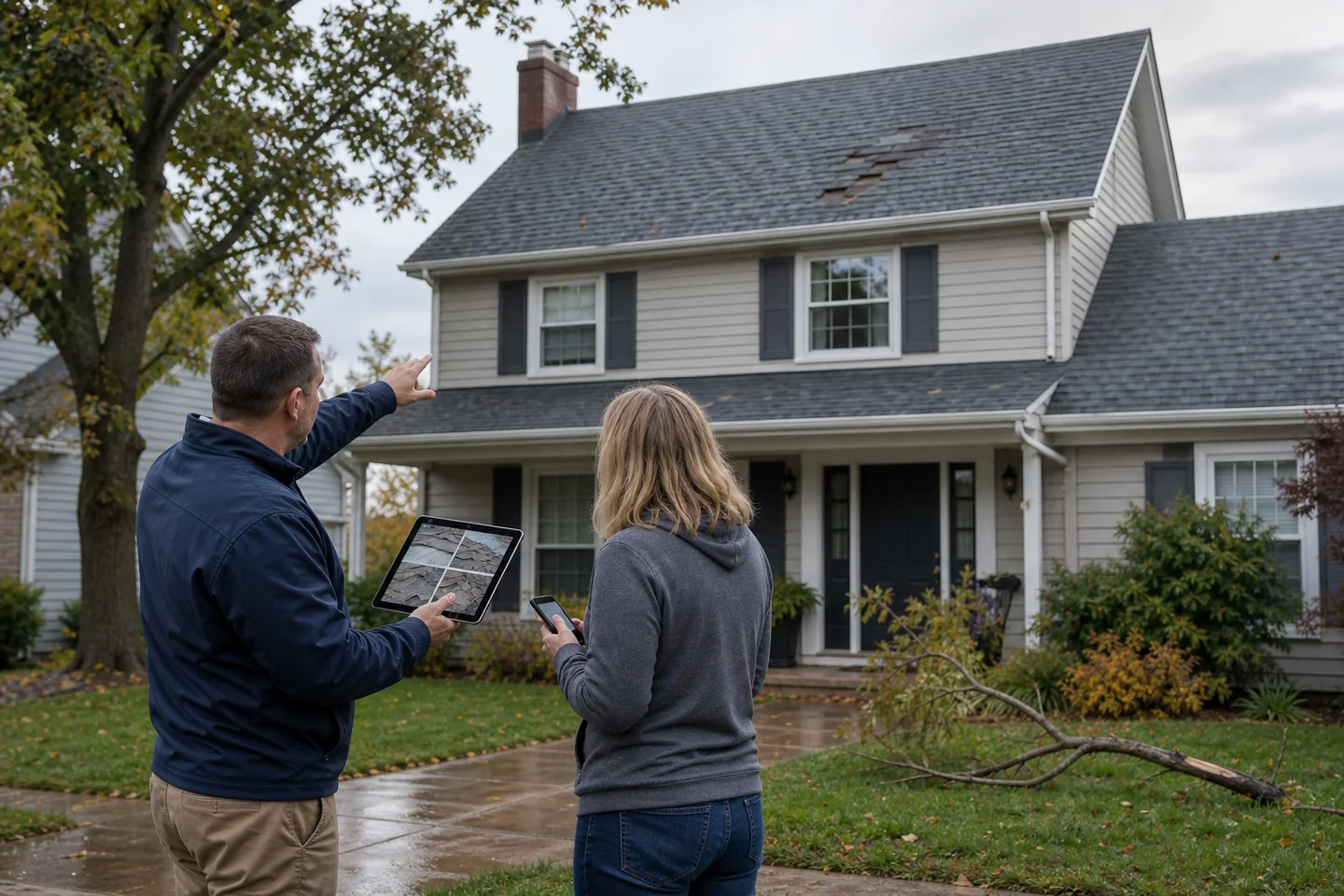
A storm just moved through, you found shingles in the yard, and now every roofing ad seems to say the same thing: your whole roof may be ruined. Maybe it is. Maybe it isn't. The useful first step is not guessing or signing a contract. It's making the property safe and building a clear record of what changed.
This checklist helps you observe safely, document wind, hail, tree, and water damage, and ask questions before authorizing work.
First, decide whether the house is safe to approach
Roof damage can wait a few minutes. A downed electrical line, gas leak, unstable tree, sagging ceiling, or shifted wall cannot. FEMA advises checking utility lines and structural safety before entry. If you smell gas, see sparks, or suspect instability, leave and call emergency services or the utility.
Don't touch a downed line, step into water to reach an electrical panel, or enter an area officials have restricted. Keep children and pets away from debris and hanging materials.
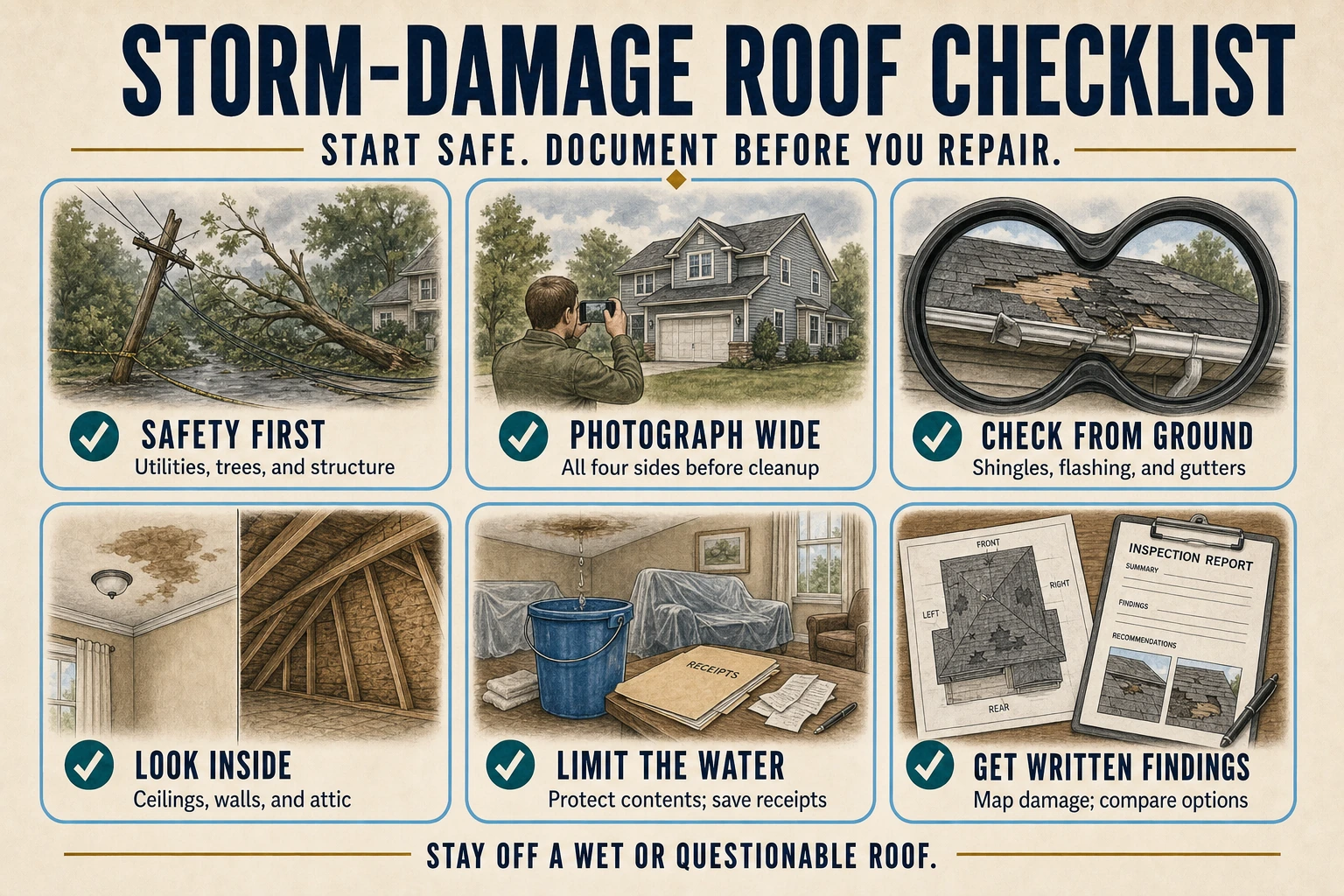
The first 30 minutes: a homeowner's storm checklist
| Priority | What you can do safely | When to stop and call a professional |
|---|---|---|
| People and utilities | Check occupants, pets, gas odor, visible wiring, standing water, and local safety notices | Gas odor, sparks, downed lines, fire, major structural movement, or an evacuation order |
| Exterior overview | Photograph all four sides from the ground before moving debris | A tree rests on the house, masonry is loose, or the roofline visibly sags |
| Interior check | Look at top-floor ceilings, walls, closets, and accessible attic areas | Ceiling bulges, water reaches wiring or fixtures, or framing appears displaced |
| Water control | Place containers, move belongings, and protect surfaces where it is safe | The leak is heavy, the ceiling is unstable, or roof access would be required |
| Documentation | Record date, time, rooms, roof sides, photos, videos, calls, and receipts | You are being pressured to sign, pay in full, or let someone inspect while you are absent |
1. Record the scene before cleanup changes it
Take wide photos from all four sides, then close-ups. Photograph fallen shingles where you found them before moving them, and keep a dry sample if safe.
2. Walk the perimeter, not the roof
From the ground, a window, or with binoculars, look for missing shingles, lifted ridge caps, bent flashing, damaged vents, branches, sagging gutters, and roofing debris. Don't climb onto a wet or questionable roof.
3. Check the house beyond the shingles
Photograph damage on gutters, downspouts, vents, siding, screens, trim, outdoor equipment, fences, and vehicles. These clues provide context but do not prove the roof needs replacement.
4. Look inside every top-floor room
Check ceilings, walls, closets, light fixtures, and chimneys. Date the edge of a stain with painter's tape to see whether it grows. Water can travel along framing, so the entry point may not be directly above it.
5. Check the attic only if access is safe
From safe footing, look for drips, wet sheathing, damp insulation, daylight, rusty fasteners, displaced vents, or sagging. Don't step between joists or touch wet electrical parts.
6. Limit further damage without creating a new hazard
Move valuables, catch water, and photograph the steps. Tarp installation involves fall risk and may add holes, so leave unsafe exterior work to an insured professional and ask how the tarp will be attached.
What wind, hail, and falling debris can look like
Storm damage is not one universal mark. Material, age, slope, storm direction, and impact all matter. GAF identifies missing shingles, raised or creased tabs, damaged roof edges, failed flashing, punctures, and interior water signs as common wind-related clues. IBHS research describes asphalt-shingle hail damage as deformation, granule displacement, or a tear, crack, or rupture.
| Possible cause | What may be visible | What the finding does not prove by itself |
|---|---|---|
| Wind | Missing shingles, lifted edges, creases, torn tabs, loose ridge caps, displaced flashing, debris punctures | That every slope is damaged or the entire roof requires replacement |
| Hail on asphalt | Random dents or depressions, impact marks, displaced granules, fractures or exposed asphalt | That every dark spot, blister, or area of ordinary wear is hail damage |
| Hail on metal | Dents, damaged coating, affected seams, flashing, fasteners, or penetrations | That a cosmetic dent automatically affects water-shedding performance |
| Tree or debris impact | Broken covering, punctured decking, damaged ridge, shifted framing, crushed gutter, embedded debris | That the visible hole is the full structural scope |
| Heavy rain | Interior stains, wet insulation, dripping, peeling paint, saturated decking | That the water entered directly above the stain or that shingles are the only cause |
Hail evidence deserves context
Ask for the distribution of suspected impacts, not just tight close-ups. The inspector should distinguish them from blisters, foot traffic, and ordinary granule loss. Dents on vents or gutters add context, but the roof still needs its own assessment.
Wind damage can be obvious—or easy to oversell
A missing shingle is obvious; a crease is harder to see. Ask whether a photo shows storm damage or an aged edge lifted during inspection. Be present when possible and request wide shots before the roof is touched or marked.
A tree strike changes the inspection
A small opening may hide broken decking or stressed rafters. If the roofline, wall, ceiling, or framing moved, involve a qualified building professional. Stay out from beneath sagging areas.
What to photograph and write down
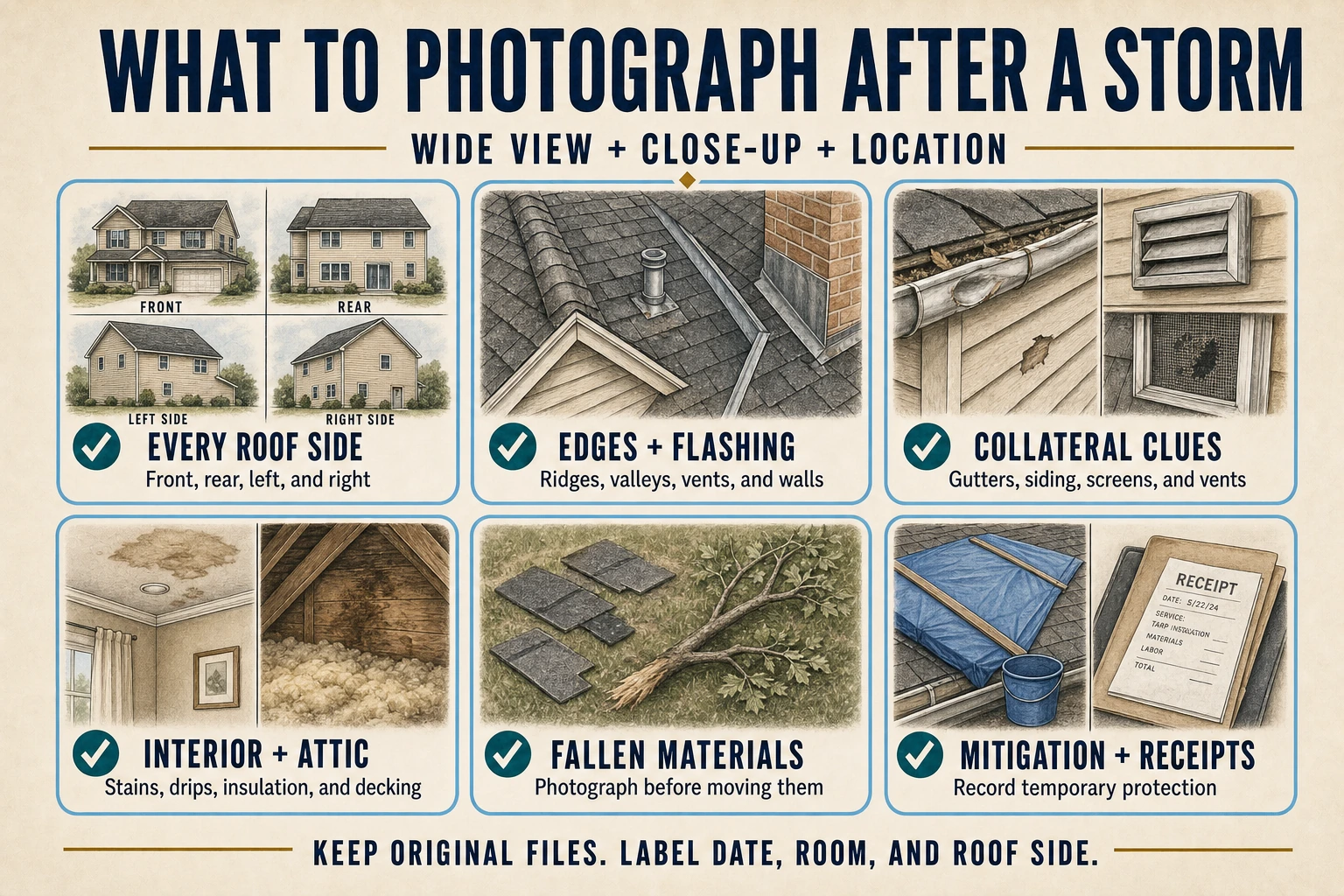
Your photos should preserve a dated record another person can follow. FEMA recommends documenting damage before discarding items and keeping repair and replacement receipts.
| Record | Useful detail | Simple labeling example |
|---|---|---|
| Storm information | Date, approximate time, hail or wind observations, warning text, and when damage was first noticed | August 27, 7:15 p.m.; wind and hail; leak noticed 7:40 p.m. |
| Exterior overview | Each side of the home and each visible roof plane, including undamaged context | North elevation; wide view from driveway |
| Damage detail | Close-up plus a wider image that shows where the detail sits | Rear west slope; missing shingle below upper vent |
| Interior | Room, ceiling or wall location, stain edge, active drip, and nearby fixture | Second-floor front bedroom; north ceiling corner |
| Mitigation | Buckets, moved contents, tarp, drying equipment, service calls, and receipts | Emergency tarp installed August 28; invoice saved |
| Communication | Insurer claim number, adjuster, contractor, dates, promised follow-up, and documents sent | Claim reference and inspection appointment in one log |
Use a roof-plane map
Label a simple roof sketch front, rear, left, and right, then match photo names to it. 'Rear-slope-lifted-ridge-cap-01' is more useful than 'IMG_4821.'
Keep the originals
Save originals, invoices, emails, and texts in one folder. If you mark up an image, keep the original. Safely photograph temporary work before and after installation.
Temporary repairs: protect the home without erasing the evidence
Emergency steps can reduce additional loss. Photograph first when practical, notify the insurer, keep receipts, and separate temporary stabilization from permanent work.
- Ask the emergency roofer to photograph the opening and explain how temporary protection will be attached.
- Get a written price and scope; a 'free' tarp may carry contract obligations.
- Don't authorize broad tear-off merely to obtain emergency service unless you understand and choose that scope.
- Document interior drying separately and keep every receipt; coverage and deadlines are policy-specific.
Should you call the roofer or insurer first?
It depends. Stabilize an immediate opening safely and notify the carrier. If damage appears limited, a documented inspection and deductible review may help before you file. Ask the insurer how it wants permanent repairs handled.
A contractor explains construction and price; the insurer interprets coverage. Those roles are not the same.
Repair or replacement? Ask what the evidence supports
| Inspection pattern | A focused repair may be reasonable | Replacement deserves closer evaluation |
|---|---|---|
| Missing or lifted shingles | A limited area is affected, surrounding shingles remain workable, and matching material is available | Damage is spread across multiple planes or surrounding shingles are too brittle for a durable repair |
| Flashing or vent damage | The failed detail can be rebuilt and adjacent decking and covering are sound | Several penetrations or transitions failed, or water damaged the surrounding assembly |
| Hail findings | Impacts are limited and functional damage can be repaired without compromising the field | Documented functional damage is widespread or affects multiple roof components |
| Tree impact | Covering and a small deck area are damaged, with framing confirmed sound | Decking, rafters, trusses, ridge, or walls are displaced or damaged |
| Roof age and history | The rest of the roof has useful service life and few prior patches | Widespread age-related wear combines with storm damage and repeated repairs |
Here's the thing: an insurance decision and a construction decision may use different terms. Coverage depends on the policy and cause of loss. A roofer's opinion does not guarantee payment, and an insurer's estimate does not replace the need for a clear construction scope.
What storm-damage roof work may cost in 2026
These national ranges are not local quotes or coverage promises. Size, pitch, access, material, timing, hidden damage, permits, and post-storm demand change the price.
| Service | Published 2026 planning range | What to confirm before comparing prices |
|---|---|---|
| Standard roof inspection | $125-$358; about $252 average | Photos, written report, attic access, every roof plane, and whether the fee is credited to work |
| Physical inspection | $75-$200 | Safe roof access, interior review, storm versus age findings, and limitations |
| Drone inspection | $150-$400 | Image resolution, inaccessible details, operator qualifications, and written interpretation |
| Roof repair | $395-$1,966; about $1,173 average | Exact repair area, material, flashing method, decking, cleanup, and workmanship coverage |
| Leak repair | $360-$1,550 | Whether the entry point and damaged roof materials are included; interior drying may be separate |
| Hail-damage repair | $700-$4,000 | Material and area affected; this is not a replacement estimate |
| Asphalt replacement | $5,800-$20,000 in one 2026 guide | Measured roof area, tear-off, disposal, decking, flashing, ventilation, permit, and warranty |
An inspection marketed as free may be an estimate visit rather than an independent condition report. That is not automatically a problem—just ask what you will receive and whether the inspector is paid only if a project is sold.
What a professional storm inspection should include
- Storm date, roof age, material, layers, prior repairs, and leak history
- Wide and close photos of every accessible plane, ridge, valley, edge, flashing, and penetration
- A map of observed damage plus an explanation of look-alike conditions
- Collateral surfaces and accessible attic or interior observations
- Separate emergency, repair, and replacement scopes when technically reasonable
- Material limits, decking prices, permits, cleanup, and warranty terms
Questions to ask before giving anyone your contact information
- Will I get wide and close photos even if I don't hire you?
- How do you separate storm damage from age, defects, foot traffic, or prior repairs?
- Will you inspect every accessible plane, flashing, penetration, gutter, and attic area?
- If repair is possible, what will it cost and what service life is realistic?
- Are you insured and registered where required, and who obtains the permit?
- Does this paper authorize only inspection, or also the job, claim authority, or a cancellation fee?
- What are the deposit, progress-payment, lien-release, and completion terms?
Storm-chaser red flags are mostly about control
The your state Department of Insurance advises homeowners to read every document, never sign a blank contract, avoid giving a contractor power of attorney over a claim, obtain multiple estimates, and avoid paying in full before completion. Be present for the inspection when possible.
Pressure is the red flag. A promise that insurance will definitely buy a new roof is not evidence. The contractor should explain scope, payment, cancellation, and options without controlling your claim.
Local permits—and why your municipality matters
The your local municipality says a residential permit is required to reroof a home. Its permit page separately lists patching a leaking roof covering and replacing the same shingle material on no more than 10% of the roof area as minor repairs that do not need a building permit. Confirm the current rule for the exact scope before work begins.
Other your area municipalities may differ. Put permit responsibility in the proposal and request final approval when applicable.
Frequently asked questions
Should I climb onto the roof after a storm?
No. Start from the ground, windows, and a safely accessible attic. Wet materials, hidden deck damage, steep slopes, loose debris, and nearby electrical hazards make a post-storm roof a poor place for a homeowner inspection.
What does hail damage look like on asphalt shingles?
Possible signs include random dents or depressions, displaced granules, fractures, and exposed asphalt. Not every dark mark or missing granule is hail damage. Ask for roof-wide context and an explanation of look-alike wear.
Can my roof be damaged without leaking?
Yes. Lifted, creased, punctured, or impact-damaged materials may not create an immediate interior drip. The reverse is also important: a ceiling stain does not automatically prove widespread shingle damage.
How soon should I schedule an inspection?
Promptly if shingles are missing, water is entering, flashing moved, or debris hit the roof. If there is no active leak, document the condition and arrange an inspection soon enough to avoid losing the storm timeline or missing a policy deadline.
Does one missing shingle mean I need a new roof?
Not necessarily. A limited repair may work if the surrounding roof is sound and compatible material is available. Age, brittleness, damage distribution, decking, and repair history change the answer.
Should I file an insurance claim before getting an estimate?
There is no universal sequence. For urgent damage, contact the carrier promptly and prevent additional loss safely. For uncertain or apparently small damage, review your deductible and ask how the carrier wants the condition documented. Coverage is policy-specific.
Will insurance replace an older roof?
Age alone does not answer that. The cause of loss, policy wording, deductible, exclusions, depreciation, roof-payment schedule, and documented condition may all matter. Ask the insurer to explain the decision in writing.
Can I make permanent repairs before the adjuster visits?
Emergency protection may be necessary, but discuss permanent work with the carrier when a claim may be involved. Photograph conditions first when safe, keep removed material if requested, and save all invoices and receipts.
Your next move should be evidence, not urgency
Ask three questions: Is the property safe? What changed in this storm? What scope fixes it? Keeping them separate filters the sales noise.
Document first and compare itemized findings. If replacement is recommended, ask why repair won't work. If repair is recommended, ask what remains vulnerable.
Sources
FEMA: How to Document Damage After Severe Weather Events
FEMA: Tips for Returning Home Safely After a Disaster
FEMA: Recovering From Disaster—Returning Home
National Weather Service your local area: Local Weather Event Summaries
National Weather Service your local area: April 15, 2026 Severe Weather
Your state Department of Insurance: Contractor Fraud Checklist
Your state Emergency Management Agency: Home Repair Scams After Severe Weather
GAF: Storm Damage Roof Repairs Resource Guide
GAF: How to Identify Wind-Damaged Shingles
GAF Technical Advisory: Damage to Shingles Caused by Hail
Insurance Institute for Business & Home Safety: Roof 101
your local municipality: Department of Building and Housing
your local municipality: Construction Permits
Angi: Roof Inspection Cost (2026)
Angi: Asphalt Shingle Roof Cost and Planning Questions (2026)